Wire Harness Components: Complete Guide to Parts, Materials & Selection
A comprehensive guide to every component in a wire harness—from conductors and connectors to seals, sleeving, and strain relief—with material comparisons and selection best practices for engineers.
A wire harness is only as reliable as its individual components. From the conductor that carries current to the connector that interfaces with your system, every part must be specified correctly to ensure performance, safety, and longevity. This guide breaks down every major wire harness component, explains material options, and provides selection criteria for engineers and procurement teams.
1. Conductors and Wires
The conductor is the backbone of any wire harness. Selecting the right wire involves balancing current-carrying capacity, flexibility, weight, and cost.
Copper vs. Aluminum Conductors
Copper remains the dominant choice for wire harness conductors due to its excellent conductivity, ductility, and solderability. Aluminum conductors are lighter and less expensive but require larger cross-sections to match copper's ampacity and present termination challenges due to oxide formation and thermal expansion differences.
For a detailed comparison, see our copper vs. aluminum wiring guide.
Stranded vs. Solid Wire
Wire harnesses almost exclusively use stranded conductors because they offer superior flexibility and fatigue resistance compared to solid wire. The stranding configuration—number of strands and individual strand diameter—affects both flexibility and current capacity. Fine-stranded wire (e.g., 665/36) provides maximum flexibility for robotic and high-flex applications, while coarse-stranded wire (e.g., 19/26) is adequate for static installations.
Wire Gauge Selection
AWG (American Wire Gauge) selection depends on:
- Current requirements: Follow NEC or IEC derating tables, applying a 20–30% margin
- Voltage drop: Calculate for long runs; target less than 3% drop at full load
- Mechanical strength: Minimum 24 AWG for most harness applications; 30 AWG acceptable in high-density, low-current scenarios
- Bundle derating: Wires bundled together dissipate heat less effectively, requiring further ampacity reduction
2. Insulation Materials
Insulation protects the conductor from environmental hazards and prevents short circuits. Material choice directly impacts temperature rating, chemical resistance, and flexibility.
| Insulation Material | Temperature Range | Flexibility | Chemical Resistance | Typical Cost | Common Applications |
|---|---|---|---|---|---|
| PVC | -40°C to 105°C | Good | Moderate | Low | General-purpose harnesses |
| TPE | -55°C to 125°C | Excellent | Good | Medium | Robotic and flex applications |
| Silicone | -60°C to 200°C | Excellent | Excellent | High | High-temperature environments |
| XLPE | -55°C to 125°C | Moderate | Good | Medium | Power distribution harnesses |
| PTFE (Teflon) | -70°C to 260°C | Good | Excellent | Very High | Aerospace and military |
| Polyurethane | -40°C to 125°C | Excellent | Good | Medium-High | Abrasion-resistant applications |
| Kapton (Polyimide) | -269°C to 400°C | Moderate | Excellent | Very High | Extreme-temperature aerospace |
For more on insulation materials, see our PVC vs. TPE vs. silicone cable comparison and top 5 high-temperature materials guide.
3. Terminals and Contacts
Terminals provide the electrical interface between the wire and the connector or mating component. Proper terminal selection and crimping are critical for reliable connections.
Terminal Types
- Ring terminals: For stud-mount connections; secure under vibration; available in insulated and non-insulated versions
- Spade terminals: Quick disconnect capability; fork design allows installation without fully removing mounting hardware
- Butt splices: Inline wire-to-wire connections; commonly used in repair and harness splicing; available with heat-shrink insulation for environmental sealing
- Pin and socket contacts: Used inside connector housings; available in stamped-and-formed (cost-effective) or machined (higher current, higher cycle life) styles
- Flag terminals: Right-angle exit for space-constrained applications where standard terminals cannot fit
Crimp Quality
A properly crimped terminal forms a cold-weld bond between the wire and terminal barrel. The IPC/WHMA-A-620 standard defines acceptance criteria for crimp height, pull force, and visual inspection. Our crimping best practices guide and crimping capabilities page cover this in detail.
A terminal crimp outside specification can reduce pull-out force. In vibration-heavy applications such as automotive systems, maintaining the specified crimp geometry is essential to service life.
4. Connectors
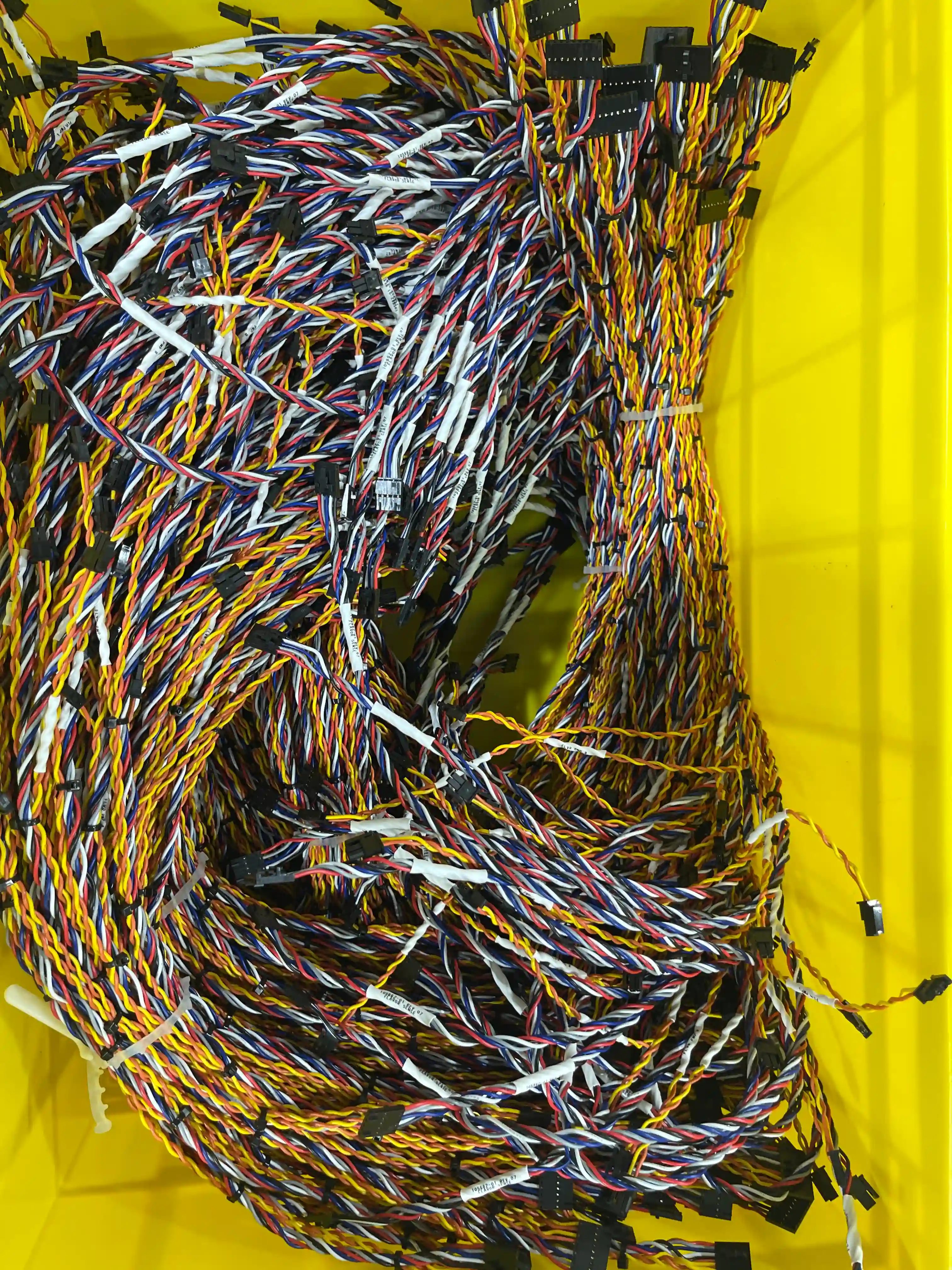
Connectors are often the most complex and expensive components in a wire harness. They define the interface between the harness and the rest of the system.
Connector Selection Criteria
- Pin count and pitch: Must match PCB or device layout; consider future expansion needs
- Current rating per pin: Verify against actual load with derating, not just datasheet maximums
- Mating cycles: Some connectors are rated for only 25 cycles; others exceed 10,000—match to your service requirements
- Environmental protection: IP rating, sealing, and corrosion resistance must align with operating conditions
- Locking mechanism: Positive locks (latches, screws, bayonet) prevent accidental disconnection under vibration
- Keying and polarization: Prevent incorrect mating of similar-looking connectors
Common Connector Systems
For detailed comparisons, see our guides on Molex vs. JST vs. TE connectors, common connector types, and 4-pin connector types.
5. Seals and Grommets
Wire Seals
Wire seals (also called cavity seals or connector seals) fit into connector cavities around individual wires to prevent moisture, dust, and gas ingress. They are essential for achieving IP67 and higher ratings.
- Silicone seals: Best temperature range (-60°C to 200°C); standard in automotive applications
- EPDM seals: Excellent ozone and weather resistance; common in outdoor and industrial applications
- Fluorosilicone seals: Superior fuel and chemical resistance; used in engine compartments and fuel system harnesses
Critical note: Wire seals must match the wire outer diameter precisely. A 0.5mm gap between seal and wire compromises the entire IP rating of the connector.
Grommets
Grommets protect wires as they pass through sheet metal, firewall, or panel openings. They also provide strain relief and environmental sealing at bulkhead transitions. Common materials include EPDM, silicone, and neoprene, selected based on temperature and chemical exposure at the transition point.
For waterproof harness designs, explore our waterproof wire harness capabilities.
6. Protective Sleeving and Conduit
Braided Sleeving
Expandable braided sleeving (typically PET or nylon) bundles wires neatly while allowing breakouts at any point along the run. It offers moderate abrasion resistance and a professional appearance. Monofilament braiding provides better abrasion resistance, while multifilament offers a softer feel and better flexibility.
Corrugated Conduit
Corrugated plastic conduit (usually polypropylene or nylon) provides superior mechanical protection, especially against crushing and impact. It's standard in automotive wire harnesses where wires route near sharp edges or hot components. Split conduit allows installation on existing harnesses without disconnection.
Heat Shrink Tubing
Heat shrink tubing provides insulation, strain relief, and environmental sealing. Selection depends on shrink ratio (2:1, 3:1, 4:1), wall thickness, and adhesive lining. Adhesive-lined tubing provides the best environmental seal. See our heat shrink tubing guide for detailed specifications.
Tape and Wrapping
- PVC tape: Basic insulation and bundling; low cost; limited temperature range
- Fabric tape: Noise reduction (NVH) in automotive; self-welding at overlaps for clean appearance
- PTFE tape: High-temperature and chemical-resistant wrapping for extreme environments
- Mastic tape: Provides environmental sealing and cushioning at connector backshells
7. Strain Relief Components
Strain relief prevents mechanical stress from transferring to the wire-connector interface, which is the most failure-prone point in any harness.
Types of Strain Relief
- Backshell adapters: Threaded onto military and aerospace connectors; provide 360° shielding and strain relief
- Overmolded strain reliefs: Integrated into the connector body during overmolding; most robust and professional-looking option
- Cable glands: Provide strain relief and sealing at enclosure entry points; available in plastic and metal
- Heat shrink boots: Combine strain relief with environmental sealing; conform to connector geometry when heated
- Spring-style reliefs: Metal or plastic springs that absorb flex stress; common on power cords
For a comprehensive comparison, see our top 7 strain relief solutions.
The wire-connector junction is a common field-failure location. Strain relief is therefore an essential reliability feature rather than an optional accessory.
8. Labels and Identification
Proper identification is essential for manufacturing, testing, installation, and maintenance of wire harnesses. The IEC 62444 standard and IPC/WHMA-A-620 both address marking requirements.
Labeling Methods Comparison
| Method | Durability | Cost | Best For |
|---|---|---|---|
| Heat shrink labels | Excellent | Medium | Permanent wire identification in harsh environments |
| Self-laminating wraps | Good | Low | Panel and connector labeling; indoor use |
| Printed flags | Good | Low | High-visibility wire markers; quick identification |
| Laser-etched markers | Excellent | High | Aerospace and military; permanent traceability |
| Hot stamp markers | Good | Low | High-volume production; consistent marking |
| Tag labels | Moderate | Very Low | Temporary or prototype identification |
For more on identification standards, see our wire harness labeling and marking guide.
9. Ties, Clamps, and Mounting Hardware
Cable Ties
Nylon cable ties (zip ties) are the most common wire management component. Selection considerations include:
- Operating temperature: Standard nylon 6/6 is rated to 85°C; heat-stabilized versions reach 105°C
- UV resistance: Required for outdoor applications; UV-stabilized nylon or stainless steel options
- Releasable vs. permanent: Releasable ties aid in serviceability during maintenance
- Stainless steel ties: For extreme temperature or corrosive environments; common in marine and food processing
- Mounting head ties: Integrated mounting feature for panel or DIN rail attachment
Clamps and Brackets
Wire clamps secure harnesses to chassis, frames, and panels:
- Adhesive-backed clamps: Quick installation on flat surfaces; no drilling required
- Screw-mount clamps: Secure attachment for heavy harnesses; highest holding force
- Push-mount ties: Insert into pre-drilled holes; common in automotive body-in-white
- P-clamps: Bolt-on attachment with rubber cushion for vibration isolation; available in zinc-plated steel and stainless steel
10. Overmolding and Potting
Overmolding
Overmolding encapsulates connector backshells and cable junctions in a protective polymer shell. Benefits include superior strain relief, environmental sealing (IP67+), professional appearance, and tamper resistance. Common overmold materials include PVC, TPE, and polyurethane, selected based on hardness (Shore A), temperature range, and chemical resistance requirements.
Explore our overmolded wire harness capabilities for custom designs.
Potting
Potting fills connector cavities or junction boxes with a resin compound (typically epoxy, polyurethane, or silicone) to seal and protect connections. It's more economical than overmolding for some applications but offers less mechanical strain relief. Potting is especially effective for medical cable assemblies where biocompatibility and sterilization resistance are required.
See our overmolding vs. potting comparison for detailed trade-offs.
Best Practices for Component Selection
1. Start with the Environment
Define the operating environment before selecting any component. Temperature extremes, chemical exposure, vibration profile, and moisture ingress drive material choices more than any other factor. A harness for an EV battery compartment faces completely different challenges than one for a medical device.
2. Derate Conservatively
Always apply derating factors to current ratings, voltage ratings, and temperature limits. A connector rated for 10A at 25°C may only carry 6A at 85°C. Consult manufacturer derating curves and apply an additional safety margin of 20–30%.
3. Standardize Where Possible
Using standard connector systems and wire types across product lines reduces inventory, simplifies tooling, and improves supply chain resilience. Custom components should only be specified when standard options cannot meet performance requirements.
4. Validate with Testing
Don't rely solely on datasheet specifications. Validate your component selections with testing that replicates actual operating conditions, including thermal cycling, vibration, humidity exposure, and mechanical stress.
5. Consider Total Cost of Ownership
A cheaper connector that fails in the field costs far more than a premium connector that lasts the product's lifetime. Factor in warranty costs, field service labor, replacement parts, and brand reputation damage.
Common Mistakes in Wire Harness Component Selection
-
Ignoring vibration requirements: Selecting connectors without positive locking mechanisms for high-vibration environments leads to intermittent connections and field failures. Always specify connectors with latches, screws, or bayonet locks for automotive and aerospace applications.
-
Mismatched seal and wire diameter: Wire seals must match the wire OD precisely. A 0.5mm gap between seal and wire compromises the entire IP rating of the connector. Always verify seal compatibility with your specific wire insulation OD.
-
Under-specifying insulation temperature: Using PVC insulation in an engine compartment where temperatures exceed 105°C causes insulation degradation, cracking, and eventual short circuits. Always specify insulation rated at least 15–20°C above the maximum expected ambient temperature.
-
Omitting strain relief: Skipping strain relief to save cost or space is a false economy. The wire-connector junction will fail under normal handling and vibration. Every harness should have strain relief at every termination point.
-
Using aluminum terminals on copper wire: Galvanic corrosion between dissimilar metals causes increased resistance and eventual connection failure. Always use bimetallic terminals (copper-aluminum) for mixed-metal connections, or better yet, avoid mixing conductor materials.
-
Neglecting UV exposure: Standard nylon cable ties and PVC insulation degrade rapidly under UV exposure in outdoor applications. Specify UV-stabilized materials for any harness exposed to sunlight.
The true cost of a wire harness component includes the field-failure risk it controls. Seals and other protective components should be selected for reliability rather than removed solely to reduce unit cost.
Component Selection Checklist
Before finalizing your wire harness bill of materials, verify:
- [ ] All wire gauges meet current-carrying requirements with appropriate derating applied
- [ ] Insulation materials are rated for the maximum operating temperature plus at least 15°C margin
- [ ] Connectors have adequate pin count, current rating, and mating cycle life for the application
- [ ] Seals match wire diameters precisely and achieve the required IP rating as a system
- [ ] Strain relief is specified at every wire-connector interface without exception
- [ ] Protective sleeving or conduit covers all wires in abrasion-prone routing areas
- [ ] Labels and markers comply with relevant standards and remain legible after environmental exposure
- [ ] All components are available from approved suppliers with acceptable lead times
- [ ] Component materials are compatible—no galvanic corrosion risk between dissimilar metals
- [ ] Total harness weight and bundle diameter fit within routing constraints and support requirements
Ready to specify components for your next project? Submit your requirements through our inquiry form or explore our custom wire harness capabilities.
FAQ
What are the main components of a wire harness?
A wire harness consists of wires and cables (conductors with insulation), terminals and contacts, connectors, seals and grommets, protective sleeving or conduit, strain relief components, cable ties and clamps, labels and markers, and optional overmolding or potting. Each component serves a specific electrical, mechanical, or environmental function, and the reliability of the complete harness depends on proper selection and integration of every part.
How do I select the right connector for my wire harness?
Start by defining your electrical requirements (pin count, current per pin, voltage), environmental conditions (temperature, moisture, vibration), mating cycle expectations, and space constraints. Then match these requirements to connector families from major manufacturers like TE Connectivity, Molex, and JST. Always verify that the connector's IP rating and locking mechanism meet your application needs, and confirm seal compatibility with your wire diameters.
What is the difference between a wire seal and a grommet?
Wire seals fit inside connector cavities around individual wires to prevent moisture and contaminant ingress at the connector interface. Grommets are larger components that protect wire bundles as they pass through bulkheads, firewalls, or panel openings. Both provide environmental protection, but at different locations in the harness—wire seals protect at the connector, while grommets protect at structural transitions.
Why is strain relief important in wire harnesses?
Strain relief prevents mechanical forces—pulling, bending, and vibration—from transferring to the wire-connector junction, which is the weakest point in any harness. Without strain relief, even moderate handling or vibration can cause wires to pull out of terminals, leading to intermittent connections or complete circuit failure. Over 60% of field harness failures occur at this junction.
What insulation material should I use for high-temperature applications?
For continuous operation above 105°C, consider XLPE (up to 125°C), silicone rubber (up to 200°C), or PTFE/Teflon (up to 260°C). For extreme environments above 260°C, Kapton/polyimide insulation can reach 400°C. The choice depends on your specific temperature requirement, flexibility needs, chemical exposure, and budget. PTFE offers the highest temperature rating and chemical resistance but at a significantly higher cost than XLPE or silicone.
How do I ensure my wire harness meets IP67 requirements?
IP67 requires protection against dust ingress and temporary immersion in water up to 1 meter for 30 minutes. You need sealed connectors with cavity seals matching each wire diameter, grommets or cable glands at bulkhead transitions, and either overmolded or potted junctions. Every entry and exit point of the harness must have appropriate sealing. Test the completed assembly per IEC 60529 to verify compliance—individual component ratings do not guarantee system-level performance.
What standards govern wire harness component selection?
Key standards include IPC/WHMA-A-620 (Requirements and Acceptance for Cable and Wire Harness Assemblies), UL 758 (Appliance Wiring Material), SAE AS50881 (Aerospace Vehicle Wiring), and ISO 6722 (Road vehicle 60V and 600V single-core cables). For military applications, MIL-DTL-17 and MIL-DTL-24643 apply. Always verify which standards apply to your specific industry and application before finalizing component selections.