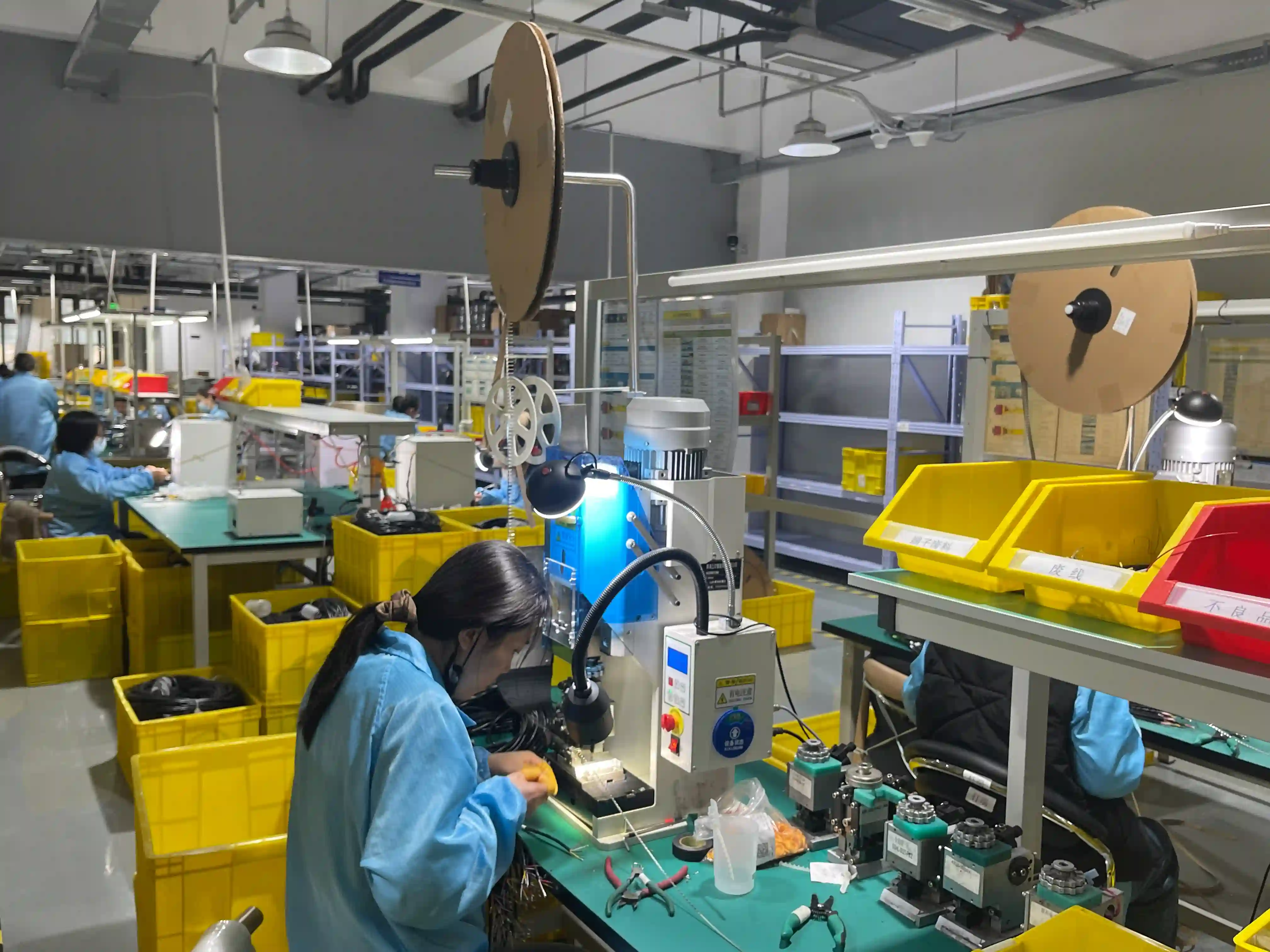
Heat shrink tubing is the most versatile protection method in cable assembly manufacturing, used in everything from consumer electronics to military avionics. A single material selection error—choosing PVC where polyolefin was needed, or skipping adhesive lining where moisture ingress was likely—can reduce harness life from decades to months.
This guide covers every variable that affects heat shrink performance in production cable assemblies: material chemistry, wall construction, shrink ratios, sizing methodology, and application technique. Whether you are specifying heat shrink for an automotive engine harness rated to 150°C or a medical device cable that must survive autoclave sterilization at 134°C, the selection matrix below maps your operating conditions to the right product.
Material Types Available
Min Operating (PTFE)
Max Operating (PTFE)
Highest Shrink Ratio
What Is Heat Shrink Tubing?
Heat shrink tubing is a polymer sleeve that contracts radially when heated above its activation temperature, forming a tight, conforming layer around wires, splices, connectors, and cable bundles. The shrinking process is irreversible—cross-linked polymer chains lock into their recovered state permanently.
Manufacturers produce heat shrink through a two-stage process. First, they extrude the base polymer into a tube. Then, they cross-link the material using electron beam irradiation or chemical agents, and expand it to its "supplied" diameter. When you apply heat (typically 90–200°C depending on the material), the tube recovers to its original extruded diameter. This recovery ratio—expressed as 2:1, 3:1, or higher—determines how much the tubing shrinks.
Per industry standards, heat shrink provides four core functions: electrical insulation (rated up to 600V for standard polyolefin), mechanical protection against abrasion, environmental sealing (when adhesive-lined), and strain relief at cable-to-connector transitions.
"Heat shrink tubing is the one protection method that every cable assembly uses regardless of industry. The challenge is not whether to use it, but which of the 50+ material-ratio-wall combinations fits your specific operating envelope. Getting that wrong is how you end up with cracked insulation at -40°C or a melted mess at 180°C."
OurPCB Engineering Team
Material Comparison: Polyolefin vs PVC vs PTFE vs Silicone
Material selection determines 80% of heat shrink performance. Each polymer chemistry offers a distinct combination of temperature range, chemical resistance, flexibility, and cost. Polyolefin dominates general-purpose applications with roughly 70% market share, but specialized environments demand PTFE, silicone, fluoroelastomer (Viton), or PVDF.
| Property | Polyolefin | PVC | PTFE | Silicone |
|---|---|---|---|---|
| Operating Temp | -55°C to +135°C | -30°C to +105°C | -55°C to +260°C | -55°C to +200°C |
| Shrink Temp | 90–120°C | 100–110°C | 340–360°C | 150–175°C |
| Shrink Ratios | 2:1, 3:1 | 2:1 | 2:1, 4:1 | 2:1 |
| Chemical Resistance | Good | Moderate | Excellent | Good |
| Flexibility | Good | Good | Low | Excellent |
| UV Resistance | Black only | Poor | Excellent | Good |
| Flame Rating | UL VW-1 | Self-extinguishing | Non-flammable | Self-extinguishing |
| Relative Cost | $ | $–$$ | $$$$ | $$$ |
| Best For | General purpose, automotive | Low-temp electronics, labeling | Aerospace, military, chemical | Medical, high-flex applications |
Polyolefin: The Industry Workhorse
Polyolefin heat shrink handles -55°C to +135°C, meets UL 224 VW-1 flame ratings, and costs 40–60% less than specialty alternatives. Standard grades from TE Connectivity (Raychem) and HellermannTyton ship in 2:1 and 3:1 ratios across 1.6mm to 120mm diameters. For most cable assembly applications, polyolefin is the default starting point.
One limitation: non-black polyolefin degrades under prolonged UV exposure. Outdoor harnesses exposed to sunlight need either black polyolefin or a UV-stabilized variant. This matters for solar energy cable assemblies and outdoor telecom installations.
PVC: Lower Cost, Narrower Temperature Range
PVC heat shrink costs 10–60% less than polyolefin per meter and offers superior tensile strength and abrasion resistance. The trade-off is a narrower operating range: -30°C to +105°C. PVC works well for indoor electronics, consumer cable assemblies, and wire identification/labeling where environmental extremes are not a factor.
PVC is also available in transparent formulations that are flame-retardant—a property that clear polyolefin lacks. This makes transparent PVC the preferred choice when visual inspection of underlying connections is required.
PTFE: Extreme Environments
PTFE (Teflon) heat shrink operates from -55°C to +260°C with near-total chemical inertness. It resists jet fuel, hydraulic fluid, and aggressive solvents that destroy other polymers. The downside: PTFE requires 340–360°C to shrink, demands specialized heat tools, and costs 8–12x more than polyolefin.
PTFE is standard in aerospace and defense cable assemblies where MIL-DTL-23053 compliance is required. It also sees heavy use in medical device assemblies that undergo repeated autoclave sterilization.
Silicone: Maximum Flexibility
Silicone rubber heat shrink delivers the widest flexibility range and excellent biocompatibility. Operating from -55°C to +200°C, silicone tubing bends without cracking even at extreme low temperatures. Medical cable assemblies and laboratory equipment cables are the primary applications. Silicone is not ideal for applications requiring high abrasion resistance—its soft surface wears faster than polyolefin under mechanical contact.
Single-Wall vs Dual-Wall (Adhesive-Lined)
Adhesive-lined (dual-wall) heat shrink contains a hot-melt adhesive inner layer that flows during heating, creating a waterproof seal rated to IP67 or higher. Single-wall tubing provides insulation and mechanical protection but does not seal against moisture ingress. This distinction determines whether a splice survives 10 years in an engine bay or corrodes within 18 months.
Single-Wall
- Lower cost per meter (30–50% less)
- Thinner profile, better for tight spaces
- Easier to remove for rework/repair
- No moisture seal—water wicks along wire strands
- Can slide if not fully recovered
Dual-Wall (Adhesive-Lined)
- Waterproof seal (IP67+)
- Adhesive bonds to substrates, prevents sliding
- Additional corrosion protection on terminals
- Higher cost, thicker wall profile
- Difficult to remove once applied
When to Mandate Adhesive-Lined
Any application exposed to water, humidity, salt spray, or condensation requires adhesive-lined heat shrink. This includes marine wire harnesses, underbody automotive harnesses, outdoor telecom junctions, and any splice in an IP-rated enclosure.
Shrink Ratios Explained: 2:1, 3:1, and 4:1
Shrink ratio defines the relationship between supplied diameter and fully recovered diameter. A 2:1 ratio tube supplied at 12mm shrinks to 6mm. Higher ratios cover wider ranges of substrate diameters with a single tubing size, reducing inventory but often increasing wall thickness.
| Ratio | Supplied → Recovered | Best Use Case | Availability |
|---|---|---|---|
| 2:1 | 12mm → 6mm | Standard wire insulation, uniform-diameter bundles | All materials, widest selection |
| 3:1 | 12mm → 4mm | Splices, connectors, irregular shapes | Polyolefin, adhesive-lined |
| 4:1 | 12mm → 3mm | Multi-branch transitions, large diameter steps | Specialty polyolefin, PTFE |
| 6:1 | 12mm → 2mm | Extreme diameter variation, repair kits | Limited, heavy-wall specialty |
For production cable assemblies, 2:1 polyolefin covers about 75% of applications. Specify 3:1 when covering crimped terminations where the connector barrel is significantly larger than the wire. Reserve 4:1 and higher for breakout boots and multi-conductor junctions where you must transition from a single large bundle to several smaller branches.
A common issue is engineers default to 3:1 everywhere because they assume higher is always better. The opposite is true for production. A 3:1 tube has thicker walls after recovery than a 2:1, which means larger bend radius and harder routing through tight conduits. Use 2:1 unless the geometry demands otherwise.
OurPCB Engineering Team
How to Size Heat Shrink Tubing Correctly
Incorrect sizing is the most common heat shrink failure mode in production. The expanded (supplied) inside diameter must be 20–30% larger than the largest substrate diameter, and the recovered inside diameter must be 10–20% smaller than the smallest substrate diameter. Violate either rule and the tubing either will not fit over the component or will not compress tightly enough to seal.
Three-Step Sizing Rule
- 1Measure the largest diameter you need to slide the tubing over (connector, splice, or bundle OD).
- 2Select a supplied ID that is at least 20% larger than that measurement. Example: 10mm substrate → minimum 12mm supplied ID.
- 3Verify the recovered ID is at least 10% smaller than the smallest diameter at any point under the tubing. Example: 5mm wire → recovered ID must be ≤4.5mm.
Common Heat Shrink Sizes for Cable Assembly
| Wire Gauge (AWG) | Wire OD (mm) | Recommended 2:1 Size | Recommended 3:1 Size |
|---|---|---|---|
| 26–24 AWG | 1.0–1.4 | 1.6mm (1/16") | 1.5mm |
| 22–20 AWG | 1.6–2.0 | 2.4mm (3/32") | 3.0mm |
| 18–16 AWG | 2.3–3.0 | 3.2mm (1/8") | 4.8mm |
| 14–12 AWG | 3.5–4.5 | 6.4mm (1/4") | 6.0mm |
| 10–8 AWG | 5.5–7.0 | 9.5mm (3/8") | 9.0mm |
| 6–4 AWG | 8.0–10.5 | 12.7mm (1/2") | 12.0mm |
Always account for longitudinal shrinkage. Most polyolefin tubing shrinks 5–10% in length during recovery. Cut pieces 10% longer than the coverage area to compensate. Adhesive-lined tubing shrinks more—up to 15% lengthwise—because the melting adhesive draws the material inward.
Application Methods & Equipment
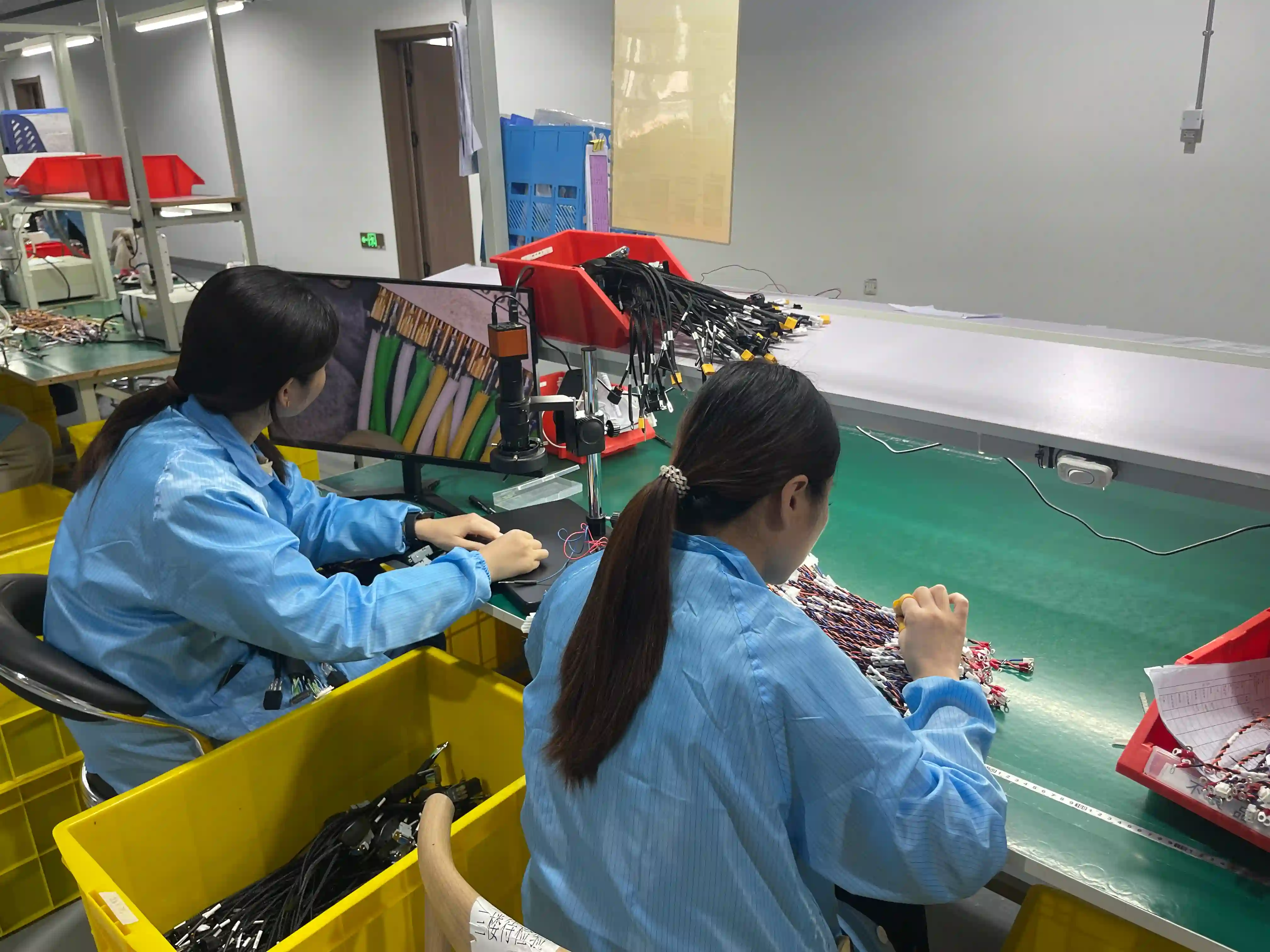
Heat shrink recovery requires controlled, uniform heating. Uneven application causes fish-mouthing (open ends), trapped air bubbles, and incomplete adhesive flow. The method you choose depends on production volume, tubing material, and the heat sensitivity of adjacent components.
Hot Air Gun (Most Common)
Handheld heat guns with adjustable temperature (100–500°C) and airflow are the standard tool for low-to-medium volume production. Start heating from the center and work outward toward both ends, keeping the nozzle 25–50mm from the surface. Moving toward the ends pushes trapped air out rather than sealing it in.
Best for: Prototype runs, repair, production volumes under 500 units/day
Infrared Oven / Tunnel
Conveyor-fed IR ovens deliver consistent 360° heating at controlled belt speeds. Recovery is uniform with no operator dependency, making this the preferred method for high-volume wire harness assembly lines processing over 1,000 units/day. Capital cost: $5,000–$25,000 depending on tunnel length and temperature range.
Best for: High-volume production, adhesive-lined tubing, consistent quality requirements
Torch (Butane/Propane)
Open-flame torches provide the fastest heating but carry the highest risk of damage. The flame can melt wire insulation, char the tubing, or ignite nearby materials. Per IPC/WHMA-A-620D Section 11, open flame is not recommended for production environments. Reserve torch application for field repairs where no electrical power is available.
Best for: Field repairs only, not recommended for production
Industry-Specific Selection Guide
Each industry imposes distinct environmental and regulatory demands on heat shrink selection. The table below maps seven major industries to their typical material, wall type, and governing specification.
| Industry | Material | Wall Type | Key Specification |
|---|---|---|---|
| Automotive | Polyolefin / Adhesive-lined | Dual-wall (3:1) | SAE J1128, -40°C to +125°C |
| Aerospace / Military | PTFE / FEP | Single-wall (2:1) | MIL-DTL-23053, AMS-DTL-23053 |
| Medical Devices | Silicone / FEP | Single-wall (2:1) | ISO 10993 biocompatibility |
| Marine | Adhesive-lined polyolefin | Dual-wall (3:1) | SAE J1127, ABYC E-11 |
| EV / High Voltage | Semi-rigid polyolefin | Heavy-wall (3:1) | UL 486A-486B, 1,000V rated |
| Industrial Automation | Polyolefin | Single-wall (2:1) | UL 224 VW-1, CSA OFT |
| Telecom / Data | UV-stabilized polyolefin | Dual-wall (3:1) | Telcordia GR-771 |
"We process over 200 different heat shrink SKUs across our production lines. The most expensive mistake clients make is specifying PTFE everywhere 'just to be safe.' A $0.03/piece polyolefin sleeve works identically to a $0.35 PTFE sleeve in 90% of applications. We help engineering teams match the material to the actual operating envelope, not the worst case they can imagine."
OurPCB Engineering Team
5 Common Heat Shrink Mistakes That Cause Field Failures
Heat shrink application seems straightforward until a batch of 5,000 harnesses comes back from the field with moisture damage, cracked insulation, or exposed conductors. These five errors account for the majority of heat-shrink-related warranty claims.
1. Undersizing: Tubing Does Not Fully Slide Over the Substrate
Forcing tight-fitting tubing over a connector barrel stretches the material unevenly. The recovered wall thickness becomes inconsistent—thin spots fail first under vibration. Always verify the supplied ID is 20%+ larger than the substrate.
2. Ignoring Longitudinal Shrinkage
Polyolefin shrinks 5–10% in length. Cut a 50mm piece and you get 45mm of coverage after recovery. Adhesive-lined tubing can lose up to 15%. If the heat shrink no longer extends past both edges of the splice, moisture enters from the exposed ends.
3. Overheating: Charring or Melting the Tubing
Holding a heat gun stationary on one spot for more than 3 seconds can exceed the degradation temperature. Charred tubing loses all mechanical and insulating properties. Keep the heat source moving and maintain 25–50mm distance.
4. Incomplete Recovery ("Fish-Mouthing")
When the tubing ends are not fully recovered, they flare outward creating a funnel shape that traps moisture. This happens when operators heat only the center. The correct technique is center-out heating, pushing air toward the open ends until the tubing conforms tightly at both termination points.
5. Using Single-Wall Where Dual-Wall Is Required
Single-wall tubing on a splice in a wet environment will wick moisture along wire strands by capillary action, causing corrosion at the termination. Per IPC/WHMA-A-620D Class 2 and 3 criteria, any splice or termination exposed to moisture must use adhesive-lined heat shrink with visible adhesive flow at both ends.
References
Frequently Asked Questions
What temperature does heat shrink tubing need to activate?
Activation temperature varies by material. Polyolefin starts shrinking at 90°C and fully recovers at 120–135°C. PVC activates at 100–110°C. PTFE requires 340–360°C. Silicone needs 150–175°C. Always check the manufacturer datasheet for the specific product—shrink temperature and operating temperature are two different specifications.
I need waterproof splices for an automotive underbody harness—should I use adhesive-lined heat shrink or potting compound?
For individual splice protection, adhesive-lined (dual-wall) heat shrink with a 3:1 ratio is the standard choice. It provides IP67-level sealing at a fraction of the cost and weight of potting compound. Potting is better suited for protecting entire connector housings or junction boxes where multiple wires enter a single enclosure. For underbody automotive work, specify adhesive-lined polyolefin rated to SAE J1128.
Can I use polyolefin heat shrink for a 200°C application, or do I need PTFE?
Polyolefin maxes out at 135°C continuous operating temperature. At 200°C it will soften, deform, and eventually crack. You need either PTFE (rated to 260°C) or silicone (rated to 200°C). If your application involves chemical exposure alongside high temperature, PTFE is the only viable option due to its superior chemical inertness.
How do I calculate the right heat shrink size for a cable with connectors?
Measure the outside diameter of the connector (the largest point the tubing must pass over). Select a supplied ID at least 20% larger. Then verify the recovered ID is at least 10% smaller than the cable OD behind the connector. For example, a connector at 15mm OD with a 8mm cable: choose a supplied ID ≥18mm with recovered ID ≤7.2mm. A 3:1 ratio tube with 19mm supplied ID (recovers to ~6.3mm) works perfectly.
We are building 10,000 harnesses per month—what is the most cost-effective heat shrink specification?
At 10,000 units/month, material cost per piece compounds fast. Standard black polyolefin 2:1 in bulk spools (100m or 200m rolls) is the most economical option, typically $0.02–0.05 per piece at production volumes. Switch to adhesive-lined only where moisture sealing is mandatory. Invest in an IR conveyor oven ($8,000–$15,000) to eliminate operator variability and reduce application time to under 5 seconds per piece versus 15–20 seconds with a heat gun.