
Four-pin connectors are the workhorse of electrical systems. They carry enough circuits for power and signal in a compact body, without the bulk and cost of higher-pin-count alternatives. Sensors, motors, LED strips, trailer wiring, industrial networks—all run on 4-pin connections.
The problem: over a dozen different 4-pin connector families exist, each designed for a specific environment. Picking the wrong one costs money and causes field failures. This guide covers 12 common 4-pin connector types, with the specs, trade-offs, and selection criteria our engineering team uses daily.
4-Pin Connector Families
Current Range Covered
Protection Ratings
Wire Gauge Support
What's in This Guide
"Engineers overthink pin count and underthink environment. A 4-pin M12 rated IP67 will outlast a 12-pin connector that wasn't sealed properly. Match the connector to the conditions first, then worry about pin count and pitch."
OurPCB Engineering Team
Master Comparison: 12 Types of 4-Pin Connectors
This table gives you the critical specs at a glance. Below it, we break down each connector family with use cases, pros, and cons.
| Connector Type | Pitch | Current/Pin | IP Rating | Typical Use |
|---|---|---|---|---|
| Molex Mini-Fit Jr | 4.20mm | 13A | IP20 | PC power, industrial power |
| Molex KK 254 | 2.54mm | 4A | IP20 | PCB signal, fans |
| Molex Micro-Fit 3.0 | 3.00mm | 5A | IP20 | Mid-power, compact |
| JST XH | 2.50mm | 3A | IP20 | LED, battery, PCB |
| JST PH | 2.00mm | 2A | IP20 | Drones, RC, wearables |
| JST SM | 2.50mm | 3A | IP20 | LED strips, consumer |
| DuPont 2.54mm | 2.54mm | 3A | IP20 | Prototyping, hobby |
| DIN 4-Pin | Circular | 5A | IP40 | Audio, MIDI, legacy |
| M8 4-Pin | Circular | 4A | IP67 | Sensors, automation |
| M12 4-Pin (A/D) | Circular | 4A | IP67/IP68 | Ethernet, fieldbus, PLC |
| Deutsch DT 4-Pin | Rectangular | 13A (size 16) | IP68 | Automotive, off-road |
| 4-Way Flat Trailer | Flat blade | 20A+ | IP44 | Trailer lights, towing |
1Molex 4-Pin Connectors
Molex produces three 4-pin families that cover most board-level power and signal needs. Each targets a different current and density requirement.
Mini-Fit Jr (4.20mm pitch)
The Mini-Fit Jr 4-pin is the connector behind ATX CPU power cables and many industrial power feeds. Each pin handles 13A at 600V, so four pins deliver up to 52A total. The positive-latch housing prevents accidental disconnection under vibration.
We use Mini-Fit Jr 4-pin assemblies in industrial control panels where machines draw 5–10A per circuit. The 4.20mm pitch accommodates 16–24 AWG wire without special tooling.
Micro-Fit 3.0 (3.00mm pitch)
When board space shrinks but you still need 5A per pin, the Micro-Fit 3.0 fills the gap between Mini-Fit and JST. Medical devices, point-of-sale terminals, and compact industrial controllers use this family. The dual-beam contact provides redundant electrical paths, which reduces contact resistance over time.
KK 254 (2.54mm pitch)
The KK 254 is the original 0.100" pitch connector. At 4A per pin it handles signal and low-power tasks. PC fan headers, front-panel connectors, and sensor breakout boards commonly use 4-pin KK housings. The friction-lock design works for applications without heavy vibration.
2JST 4-Pin Connectors
JST (Japan Solderless Terminals) dominates the compact connector market. Their 4-pin versions appear everywhere from sensor cable assemblies to battery packs.
JST XH (2.50mm pitch)
The XH series is the go-to for 4-pin PCB connections that need a latch. Rated at 3A per pin with a working voltage of 250V, it handles LED drivers, sensor modules, and small motor controllers. The top-entry latch gives a distinct click on insertion, confirming the connection without needing pull tests.
JST PH (2.00mm pitch)
Where space is tight—drones, GPS modules, flight controllers—the PH series shaves 0.50mm per pin off the XH footprint. A 4-pin PH housing measures only 10mm wide. The trade-off is a 2A current limit and more fragile contacts. These connectors work best when the harness stays inside an enclosure and won't be unplugged frequently.
JST SM (2.50mm pitch, wire-to-wire)
The SM series connects wire-to-wire rather than wire-to-board. LED strip manufacturers adopted this as a de facto standard for addressable LED connections: power, ground, data in, data out. The locking tab resists pull-out, making it suitable for custom wire harness assemblies in lighting and signage.
3DuPont 2.54mm Headers
DuPont-style 4-pin headers are the standard in prototyping and Arduino/Raspberry Pi ecosystems. Rated around 3A per pin, they slide onto 0.100" pin headers without tools. They lack a positive latch, which limits their use in production. Vibration, gravity, or a light tug can disconnect them.
Use DuPont 4-pin connectors for benchtop testing, development boards, and low-volume proof-of-concept builds. For production harnesses, switch to a latching connector like JST XH or Molex KK.
4DIN 4-Pin Circular Connectors
DIN connectors defined the standard for audio equipment and MIDI interfaces for decades. The 4-pin variant (sometimes called a "mini DIN") carries signal and power through a keyed circular body. S-Video used a 4-pin mini-DIN with separate luma and chroma channels.
While newer standards have replaced DIN in many applications, they remain common in legacy industrial equipment, DIN cable assemblies, and European machine controls. The keyed insert prevents misinsertion, and the metal shell provides moderate shielding.
"In production, the connector you pick determines your tooling investment. Deutsch DT needs a specific crimper and positioner. M12 needs torque specs. JST XH needs an applicator for high volumes. Factor tooling cost into your BOM before you commit to a connector family."
OurPCB Engineering Team
5M8 4-Pin Connectors
M8 connectors are the smaller sibling in the industrial circular connector family. The 4-pin A-coded variant is the sensor industry's standard: pin 1 carries V+, pin 3 carries V−, and pins 2 and 4 handle signal or output. Photoelectric sensors, proximity switches, and pressure transducers across factory floors worldwide use this pinout.
IP67-rated and available in molded cable assemblies, M8 4-pin connectors resist coolant spray, dust ingress, and vibration up to 30g. The threaded coupling ring ensures the connector stays mated on machines that run 24/7. Our M8 cable assemblies ship with pre-tested continuity and insulation resistance for PLC-ready deployment.
6M12 4-Pin Connectors (A-Coded & D-Coded)
M12 connectors step up from M8 with larger contacts, higher current capacity, and coding options that prevent cross-mating between different signal types.
A-Coded (Sensors & Actuators)
A-coded M12 4-pin connectors carry DC power and sensor signals in factory automation. They handle up to 4A per pin at 250V AC/DC. The coding keyway on the A-coded insert is the default—unmarked M12 connectors are almost always A-coded.
D-Coded (Industrial Ethernet)
D-coded M12 4-pin connectors carry 100 Mbps Ethernet (100BASE-TX) for industrial network connections. EtherNet/IP, PROFINET, and Modbus TCP field devices use D-coded M12 ports instead of standard RJ45 jacks because the threaded coupling survives factory environments where an RJ45 tab would snap off in weeks.
M8 vs M12: Quick Decision Guide
Choose M8 When:
- Sensor needs 3–4 wires maximum
- Space is restricted (8mm thread vs 12mm)
- Current stays under 4A per pin
- Cost per connection matters (M8 is 20–30% cheaper)
Choose M12 When:
- Carrying Industrial Ethernet (D-coded)
- Higher current or voltage required
- Coding prevents accidental cross-mating
- IP68 or IP69K washdown rating needed
7Deutsch DT / DTM 4-Pin Connectors
Deutsch connectors are the gold standard for harsh-environment 4-pin connections. The DT series uses size-16 contacts rated at 13A, while the smaller DTM uses size-20 contacts at 7.5A. Both carry an IP68 seal with individual wire seals and an interfacial seal between plug and receptacle.
We build 4-pin Deutsch DT assemblies for automotive applications including oxygen sensor connections, relay packs, and LED light bar feeds. Off-highway vehicles, marine engines, and military ground vehicles rely on this connector family because it handles temperature cycling from −55°C to +125°C without contact degradation.
The removal tool and insertion tool requirements add cost per termination, but the reliability payoff makes it the cheapest option over a 10-year vehicle lifetime. Our Deutsch cable assemblies include crimped and insertion-verified contacts per TE Connectivity's application specifications.
84-Way Flat Trailer Connectors
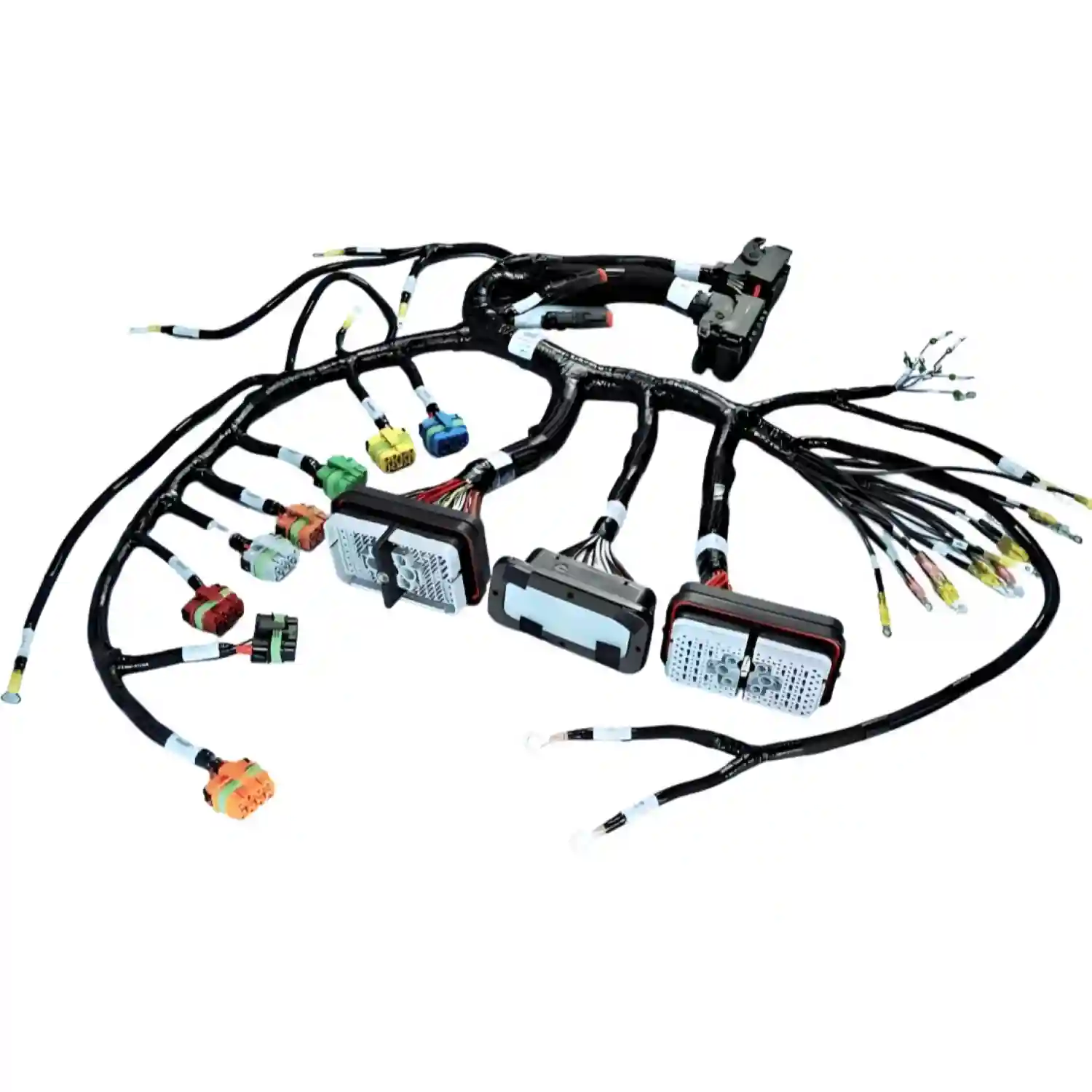
The 4-way flat connector is the most common trailer wiring standard in North America. Its four circuits carry tail/running lights, left turn/brake, right turn/brake, and ground. SAE J560-compliant versions handle up to 20A per circuit.
The flat blade design makes roadside repair straightforward—a wire stripper and crimp butt connectors can fix a broken trailer harness in minutes. The open design means these connectors are not waterproof; corrosion is the primary failure mode. Dielectric grease on the contacts extends service life from one season to three or more.
9ATX 4-Pin Peripheral (Molex 8981)
The classic "Molex connector" in PC building is a 4-pin peripheral power connector (AMP MATE-N-LOK derivative) delivering +5V and +12V to drives and fans. Each pin handles 11A. Two pins carry power, two carry ground. While SATA power has replaced it for storage, the 4-pin Molex peripheral connector remains in use for case fans, LED controllers, and water cooling pumps.
The keyed housing prevents reverse insertion, but the friction-fit design requires noticeable force to mate and unmate. This mechanical retention is an advantage in a PC chassis where vibration from fans and drives could loosen lighter connectors.
104-Pin Fan / Sensor PWM Connectors
CPU and chassis fans use a 4-pin header with 2.54mm pitch: +12V, ground, tachometer output, and PWM speed control. The PWM pin accepts a 25 kHz signal that adjusts fan speed from 20% to 100% duty cycle. This standardized pinout (Intel specification) means any 4-pin fan works on any 4-pin motherboard header.
The same 4-pin concept extends to industrial sensor interfaces. Many sensor cable assemblies carry V+, signal out, signal return, and shield/ground on four conductors—a pinout that maps cleanly to PLC analog input cards.
When a client says 'the review need a 4-pin connector,' the first question the review should request is about the environment—not the signal. Indoor rack-mount equipment lives a different life than an under-hood automotive sensor. The environment decides the connector; the pinout is secondary.
OurPCB Engineering Team
How to Choose the Right 4-Pin Connector
Narrow your choice by answering four questions. Each question eliminates connector families that don't fit.
1. What environment?
Indoor/sealed enclosure: JST, Molex, DuPont
Factory floor (IP67): M8, M12
Outdoor/vehicle (IP68): Deutsch DT, M12
Roadside/trailer: 4-way flat
2. How much current?
Under 3A: JST PH, JST XH, DuPont
3–5A: Molex Micro-Fit, M8
5–13A: Molex Mini-Fit, Deutsch DT
Over 13A: Deutsch with size-12 contacts, trailer flat
3. Board or wire-to-wire?
Wire-to-board: JST XH/PH, Molex KK/Micro-Fit
Wire-to-wire: JST SM, Deutsch DT, M8/M12
Panel-mount: M8, M12, DIN
4. Production volume?
Prototype (1–50): DuPont, hand-crimp JST
Low volume (50–1,000): JST, Molex with bench crimper
High volume (1,000+): Molex Mini-Fit, M8/M12 with applicator
5 Common Mistakes When Specifying 4-Pin Connectors
Using DuPont connectors in production harnesses
No latch means no retention. One vibration cycle can disconnect the harness. Switch to JST XH or Molex KK for any harness that ships to customers.
Ignoring the IP rating for outdoor installations
An IP20-rated JST connector outdoors will corrode within months. For anything exposed to moisture, specify M8/M12 (IP67) or Deutsch (IP68) minimum.
Mixing genuine and compatible contacts
Third-party contacts may fit the housing but fail contact retention tests. Deutsch DT contacts from non-TE sources fail pull-out tests 3× more often in our incoming quality checks.
Overlooking wire gauge compatibility
Every contact has an approved wire range. Cramming 18 AWG into a JST PH contact rated for 24–28 AWG damages the crimp barrel and creates intermittent connections.
Specifying by pin count alone
A "4-pin connector" search returns hundreds of options. Always specify the series (e.g., "Deutsch DT04-4P"), not just the pin count. Ambiguous specs cause sourcing delays and wrong-part shipments.

References & Standards
- JST Connector — Wikipedia — Overview of JST connector families, pitches, and current ratings
- M12 Connector — Wikipedia — Overview of M12 circular connectors, coding types, and industrial applications
- 4-Pin Electrical Connectors: Types, Uses, and How to Identify Them — Romtronic
Frequently Asked Questions
What is the most common 4-pin connector?
For consumer electronics and PCB applications, the JST XH 4-pin (2.50mm pitch) is the most widely used. For industrial automation, the M12 A-coded 4-pin holds that position. In automotive, the Deutsch DT04-4P dominates harsh-environment applications.
Can I use a 4-pin connector for Ethernet?
Yes. The M12 D-coded 4-pin connector carries 100BASE-TX Ethernet and is the standard for industrial Ethernet in factory environments. For Gigabit Ethernet, you need an M12 X-coded 8-pin connector instead.
What is the maximum current for a 4-pin connector?
Current capacity varies by family. JST PH handles 2A per pin (8A total). Molex Mini-Fit Jr handles 13A per pin (52A total). Deutsch DT with size-12 contacts can carry up to 25A per pin. Always check the manufacturer's datasheet for derating at elevated temperatures.
Are 4-pin connectors waterproof?
Only certain types. M8 (IP67), M12 (IP67/IP68), and Deutsch DT (IP68) offer sealed designs. Board-level connectors like JST, Molex KK, and DuPont are unrated for moisture exposure. For outdoor applications, sealed connectors with individual wire seals and interfacial seals are required.
What is the difference between M8 and M12 4-pin connectors?
M8 has a smaller 8mm thread diameter, lower cost, and is used primarily for sensors. M12 has a 12mm thread, supports higher current and voltage, offers coding options (A, B, D, X) to prevent cross-mating, and is the standard for Industrial Ethernet. Choose M8 for simple sensor connections and M12 when you need coding or network capability.
How do I identify a 4-pin connector type?
Measure the pin pitch (center-to-center distance), check the housing shape (rectangular vs circular), look for manufacturer markings, and note the locking mechanism (latch, threaded, friction). A 2.50mm pitch rectangular connector with a top latch is almost certainly a JST XH. A circular connector with a knurled locking nut is M8 or M12, depending on its thread diameter.