A wire harness connector that passes every electrical test on the bench can still fail in the field when moisture creeps into crimped terminals, vibration fatigues unsupported splices, or chemical exposure degrades insulation. Potting and encapsulation solve these problems by embedding critical connection points in a protective compound that seals out the environment and mechanically stabilizes the assembly.
The global potting compound market reached $3.8 billion in 2024, with electronics applications accounting for 44% of demand according to Mordor Intelligence. For wire harness manufacturers, the question is no longer whether to pot—it's which compound, which process, and which connection points justify the cost.
This guide covers everything you need to make that decision: the three primary potting compound families, a step-by-step process for harness potting, compound selection by industry, common failure modes and how to prevent them, and the standards your potted assemblies need to meet. Whether you're backpotting a military connector or encapsulating a junction box for marine applications, you'll find actionable guidance here.
Potting every connection adds unnecessary cost and weight, while omitting it where exposure threatens reliability invites preventable failures. The process should target vulnerable connection points with a compound matched to the operating conditions.
What Is Potting and Encapsulation in Wire Harness Manufacturing?
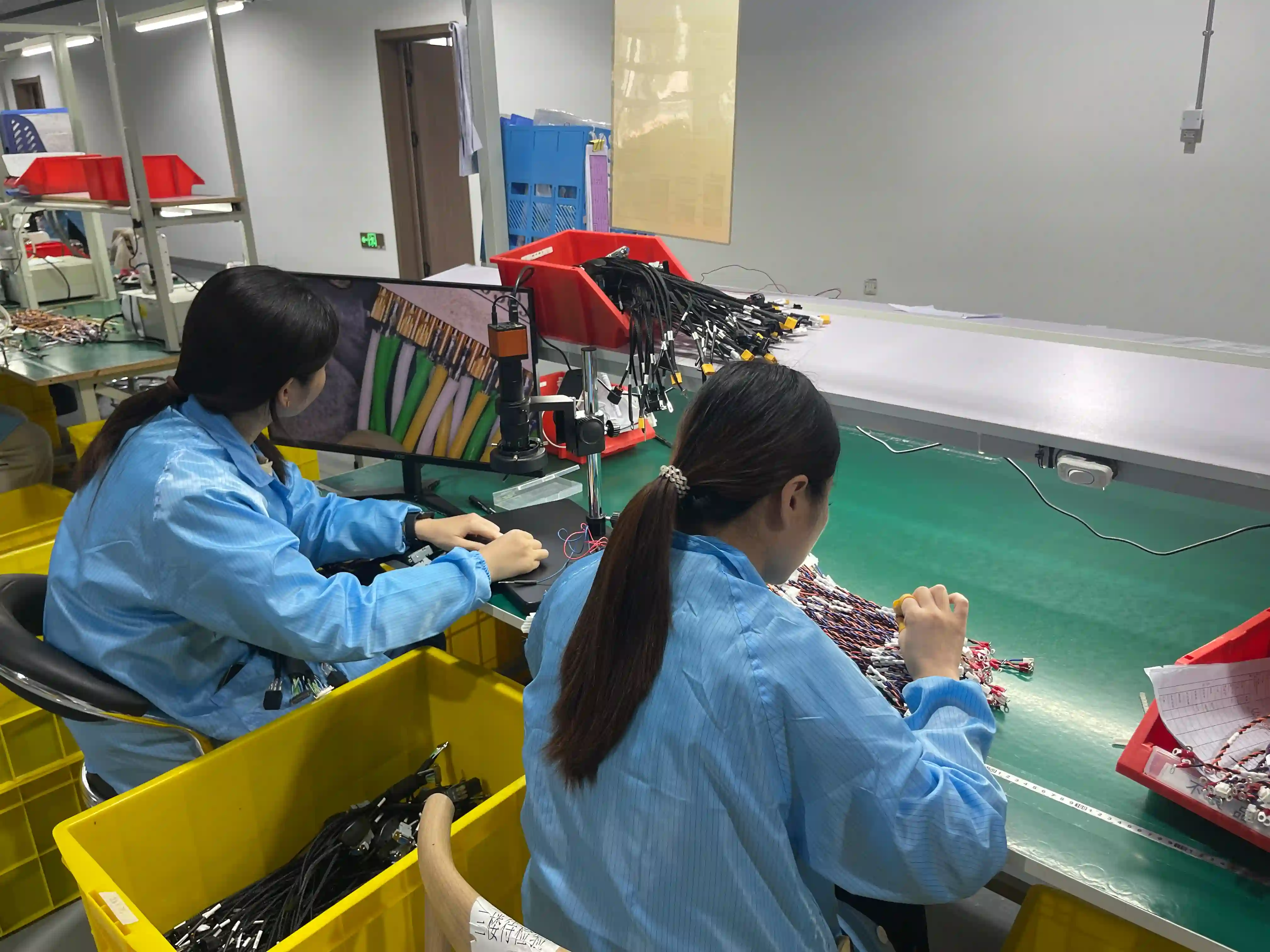
Potting is the process of filling a container (shell, housing, or mold) with a liquid compound that cures into a solid, embedding the wire harness connection points within a protective barrier. Encapsulation is closely related but typically refers to coating or surrounding components without a permanent container—the compound itself becomes the outer surface.
In wire harness manufacturing, potting is most commonly applied to:
- Connector backshells — sealing the wire-to-pin interface behind the connector body
- Splice junctions — protecting mid-harness wire joins from moisture and vibration
- Breakout points — stabilizing where a main trunk splits into sub-branches
- Junction boxes — filling electronic enclosures that house relays, fuses, or PCBs
- Sensor assemblies — encapsulating temperature, pressure, or position sensors
Potting vs. Backpotting
Potting fills an entire cavity or enclosure. Backpotting specifically refers to filling the rear cavity of a connector to seal the wire terminations. Backpotting is the most common potting application in wire harness manufacturing, and is often required by military specifications such as MIL-DTL-38999 for harsh-environment connectors.
Why Pot a Wire Harness? 8 Key Benefits
Potting transforms a vulnerable connection point into a sealed, mechanically reinforced assembly. Here are the eight primary reasons manufacturers specify potting on wire harness designs:
Moisture & IP Protection
Potting creates an impervious barrier against water, humidity, and condensation. Properly potted connectors can achieve IP67 or IP68 ratings even without mechanical seals.
Vibration Damping
The compound absorbs mechanical energy and prevents wire fatigue at termination points. Critical for automotive under-hood and aerospace applications.
Strain Relief
Potting distributes mechanical stress across a larger area, preventing concentrated loads on individual crimp terminals or solder joints.
Chemical Resistance
Protects conductors and terminals from fuel, oil, coolant, de-icing fluid, and industrial solvents that would corrode exposed connections.
Electrical Insulation
Potting compounds provide dielectric strengths of 300–500 V/mil, preventing arcing and tracking in high-voltage applications like EV battery harnesses.
Thermal Management
Thermally conductive potting compounds (0.8–4.0 W/mK) can conduct heat away from high-current connections, reducing hot spot temperatures by up to 50°C.
Tamper Resistance
Encapsulated circuits and connections cannot be easily inspected, copied, or modified. Used in defense, security, and proprietary electronics.
Extended Service Life
By eliminating the primary causes of field failures (moisture, vibration, corrosion), potting can extend harness service life by 3–5x in harsh environments.
Potting vs. Conformal Coating vs. Overmolding
Potting is one of three major protection methods for cable assemblies. Understanding when to use each—or combine them—is essential for cost-effective design. For a deeper dive on the overmolding side, see our overmolding vs. potting comparison.
| Factor | Conformal Coating | Potting / Encapsulation | Overmolding |
|---|---|---|---|
| Thickness | 25–250 μm | 1–10 mm | 1–5 mm |
| Vibration Protection | Low | High | High |
| IP Rating Achievable | IP54 | IP67–IP68 | IP67–IP69K |
| Tooling Cost | None | $100–$2,000 (molds/dams) | $10,000–$20,000 |
| Per-Unit Cost | $0.10–$1.00 | $0.30–$5.00 | $1.00–$8.00 |
| Reworkability | Easy (solvent removal) | Difficult (compound-dependent) | Not reworkable |
| Best For | PCBs, light moisture protection | Connectors, splices, junction boxes | High-volume strain relief |
Epoxy vs. Polyurethane vs. Silicone: 3 Potting Compounds Compared
The three dominant potting compound families each serve different operating environments and cost targets. Choosing the wrong one is the most common potting mistake—and it usually shows up as cracking, delamination, or premature failure after 6–18 months in service.
| Property | Epoxy | Polyurethane (PU) | Silicone |
|---|---|---|---|
| Temperature Range | -40°C to 180°C | -40°C to 130°C | -60°C to 200°C |
| Hardness | Shore D 80–90 (rigid) | Shore A 40 – Shore D 70 | Shore A 12–63 (flexible) |
| Adhesion | Excellent | Good | Fair (primer often needed) |
| Chemical Resistance | Excellent | Good | Good (fuel/oil sensitive) |
| Flexibility | Rigid | Semi-flexible to rigid | Highly flexible |
| Thermal Conductivity | 0.2–1.2 W/mK | 0.2–0.5 W/mK | 0.2–4.0 W/mK |
| Reworkability | Not reworkable | Partially removable | Removable (cut/peel) |
| Relative Cost | $$ | $ | $$$ |
| Typical Mix Ratio | 2:1 or 100:30 | 1:1 or 4:1 by volume | 1:1 or 10:1 |
Epoxy: Maximum Hardness and Chemical Resistance
Epoxy potting compounds cure into a rigid, extremely durable solid with the best adhesion and chemical resistance of the three families. They're the default choice for permanent encapsulation where rework is not expected. However, their rigidity is also their weakness: high CTE mismatch with copper conductors causes cracking during thermal cycling, making epoxy a poor choice for wide-temperature applications unless a flexible or filled formulation is specified.
Best for: Junction boxes, PCB encapsulation, indoor industrial connectors, tamper-resistant assemblies, and applications where chemical exposure (fuel, solvents, hydraulic fluid) is the primary threat.
Polyurethane: The Cost-Effective All-Rounder
Polyurethane compounds offer the widest range of hardness options (Shore A soft to Shore D rigid) and the lowest material cost. They provide good adhesion without primers and decent thermal cycling performance thanks to their inherent flexibility. PU compounds also have lower water vapor permeability than silicone, making them a strong choice for humidity-prone environments. According to Epic Resins, polyurethane can replace silicone in many applications while reducing material cost by 40–60%.
Best for: Consumer electronics, general industrial harnesses, telecom outdoor enclosures, and mid-range automotive applications where cost matters and temperatures stay below 130°C.
Silicone: Extreme Temperature and Flexibility
Silicone potting compounds excel where temperature extremes, thermal cycling, and flexibility are critical. They remain elastic from -60°C to 200°C and can be removed for rework—a major advantage for field-serviceable equipment. The silicone segment is growing at 6.8% CAGR through 2032, driven by EV and aerospace demand. The main drawbacks are higher cost, fair adhesion (typically requires primer), and higher water vapor permeability compared to epoxy or PU.
Best for: Automotive under-hood, aerospace, EV high-voltage harnesses, medical devices, and any application with wide thermal cycling or where future rework access is needed.
Epoxy provides strong chemical resistance and permanent sealing, but its rigidity can make it unsuitable for large temperature swings. Polyurethane may be a better fit for under-hood connectors that need greater compliance during thermal cycling.
Potting Compound Selection by Industry
Different industries impose different environmental stresses on wire harnesses. This selection matrix maps industry requirements to the most appropriate compound family:
| Industry | Primary Threats | Recommended Compound | Key Standard |
|---|---|---|---|
| Automotive (under-hood) | Heat, vibration, oil/fuel | Silicone or flexible PU | USCAR-2, LV 214 |
| Aerospace & Defense | Altitude, vibration, outgassing | Low-outgassing silicone | NASA KSC-STD-132, MIL-STD-810 |
| Marine & Offshore | Salt water, humidity, UV | Polyurethane (low vapor permeability) | IEC 60945 |
| Medical Devices | Sterilization, biocompatibility | Medical-grade silicone | ISO 10993, USP Class VI |
| EV Battery Systems | High voltage, thermal cycling | Thermally conductive silicone | IEC 62660, UL 2580 |
| Industrial Controls | Dust, chemicals, vibration | Epoxy or rigid PU | IPC/WHMA-A-620 |
For automotive under-hood and EV applications, see our custom battery cable assembly guide for more detail on high-voltage potting requirements. For marine environments, our marine wire harness guide covers saltwater-resistant design including potting specifications.
Step-by-Step Wire Harness Potting Process
Proper potting is a controlled process. Skipping steps—especially surface preparation and degassing—is the most common cause of potting failures in production.
Pre-Potting Inspection
Verify all crimps, solder joints, and wire routing before potting. Run continuity and hipot tests. Once the compound cures, rework is expensive or impossible. This is your last chance to catch electrical defects.
Surface Cleaning & Priming
Clean all surfaces with isopropyl alcohol to remove oils, flux residue, and contaminants. For silicone compounds, apply manufacturer-recommended primer to improve adhesion. Poor surface prep is the #1 cause of delamination.
Dam/Mold Preparation & Masking
Position the connector in the potting mold or create a dam around the potting area using heat shrink boots, RTV dams, or 3D-printed fixtures. Mask any contact surfaces, threads, or mating interfaces that must remain compound-free.
Compound Mixing
Mix the two-part compound at the manufacturer's specified ratio (e.g., 1:1, 2:1, 10:1). Use calibrated dispensing equipment for repeatability. Incorrect ratios cause incomplete cure, tacky surfaces, or brittle results.
Vacuum Degassing
Place the mixed compound under vacuum (≤3.4 kPa per NASA KSC-STD-132) for 3–10 minutes to remove trapped air. Skipping this step creates voids that become moisture ingress paths and reduce dielectric strength. For high-reliability applications, this step is mandatory.
Dispensing & Filling
Pour or inject the compound slowly to minimize air entrapment. Fill from the lowest point and let the compound flow upward. For deep fills, use staged pours — fill 50%, partially cure, then fill the remaining 50% to reduce exotherm.
Curing
Follow the manufacturer's cure schedule precisely. Room-temperature cures (24–72 hours) are common for PU and silicone. Elevated-temperature cures (60–150°C for 1–4 hours) accelerate epoxy curing. Avoid disturbing the assembly during cure.
Post-Cure Inspection & Testing
Visually inspect for voids, bubbles, and surface defects. Re-run electrical tests (continuity, hipot) to confirm no damage occurred during the potting process. For critical applications, perform cross-section analysis on sample units.
Exotherm Warning
Large-volume epoxy pours generate significant heat during curing (exothermic reaction). A 100 mL epoxy pour can reach internal temperatures exceeding 150°C, potentially damaging wire insulation and melting connector housings. Always check the compound's exotherm profile and use staged pours for volumes exceeding 50 mL.
7 Common Potting Failures and How to Prevent Them
Most potting failures are preventable with proper material selection, process control, and testing. Based on real-world failure analysis from our production line and customer returns, here are the seven most common issues:
Air Bubbles & Voids
Cause: Skipping vacuum degassing, pouring too fast, or trapping air in tight cavities.
Prevention: Vacuum degas all mixed compounds at ≤3.4 kPa. Pour slowly from the lowest point. For complex geometries, use pressure potting (3–5 bar) to collapse remaining bubbles.
Thermal Cycling Cracks
Cause: CTE mismatch between rigid compound (epoxy) and copper/plastic substrates. Stress accumulates over hundreds of thermal cycles.
Prevention: Use flexible compounds (PU or silicone) for applications with >80°C temperature swings. Rigid epoxies start cracking after ~1,000 thermal cycles in wide-temperature environments.
Delamination from Surfaces
Cause: Contaminated surfaces, missing primer (silicone), or incompatible substrate materials.
Prevention: IPA clean all surfaces. Apply primer per compound manufacturer's specification. Run adhesion pull tests on process validation samples.
Incomplete Cure (Tacky Surface)
Cause: Incorrect mix ratio, expired compound, ambient temperature too low, or moisture contamination of PU compounds.
Prevention: Use calibrated metering/mixing equipment. Store compounds per shelf-life requirements. Maintain 23°C minimum ambient for room-temperature cure systems.
Shrinkage Stress on Components
Cause: High-shrinkage compounds (some epoxies shrink 1–3% during cure) pull wires and crack solder joints.
Prevention: Specify low-shrinkage formulations (<0.5%). Use flexible compounds around delicate terminations. Stage large pours to reduce bulk shrinkage.
Exothermic Damage
Cause: Large-volume epoxy pours generate extreme heat. Internal temperatures can exceed 150°C, melting wire insulation.
Prevention: Limit pour volumes to 50 mL per stage. Use low-exotherm formulations for large cavities. Monitor peak exotherm with thermocouples during process validation.
Conductive Pigment Contamination
Cause: Carbon-based black pigments in colored potting compounds can be electrically conductive, creating short-circuit paths.
Prevention: Verify pigment type with the compound manufacturer. Use only certified non-conductive colorants. Test dielectric strength of the specific colored formulation you plan to use.
Thermal Management Through Potting Compound Selection
Standard potting compounds are thermal insulators (~0.2 W/mK). For high-current wire harnesses—EV battery interconnects, motor power feeds, industrial bus bars—heat trapped by insulating potting compound causes hot spots that accelerate insulation aging. Thermally conductive potting compounds solve this by conducting heat away from the conductor to the enclosure surface.
| Filler Type | Thermal Conductivity | Impact on Viscosity | Cost Premium |
|---|---|---|---|
| Unfilled (base polymer) | 0.2 W/mK | None (lowest viscosity) | Baseline |
| Aluminum oxide (Al₂O₃) | 0.8–1.5 W/mK | Moderate increase | 1.5–2x |
| Boron nitride (BN) | 1.5–3.0 W/mK | Significant increase | 3–5x |
| Silicone + specialty filler | 3.0–4.0 W/mK | High (paste-like) | 5–8x |
According to a Parker white paper on thermally conductive compounds, increasing thermal conductivity from 0.1 to 4.0 W/mK can reduce inductor hot spot temperature by approximately 50°C—a difference that can double the expected insulation life of high-current conductors.
Thermally conductive silicone potting can improve heat transfer at EV battery bus-bar connections. Any reduction in conductor size must still be supported by current, temperature-rise, and derating calculations for the installed assembly.
Industry Standards for Potted Wire Harnesses
Multiple standards govern how potting compounds are selected, applied, and inspected. The applicable standard depends on your industry and end-use application:
NASA KSC-STD-132 Rev E
Potting and molding electrical cable assembly terminations for NASA programs. Covers vacuum degassing (≤3.4 kPa), cure schedules, and acceptance criteria.
IPC/WHMA-A-620
General wire harness acceptance standard. Section 10 covers molded and potted assemblies including void limits, surface finish, and dimensional tolerances.
MIL-STD-810
Environmental engineering considerations for military equipment. Defines thermal cycling, humidity, vibration, and salt fog test procedures that potted assemblies must survive.
UL 94
Flammability classification for potting compounds. V-0 (self-extinguishing within 10 seconds) is required for most enclosed electronic applications.
ASTM D149
Standard test method for dielectric breakdown voltage. Used to verify that potting compounds maintain electrical insulation under high-voltage stress.
For a broader overview of wire harness quality standards, see our IPC/WHMA-A-620 guide and our top 5 certifications article.
Rework and Repair of Potted Assemblies
One of the most frequently asked questions on engineering forums is: "Can I rework a potted connector?" The answer depends entirely on the compound:
Epoxy: Not Reworkable
Cured epoxy is permanent. The only removal method is mechanical grinding or chemical stripping, both of which typically destroy the wires and connector. Design for no rework when specifying epoxy.
Polyurethane: Partial Removal
Some PU compounds can be softened with heat (80–100°C) and carefully peeled away from wires. Success rate varies by formulation. Softer Shore A compounds are easier to remove than rigid Shore D versions.
Silicone: Removable
Cured silicone can be cut, peeled, and picked out with hand tools. This is the primary reason field-serviceable military and aerospace connectors overwhelmingly use silicone potting compounds.
Design-for-Repairability Tip
If future rework is even remotely possible, specify silicone from the start. Applying release agent to connector pins before potting makes silicone removal cleaner. Some manufacturers also use sacrificial "rework plugs"—soft silicone inserts that can be pulled out to access specific terminations without removing the entire potting.
Frequently Asked Questions
What is the difference between potting and encapsulation?
Potting involves pouring compound into a permanent shell or housing that remains part of the final assembly. Encapsulation coats or surrounds the component with compound, and the mold or form is removed after curing—the cured compound itself becomes the outer surface. In wire harness manufacturing, the terms are often used interchangeably, but true potting uses a retained container.
How long does potting compound take to cure?
Cure times vary by compound type and temperature. Room-temperature silicone: 24–72 hours. Room-temperature polyurethane: 12–24 hours. Heat-cured epoxy: 1–4 hours at 60–150°C. Many compounds reach handling strength in 2–4 hours but require full cure time before environmental exposure.
Can I pot a wire harness without vacuum degassing equipment?
For non-critical applications (consumer electronics, indoor equipment), yes—careful slow pouring and allowing bubbles to rise before cure can produce acceptable results. For military, aerospace, medical, or automotive under-hood applications, vacuum degassing is effectively mandatory. NASA KSC-STD-132 specifies a maximum absolute pressure of 3.4 kPa (0.5 psi) during degassing.
Does potting add significant weight to a cable assembly?
Potting typically adds 5–50 grams per connection point, depending on cavity volume and compound density. Silicone compounds are the lightest (density ~1.0–1.1 g/cm³), while filled epoxies can reach 1.5–2.0 g/cm³. For aerospace applications where every gram matters, specify low-density silicone formulations and minimize cavity volume.
What is the best potting compound for outdoor or marine wire harnesses?
Polyurethane is generally the best choice for marine and outdoor applications due to its low water vapor permeability, good UV resistance (with stabilizers), and lower cost than silicone. For saltwater submersion above IP67, specify PU with IP68-rated adhesion to your connector housing material. Silicone is preferred if temperatures exceed 100°C.
Can potted connectors be re-terminated or re-pinned?
Only with silicone potting, and even then it requires careful removal. Epoxy-potted connectors cannot be re-terminated without destroying the connector. If your application requires field re-termination, use silicone potting with release agent on the contact area, or consider overmolding with a removable boot design instead of potting.
References & Standards
[1] Mordor Intelligence — Global Potting Compound Market Analysis (2024) — Market size, segment breakdown, and growth projections for the potting compound industry.
[2] Epic Resins — Polyurethane vs. Silicone Potting Compounds — Technical comparison of polyurethane and silicone potting compound properties and cost considerations.
[3] NASA KSC-STD-132 Rev E — Potting and Molding Electrical Cable Assembly Terminations — NASA standard for potting processes, vacuum degassing requirements, and acceptance criteria.
[4] IPC/WHMA-A-620 — Requirements and Acceptance of Cable and Wire Harness Assemblies — Industry standard covering potted and molded wire harness acceptance criteria (Section 10).
[5] Parker — Thermally Conductive Potting Compounds White Paper — Engineering data on thermal conductivity fillers and their impact on electronics cooling.
Related Articles
Overmolding vs Potting: Cable Protection Compared
Compare the two most common cable protection methods for strain relief and environmental sealing.
Wire Harness Environmental Testing Guide
Temperature cycling, salt spray, vibration, and humidity tests for qualifying cable assemblies.
Top 5 High-Temperature Wire and Cable Materials
Compare silicone, PTFE, FEP, ETFE, and ceramic fiber insulations for extreme environments.
About the Author
OurPCB Engineering Team brings over 15 years of combined experience in wire harness design, potting processes, and environmental protection engineering. The team has specified potting compounds for automotive, aerospace, marine, and EV applications, and helped many OEM programs select the right encapsulation strategy for their operating environment.