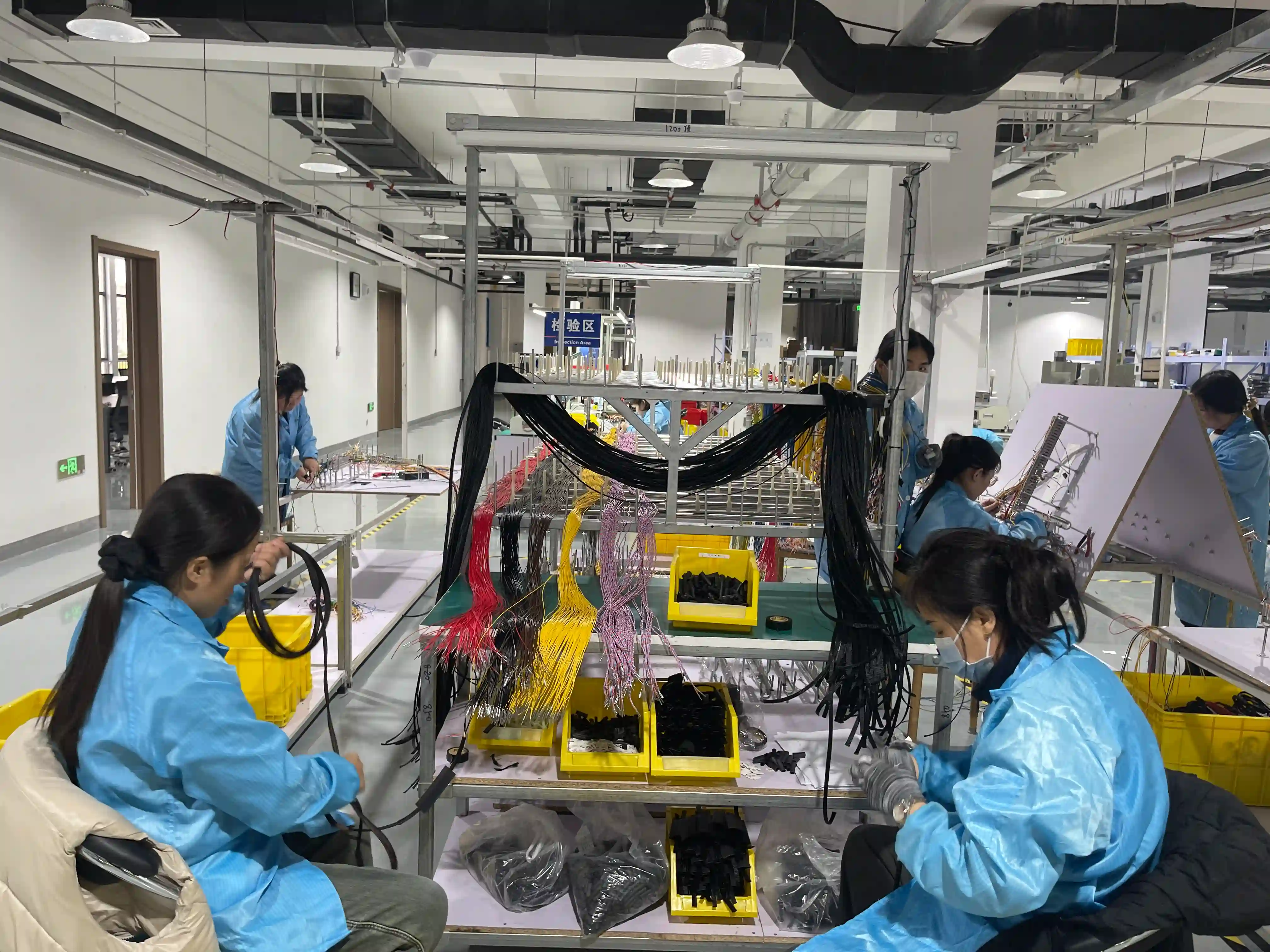
The global battery cable assembly market is accelerating at a pace few predicted even five years ago. Electric vehicle adoption has surged past 20 million units annually, grid-scale energy storage systems are deploying at gigawatt scale, and industrial electrification is replacing diesel and hydraulic power with battery-electric alternatives. Every one of these systems depends on custom battery cable assemblies to deliver hundreds of amps safely and reliably.
Unlike standard cable assemblies, battery cables face a unique combination of challenges: extreme currents that generate significant heat, high voltages that demand rigorous insulation and safety interlocks, harsh operating environments spanning -40°C to +60°C ambient, and regulatory frameworks that continue to evolve. A poorly designed battery cable doesn't just fail—it creates fire and shock hazards.
This guide covers everything engineers and procurement teams need to specify, design, and source custom battery cable assemblies—from conductor sizing fundamentals through thermal management, safety systems, and manufacturer selection criteria. Whether you're designing for an EV platform, a BESS installation, or an industrial forklift fleet, the principles here apply.
$12B+
EV Cable Assembly Market
800V
Max System Voltage
500A+
Peak Current Rating
1000V DC
Insulation Rating
"Battery cable assembly is the fastest-growing segment in our entire product portfolio. Five years ago, maybe 10% of our inquiries involved high-current battery interconnects. Today it's closer to 40%. The demand isn't just from automotive—we're seeing massive growth from energy storage, marine electric propulsion, and even aviation electrification. The common thread is that every application needs custom engineering—there are no off-the-shelf solutions at these power levels."
OurPCB Engineering Team
Battery Cable Design Fundamentals
Battery cable design starts with four foundational parameters: conductor sizing for the required current, insulation selection for the system voltage class, ampacity calculations accounting for real-world derating, and mechanical requirements for the installation environment. Get any one of these wrong and the cable assembly will either underperform or create a safety hazard.
Conductor Sizing: AWG vs kcmil
For battery cable applications below 200A continuous, standard AWG sizes (4/0 through 6 AWG) are typical. Above 200A, the industry transitions to kcmil (thousand circular mil) sizing—250 kcmil, 350 kcmil, and 500 kcmil are common in high-power battery packs and energy storage systems. The conductor is almost always fine-stranded (Class 5 or Class 6) for flexibility, particularly in stranded configurations that allow tight bend radii inside battery enclosures.
Insulation Material Selection
Insulation choice depends on voltage class, temperature rating, and environmental exposure. The three primary insulation families for battery cables are cross-linked polyethylene (XLPE), silicone rubber, and low-smoke zero-halogen (LSZH) compounds. Each offers distinct advantages depending on the application.
| Parameter | 600V Class | 1000V Class | 1500V Class |
|---|---|---|---|
| Typical Application | 48V-400V battery packs | 800V EV platforms | Utility-scale BESS |
| Insulation Thickness (min) | 0.76 mm | 1.14 mm | 1.52 mm |
| Hipot Test Voltage | 2000 VAC | 3500 VAC | 5000 VAC |
| Creepage Distance | 6.3 mm | 10 mm | 16 mm |
| Common Insulation | XLPE, PVC | XLPE, Silicone | Silicone, LSZH |
| Temp Rating (continuous) | 90°C | 125°C | 150°C |
Ampacity Calculation Basics
Published ampacity tables (NEC 310, IEC 60364) provide baseline current ratings for cables in free air or conduit. Battery applications almost always require derating from these published values due to:
- Elevated ambient temperature inside battery enclosures (typically 40-60°C vs 30°C standard)
- Bundled cable derating when multiple power cables run parallel
- Duty cycle considerations for intermittent high-current loads (fast charging)
- Altitude derating above 1000m for reduced convective cooling
For detailed conductor sizing guidance, refer to our wire & cable selection guide and the copper vs aluminum comparison for conductor material decisions.
Key Components & Hardware
A custom battery cable assembly is far more than wire and terminals. Modern battery power systems integrate multiple functional components into the cable harness, each serving a critical role in power delivery, protection, or monitoring.
High-Current Terminals
Crimp or welded copper/aluminum lugs rated for 200-500A+ continuous. Ultrasonic welding is preferred for aluminum conductors to eliminate oxidation at the joint interface.
Silver or tin plating reduces contact resistance below 50 micro-ohms
Busbar Assemblies
Rigid copper or aluminum busbars distribute power between battery modules. Laminated busbars reduce inductance and improve current sharing in parallel cell configurations.
Custom formed to match battery module geometry exactly
Fuse Links & Contactors
Pyro-fuses for fault protection and high-voltage contactors for system disconnect. Pre-charge resistors limit inrush current when the system energizes.
Interrupt ratings from 10kA to 100kA for DC fault protection
HVIL Connectors
High Voltage Interlock Loop connectors carry a low-voltage monitoring circuit that breaks before HV contacts separate, triggering system de-energization.
Required by ISO 6469 and SAE J1742 for all serviceable HV connections
Current Sensors
Hall-effect or shunt-based current sensors integrated into the cable harness for real-time BMS monitoring. Accuracy of ±0.5% typical for state-of-charge calculations.
Bandwidth to 100 kHz for transient current detection
Pre-charge Circuits
Resistor-contactor networks that limit inrush current to the inverter DC bus capacitors. Without pre-charge, closing the main contactor onto a discharged capacitor bank causes destructive current spikes exceeding 1000A.
Pre-charge time typically 200-500 ms depending on bus capacitance
Component integration is a core advantage of custom battery cable assemblies over generic cables. By combining power delivery, protection, sensing, and safety interlock functions into a single tested harness, you eliminate interface risks and simplify battery pack assembly. For connector selection guidance, see our connector types guide.
Safety & Protection Systems
Battery cable assemblies operating above 60V DC are classified as high-voltage systems, triggering a comprehensive set of safety requirements. These aren't optional design features—they are regulatory mandates enforced through UL, CSA, and CE certification processes.
HVIL (High Voltage Interlock Loop)
Prevents contact with energized HV circuits during service
Low-voltage loop through all HV connectors breaks before main contacts separate. BMS detects loop break within 5 ms and opens main contactors within 15 ms. Dual redundant loops required for ASIL-C applications.
Arc Flash Protection
Prevents sustained arcing during fault or disconnect events
DC arc energy at battery voltages can reach 10+ kJ. Protection includes pyro-fuses with sub-millisecond trip times, arc-resistant connector housings, and controlled contactor sequencing with pre-charge to limit arcing during switching.
Thermal Runaway Protection
Isolates harness from cell-level thermal events
Battery cables routed through modules must survive cell venting temperatures (up to 800°C momentary). Ceramic fiber overwrap or mica tape barriers on cable sections adjacent to cells provide thermal protection during propagation events.
IP67/IP68 Environmental Sealing
Prevents water and contaminant ingress into HV connections
All HV connectors sealed to minimum IP67 (submersion to 1m for 30 min). Battery pack boundary connectors often require IP68 or IP69K for underbody mounting exposed to road spray and pressure washing.
Orange HV Identification
Visual safety warning for service personnel and first responders
ISO 6469-3 mandates orange outer jacket for all cables carrying more than 60V DC or 30V AC. Color specification is RAL 2003 (pastel orange). All connectors, covers, and labels on HV components must also be orange.
Creepage & Clearance Requirements by Voltage Class
| Safety Parameter | 400V System | 800V System | 1500V System |
|---|---|---|---|
| Min Clearance (air) | 4.0 mm | 8.0 mm | 14.0 mm |
| Min Creepage (surface) | 6.3 mm | 12.5 mm | 25.0 mm |
| Touch Protection | IPXXB required | IPXXB required | IPXXB required |
| Insulation Monitoring | 500 ohm/V min | 500 ohm/V min | 500 ohm/V min |
| HVIL Response Time | <20 ms | <20 ms | <20 ms |
Safety Is Non-Negotiable
Battery cable assemblies carrying more than 60V DC pose lethal shock and arc flash hazards. Every custom battery cable must be designed, manufactured, and tested to meet applicable safety standards (UL, IEC, ISO) before deployment. Cutting corners on creepage distances, insulation thickness, or HVIL response times has caused fires, injuries, and product recalls in the battery industry. Always validate safety performance through accredited third-party testing.
Thermal Management
Heat is the defining engineering challenge in high-current battery cable assemblies. Every conductor generates resistive heating proportional to I²R—the square of current times resistance. Double the current and heat generation quadruples. At 500A through a 25mm² copper conductor, resistive losses generate approximately 85 watts per meter of cable length. In an enclosed battery pack with limited airflow, this heat accumulates rapidly.
Heat Generation at High Current
I²R
Heat = Current² × Resistance
250A → 21W/m
25mm² copper conductor
500A → 85W/m
4× heat at 2× current
Temperature Rise Factors
Conductor temperature rise above ambient depends on heat generation rate (I²R), thermal resistance to the environment (insulation thickness, air gap, enclosure), and duty cycle (continuous vs intermittent loading). The critical design constraint is ensuring the conductor temperature never exceeds the insulation temperature rating under worst-case conditions.
Thermal Derating Factors
- Ambient 40°C: derate to 88% of rated ampacity
- Ambient 50°C: derate to 75% of rated ampacity
- Ambient 60°C: derate to 58% of rated ampacity
- 3 cables bundled: derate to 70% of single-cable rating
Cooling Integration Methods
- Route cables along cooling plates for conductive heat transfer
- Thermal interface materials (TIM) between cable and heat sink
- Liquid-cooled connectors for 400A+ continuous applications
- Forced air channels within battery enclosure design
For applications requiring detailed thermal analysis, FEA (finite element analysis) simulation of the cable cross-section in its installed environment is strongly recommended. This catches thermal bottlenecks that simplified hand calculations miss—particularly at connector interfaces where current density concentrates and heat dissipation is limited by housing geometry.
Thermal management is A common challenge engineers underestimate in battery cable design. They size the conductor for current, pick an insulation for voltage, and consider themselves done. Then the cable runs through a 55°C battery enclosure next to three other power cables, and the actual temperature rise exceeds the insulation rating by 30°C. Always design for the installed thermal environment—not the datasheet free-air rating. A practical rule is: if you haven't modeled the thermal path, you haven't finished the design.
OurPCB Engineering Team
Application Areas
Custom battery cable assemblies serve a broad and rapidly growing range of industries. While the fundamental engineering principles are shared, each application imposes unique requirements on voltage class, current rating, environmental exposure, and regulatory compliance.
Electric Vehicles (BEV/PHEV)
Battery-to-inverter power cables, cell sensing harnesses, interlock loops, and charging inlet cables. IATF 16949 quality system and LV216 cable specifications required for OEM supply.
EV SolutionsBattery Energy Storage (BESS)
Module-to-module interconnects, DC combiner cables, and battery-to-inverter trunk cables for utility and commercial-scale energy storage. UL 4128 and NFPA 855 compliance increasingly required.
Battery CablesForklifts & Material Handling
High-current battery interconnects for electric forklifts, AGVs, and warehouse robots. Extreme vibration resistance, chemical splash protection, and quick-disconnect for battery swapping are key requirements.
Industrial EVSolar Inverter Connections
DC side cable assemblies connecting battery banks to hybrid inverters. Outdoor UV exposure, wide temperature range, and 25-year service life demands drive material selection toward UV-resistant XLPE and stainless steel hardware.
Cable AssemblyUPS & Critical Power
Battery cabinet interconnects for data center and critical facility UPS systems. Low-smoke zero-halogen (LSZH) insulation mandated in plenum-rated spaces. Redundant connections and hot-swappable battery module designs.
Power CablesMarine Electric Propulsion
Battery-to-motor cables for electric ferries, yachts, and workboats. Marine-grade tinned copper conductors, IP68 sealed connections, and DNV-GL / Lloyd's Register type approval required for commercial marine applications.
Marine SolutionsEmerging applications include eVTOL (electric vertical takeoff and landing) aircraft battery cables, mining vehicle electrification, and hydrogen fuel cell power distribution—all of which build on the same core engineering principles described in this guide. For more on industry-specific trends, see our top 6 EV cable trends for 2026.
Manufacturing Process
Manufacturing battery cable assemblies differs fundamentally from standard wire harness production. The combination of high currents, high voltages, and safety-critical applications demands specialized equipment, tighter process controls, and 100% end-of-line testing that goes well beyond continuity checking.
| Process Step | Battery Cable Method | Standard Cable Method | Why Different |
|---|---|---|---|
| Termination | Ultrasonic welding | Crimp terminals | Welding eliminates oxide layer issues on aluminum; lower contact resistance |
| Identification | Laser marking | Ink jet / labels | Laser marks survive HV cable operating temperatures; labels degrade |
| Crimp Monitoring | 100% force monitoring | Sample-based | Every crimp recorded with force-displacement curve for traceability |
| Electrical Test | 100% hipot testing | Continuity only | Insulation integrity verified at 2-3× working voltage on every unit |
| Traceability | Full lot traceability | Batch-level | Every component traced to supplier lot; every test result recorded per serial number |
| Visual Inspection | IPC-620 Class 3 | IPC-620 Class 2 | Tighter acceptance criteria for high-reliability applications |
Critical Manufacturing Capabilities
Ultrasonic Welding
20-40 kHz welding systems for aluminum-to-copper and aluminum-to-aluminum joints up to 120mm² cross-section
Automated Hipot Testing
Production-rate HV testing at up to 5000 VAC with automatic pass/fail recording and data archiving
Crimp Force Monitoring
Real-time force-displacement analysis on every crimp with SPC integration and automatic reject gating
Laser Marking
Permanent HV identification, serial numbers, and QR codes resistant to 200°C and common automotive fluids
Thermal Cycling Chamber
-40°C to +150°C environmental testing for design validation and process qualification
Cross-Section Analysis
Metallurgical lab for crimp and weld quality verification with automated measurement software
For more on production quality standards, see our guides on crimping best practices and top 10 quality inspection points.
Selecting a Battery Cable Assembly Manufacturer
Not every cable assembly manufacturer can produce battery cables. The combination of high-voltage safety requirements, specialized termination processes, and stringent quality systems eliminates most general-purpose shops. Use this checklist to evaluate potential suppliers—a "no" on any critical item should be a disqualifier.
Battery Cable Manufacturer Selection Checklist
Beyond technical capability, evaluate the manufacturer's engineering support depth. A good battery cable supplier doesn't just build to print—they collaborate on design optimization, identify thermal risks early, and provide DFM (design for manufacturing) feedback that improves both reliability and cost. For more supplier evaluation guidance, see our top 10 red flags when choosing a cable supplier and 8 essential questions for your cable supplier.
"We support customers from first prototype through mass production—and that journey is where the real value of a capable battery cable manufacturer shows. Anyone can build one sample cable on a bench. The challenge is building 10,000 identical cables per month with 100% hipot test passing rate and full traceability. That requires investment in process, equipment, and quality systems that most general cable shops simply don't have. When evaluating suppliers, always ask to see their production floor, not just their samples."
OurPCB Engineering Team
Frequently Asked Questions
What is the difference between battery cables for 400V and 800V systems?
The primary differences are insulation rating and creepage/clearance requirements. 400V systems typically use 600V-rated insulation, while 800V systems require 1000V or 1500V-rated insulation with significantly larger creepage distances (12.5 mm vs 6.3 mm). Cable construction may also differ—800V systems often require enhanced shielding for EMC compliance and orange outer jacketing per ISO 6469-3. Connector ratings, HVIL circuits, and hipot test voltages are all higher for 800V applications. The conductor itself may be the same size if the power level is similar, since conductor sizing is driven by current rather than voltage.
What are typical lead times for custom battery cable assemblies?
Prototype lead times range from 2-4 weeks for standard configurations using available connectors and cable, extending to 6-8 weeks if custom-tooled terminals or connectors are required. Production lead times are typically 4-6 weeks after initial setup and PPAP (Production Part Approval Process) completion. First-article production runs for automotive OEMs may take 8-12 weeks due to PPAP documentation requirements including dimensional reports, material certifications, process capability studies, and customer approval cycles.
Can you use custom connectors on battery cable assemblies?
Yes—most battery cable assemblies use custom or semi-custom connectors tailored to the battery pack geometry and electrical requirements. Options range from modifying standard high-voltage connector families (such as Amphenol HVP800, TE HVP-1800, or Molex MX150) to fully custom-tooled housings for high-volume applications. Custom connector development adds 12-16 weeks to the initial program timeline and requires tooling investment, but enables optimized packaging, lower contact resistance, and integrated HVIL and sealing features specific to your design.
What thermal testing is required for battery cable validation?
Standard thermal validation includes thermal cycling (-40°C to +125°C, 1000 cycles minimum per LV 216 or equivalent), continuous current aging at maximum rated temperature for 3000 hours, and overload testing at 1.5× rated current for 1 hour. Some OEMs add thermal shock testing (rapid temperature transition) and thermal runaway simulation testing where cables must survive brief exposure to 400-800°C cell venting gases. All thermal tests measure insulation resistance and hipot performance before and after exposure to verify no degradation.
What is the UL certification process for battery cable assemblies?
UL certification for battery cable assemblies typically involves UL 62 (flexible cords and cables) or UL 4703 (photovoltaic wire) standards depending on application. The process includes submitting construction details and materials to UL, undergoing initial product testing (flame, insulation resistance, conductor resistance, cold bend), factory inspection by UL field representatives, and establishing a follow-up service agreement for ongoing production monitoring. Timeline is 8-16 weeks from initial submission to listing. For EV applications, UL 2580 (batteries for use in EVs) may also apply to the complete battery pack including cable assemblies.
What is the minimum order quantity for custom battery cables?
Minimum order quantities vary by complexity. For prototype and development quantities, most suppliers can accommodate orders of 5-25 pieces, though unit costs will be higher due to setup charges. For production orders, typical MOQs range from 100-500 pieces depending on tooling investment and material minimum buys. High-volume automotive programs with dedicated tooling may have MOQs of 1000+ pieces per release. We recommend discussing volume projections early in the design phase so tooling and process decisions can be optimized for your expected quantities.
Related Articles
EV High Voltage Cable Guide
400V vs 800V systems, HV cable construction, shielding, and safety standards.
Read articleEV Battery Harness Case Study
800V battery pack harness design and manufacturing from prototype to high-volume annual production.
Read articleCopper vs Aluminum Wiring
Conductor material comparison for conductivity, cost, weight, and application suitability.
Read articleAbout the Author
OurPCB Engineering Team brings over 15 years of combined experience in power cable design and manufacturing. The team specializes in high-current battery interconnects for EV, energy storage, and industrial electrification applications, having led 30+ custom battery cable programs from initial specification through production launch. Its technical focus areas include thermal management optimization, ultrasonic welding process development, and safety interlock system design for 400V-1500V battery systems.