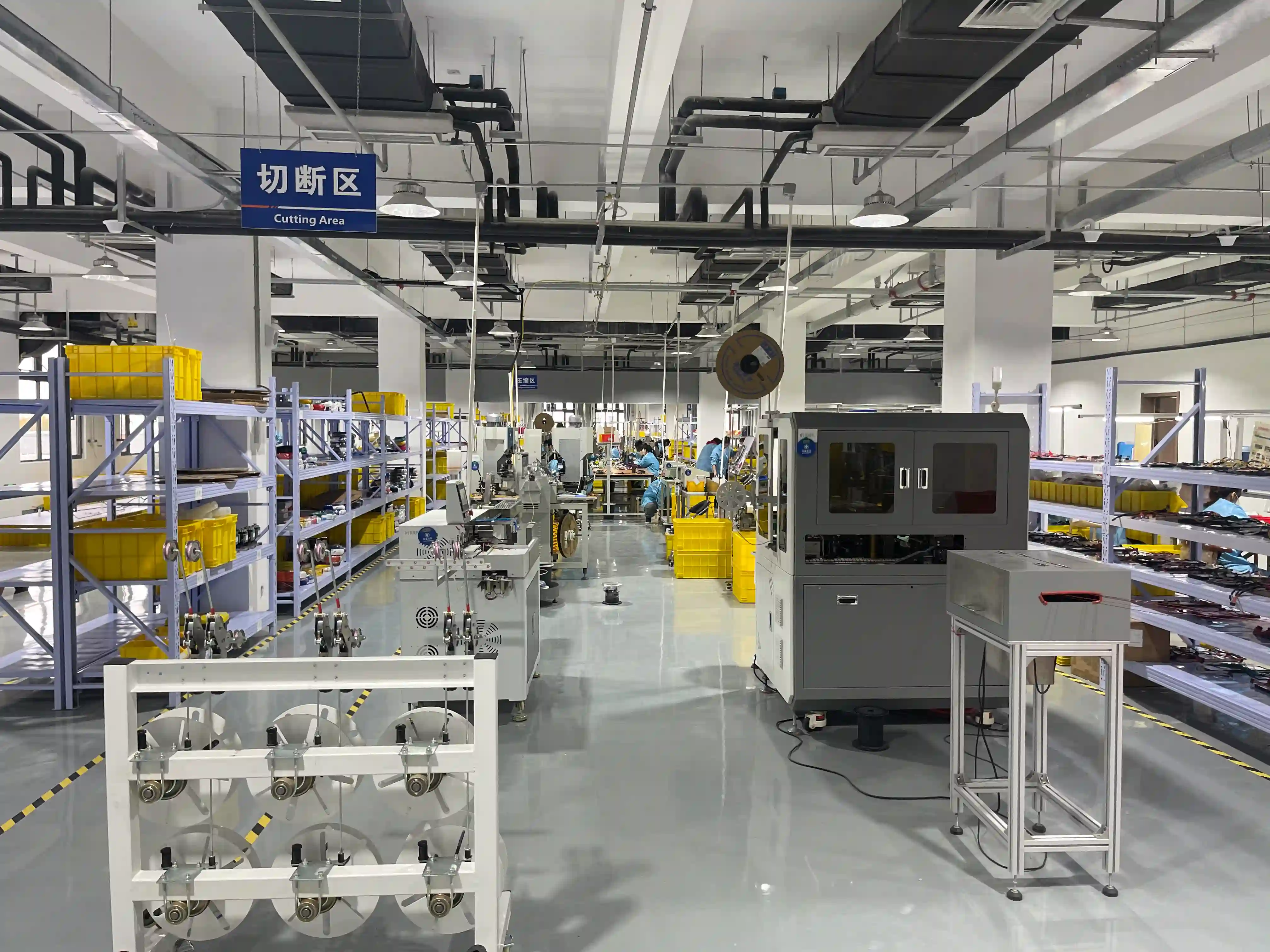
Every wire harness that leaves our factory floor goes through at least 12 distinct manufacturing steps. Miss one, rush another, and you've got a harness that might pass initial testing but fails in the field. After producing millions of harnesses, I can tell you: the process matters as much as the design.
For industry reference, see cable harness and IPC standards.
This guide walks through our complete wire harness and cable assembly manufacturing process. Whether you're an engineer specifying harnesses, a purchasing manager evaluating suppliers, or just curious about how these critical components are made—this is what actually happens.
The 12-Step Manufacturing Process
Pre-Production (1-3)
- Design Review & DFM
- Material Procurement
- Work Order Creation
Production (4-9)
- Wire Cutting & Stripping
- Crimping
- Soldering (if required)
- Harness Assembly
- Secondary Operations
- Overmolding/Potting
Post-Production (10-12)
- Electrical Testing
- Visual Inspection
- Packaging & Shipping
1Design Review & DFM Analysis
Every project starts with our design engineering team reviewing your specifications. This isn't a rubber-stamp process—we're looking for potential issues before they become production problems.
What We Review:
- Connector compatibility: Do the specified terminals match the wire gauge? Will the housing accommodate the number of circuits?
- Wire routing feasibility: Can the harness be built on our assembly boards? Are bend radii achievable?
- Material availability: Are all components in stock or readily available? What are lead times?
- Testing requirements: What electrical and mechanical tests are needed? Do we have the capability?
This DFM (Design for Manufacturing) step catches approximately 30% of potential issues before production starts. It's free for quoted projects, and we provide detailed feedback within 24-48 hours.
2Material Procurement & Kitting
Our global sourcing team procures all materials from approved suppliers. We maintain relationships with authorized distributors for major connector brands—Molex, JST, TE Connectivity, Amphenol, Deutsch, and others.
Materials are kitted in our warehouse before production starts. Each work order gets a dedicated kit containing exact quantities of wire, terminals, connectors, and accessories. This eliminates line-side shortages and ensures traceability.
3Work Order Creation & Traveler Documentation
Every harness is built against a detailed work order that travels with the product through production. This traveler includes:
- Full assembly drawing with dimensions and callouts
- Bill of materials with part numbers and quantities
- Step-by-step work instructions
- Quality checkpoints and inspection criteria
- Test specifications and acceptance criteria
For automotive and medical harnesses, the traveler also captures operator signatures, lot numbers, and any process deviations. This documentation is retained for 10+ years per IATF 16949 and ISO 13485 requirements.
The work order documentation seems like overhead until you have a quality issue. When a customer calls with a problem, the review can pull up exactly who built that harness, what lot of wire was used, and every test result—within minutes. That traceability has saved major customer relationships.
OurPCB Engineering Team
On Quality Documentation
4Wire Cutting & Stripping
Cutting and stripping is the first hands-on production step. Our automatic cut-and-strip machines handle wire from 32 AWG to 2 AWG, processing thousands of wire segments per hour with ±0.5mm length tolerance.
Key Parameters:
| Parameter | Specification | Why It Matters |
|---|---|---|
| Cut Length | ±0.5mm tolerance | Ensures proper fit in harness routing |
| Strip Length | Matched to terminal crimp barrel | Critical for proper crimp engagement |
| Insulation Damage | None visible at 4x magnification | Prevents conductor nicking/severing |
| Strip Quality | Clean cut, no pulled strands | Ensures consistent crimp quality |
For specialty wires—high-temperature, shielded, or multi-conductor—we use semi-automatic or manual stripping with custom blade sets to prevent damage.
5Terminal Crimping
Crimping is where most harness failures originate—and where proper process control makes the difference. We operate 50+ crimping stations with tooling for virtually every terminal type.
Our Crimping Process:
- Applicator setup: Tooling configured for specific terminal/wire combination
- First-piece inspection: Cross-section and crimp height verification before production
- Production crimping: Automatic or semi-automatic depending on volume
- Crimp force monitoring: Real-time verification on critical applications
- Pull-force testing: Sample testing per IPC-620 requirements
Critical insight: Crimp height alone doesn't guarantee quality. We perform cross-section analysis on setup pieces to verify the wire strands are properly compacted within the crimp barrel. This is especially important for fine-stranded and high-flex wires.
6Soldering Operations
Not every harness requires soldering, but when it does, proper technique is critical. Common soldering applications include:
- PCB terminations (through-hole and surface mount)
- Cup terminals and turret connections
- Shield terminations and ground braids
- Splice joints (when crimping isn't practical)
- Component integration (resistors, capacitors, LEDs)
Our operators are IPC-certified for hand soldering. For high-volume production, we use selective soldering and reflow processes to ensure consistency.
7Harness Assembly
This is where individual wires become a harness. Assembly happens on form boards—large fixtures that hold the harness in its final shape during construction.
Assembly Steps:
- Terminal insertion: Pre-crimped wires are inserted into connector housings per the assembly drawing
- Wire routing: Wires are laid out following the form board path
- Bundling: Wire bundles are secured with tape, ties, or sleeving
- Connector seating: All connectors verified for proper terminal seating (TPA/CPA where applicable)
- Breakout positioning: Branch points secured at specified locations
For complex automotive harnesses, a single harness might pass through 15-20 stations, with different operators handling different sections.
8Secondary Operations
Beyond basic assembly, many harnesses require additional processing:
Wire Braiding
EMI shielding for signal integrity in shielded harnesses. We use copper, tinned copper, or aluminum braiding depending on requirements.
Heat Shrink Application
Environmental sealing, strain relief, and identification. Available in standard, adhesive-lined, and dual-wall configurations.
Laser Marking
Permanent wire identification for traceability. Essential for aerospace and military applications.
Labeling
Wire markers, connector labels, and barcode tags. Supports customer-specific labeling requirements and inventory tracking.
9Overmolding & Potting
For waterproof cable assemblies and harsh environment applications, overmolding and potting provide the ultimate protection.
Overmolding:
Thermoplastic material (typically TPE, TPU, or PVC) is injection-molded around the connector interface, creating a sealed, strain-relieved connection. We operate 8 injection molding machines for in-house overmolding capability.
Potting:
For electronics encapsulation, we use epoxy or polyurethane potting compounds. This protects sensitive components from moisture, vibration, and thermal cycling.
"Overmolding tooling is the hidden cost that surprises new customers. Plan for $2,000-$8,000 per mold depending on complexity. But for volume production, the per-piece cost becomes negligible—and you get consistency that hand potting can't match."
OurPCB Engineering Team
On Overmolding Economics
10Electrical Testing
Every harness receives 100% electrical testing. This isn't optional—it's how we catch defects before product leaves our facility.
Standard Test Suite:
| Test | Purpose | Acceptance Criteria |
|---|---|---|
| Continuity Testing | Verify all circuits are connected correctly | <1Ω typically, per spec |
| Insulation Resistance | Verify circuits are isolated | >100MΩ at 500VDC typical |
| Hi-Pot (Dielectric) | Verify insulation integrity | Per safety standard (1500VAC common) |
| Pull-Force | Verify crimp retention | Per wire gauge/terminal spec |
For automotive and medical applications, additional environmental testing may include temperature cycling, vibration, and salt spray exposure.
11Visual Inspection & Quality Audit
After electrical testing, every harness receives visual inspection against IPC/WHMA-A-620 workmanship standards. Inspectors check:
- Connector and terminal condition
- Wire routing and bundling quality
- Label placement and readability
- Solder joint quality (where applicable)
- Overall cleanliness and appearance
- Dimensional conformance to drawing
Rejected harnesses are tagged, segregated, and either reworked or scrapped depending on the defect severity. We maintain detailed records of all rejections for continuous improvement analysis.
12Packaging & Shipping
Proper packaging protects your investment during transit. We customize packaging based on product requirements:
- Individual poly bags: Standard for most harnesses, with part number labels
- Anti-static bags: For ESD-sensitive assemblies
- Coiled and banded: Long harnesses wound to prevent tangling
- Custom trays: For delicate or complex geometries
- Reusable racks: For kanban delivery programs
Our inventory management system supports various fulfillment models including stock-and-release, consignment, and JIT delivery.
Quality Standards We Follow
Automotive quality management
Medical device quality management
Cable & harness workmanship standard
Safety certification capability
Why Process Matters
You can have a perfect design and premium materials, but without disciplined manufacturing processes, quality is inconsistent. Every step in our 12-step process has been refined over thousands of production runs and millions of harnesses.
Whether you need rapid prototypes or production quantities, the process remains the same. The only difference is scale—and we've engineered our facilities to handle everything from one-off samples to hundreds of thousands per month.
FAQ
How long does a typical wire harness manufacturing cycle take?
Prototype builds can move in 48 hours to 2 weeks, while stable production programs usually run on 2- to 6-week schedules depending on connector lead times, tooling readiness, and inspection requirements.
Which process step causes the most quality escapes in harness assembly?
Crimping is the most sensitive step because one bad setup can affect hundreds of circuits. That is why serious factories use applicator setup sheets, pull-force verification, and IPC/WHMA-A-620 workmanship checks at the machine and line level.
Why is 100% electrical testing standard for production harnesses?
Because continuity, shorts, miswires, and polarity mistakes can hide until final assembly. A full test cycle catches them in seconds and costs far less than one field return or line-stop event.
What documentation should I expect from a qualified harness manufacturer?
At minimum: controlled drawings, BOM revision history, test instructions, first-article results, and lot traceability. Automotive and medical builds often add PPAP or DHR-style records on top of the core package.
How do manufacturers keep quality stable as volume increases?
The winning formula is process discipline, not heroics. Build logic should remain stable from pilot to volume, with fixtures, automation, and layered audits scaling the same core method.
"Complete Wire Harness Manufacturing Process: 12 Steps from Design to Delivery only becomes production-ready after measurable validation. That usually means 100% continuity, a defined insulation threshold such as 500 VDC, and one application-specific check tied to IEC 60529, UL, or the customer's own spec."
Explore Our Capabilities
About OurPCB Engineering Team
OurPCB Engineering Team oversees production engineering for our wire harness manufacturing operations. With hands-on experience at every station described in this guide, the team brings practical insights that translate engineering requirements into production reality. Contact our engineering team for factory tours or manufacturing consultation.