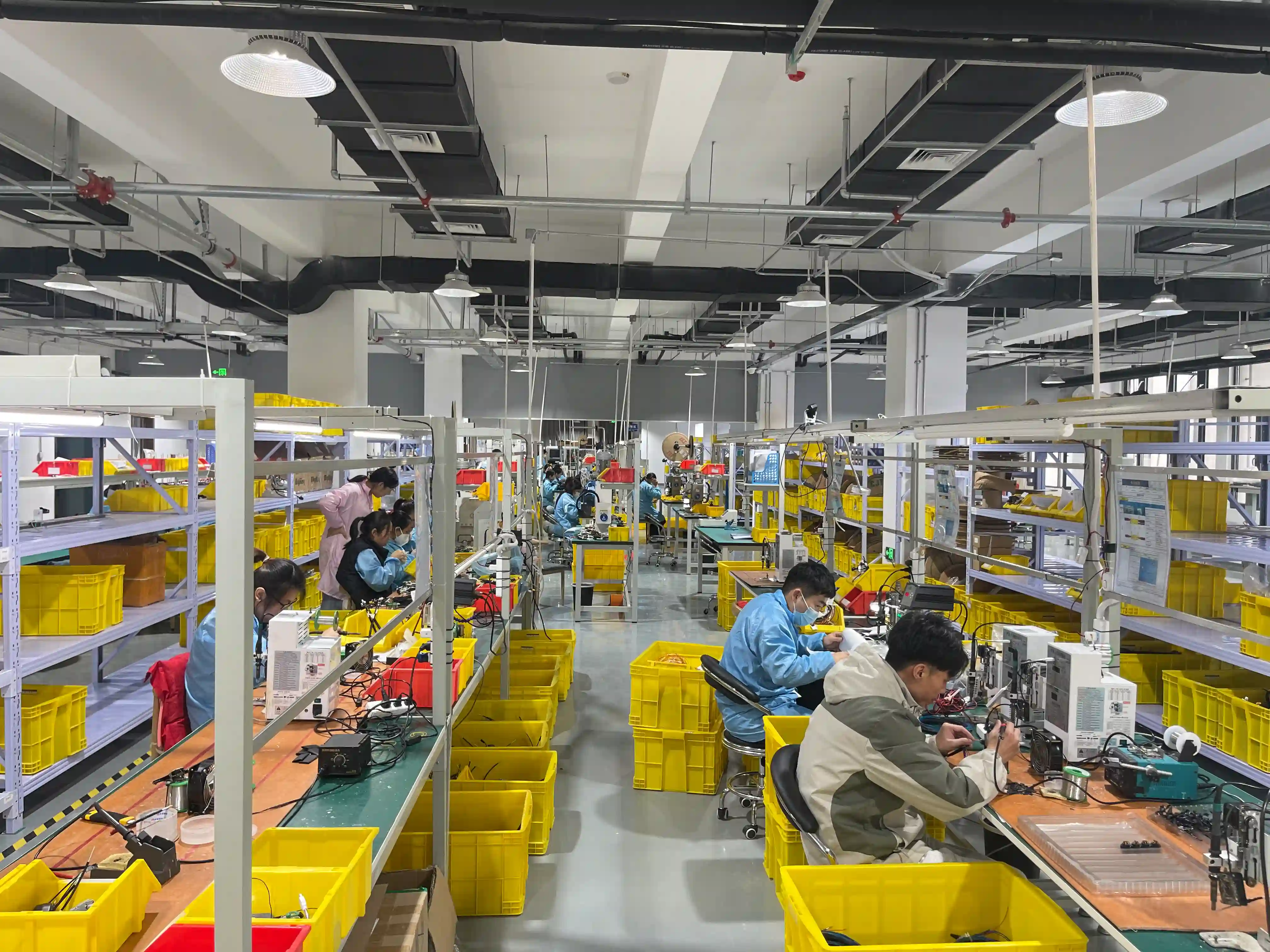
Project Overview
This representative project illustrates how we approach a challenging premium-EV program: design and manufacture the complete battery pack wiring harness for their next-generation 800V platform. The harness would connect 96 battery cells to the Battery Management System (BMS), handle power distribution at up to 350kW, and integrate thermal sensing and safety interlock systems—all within tight weight and space constraints.
Project At-a-Glance
800V
Battery voltage
350kW
Peak power capacity
96
Battery cell connections
High
Annual production volume
This representative engineering scenario documents common technical challenges, possible design responses, and lessons across a multi-phase development and launch process. For suppliers entering the EV wire harness market, this project illustrates both the opportunities and complexities of high-voltage battery applications.
Technical Challenges
The 800V battery pack harness presented several significant engineering challenges that exceeded typical automotive harness complexity. Understanding these challenges is essential for any supplier considering high-voltage EV projects.
Challenge 1: High Voltage Insulation
800V systems require 1500V rated insulation with enhanced creepage and clearance distances. Standard automotive wire (600V) is inadequate. We needed cables meeting LV216 requirements with silicone insulation rated for 150°C continuous operation.
Challenge 2: Thermal Management
Peak charging at 350kW generates significant heat. Cables carrying 500A+ require careful derating. The harness must survive -40°C to +85°C ambient while cables reach 125°C during fast charging.
Challenge 3: Safety Interlock System
ISO 26262 ASIL-C functional safety requirements mandated redundant interlock circuits with sub-millisecond response. Any connector unmating must cut HV power in under 20ms before arc hazard occurs.
Challenge 4: Cell Sensing Accuracy
BMS requires individual cell voltage monitoring to ±2mV accuracy and temperature sensing to ±0.5°C. 96 sensing circuits must resist EMI from the adjacent high-power conductors.
Additional Constraints:
- Weight budget: Maximum 3.8 kg for complete harness assembly
- IP67 sealing: Battery pack operates in underbody location exposed to water/dust
- 15-year service life: Thermal cycling, vibration, and humidity exposure over 300,000 km
- Production scalability: Design for automated assembly to support high-volume annual production
Design Solution
After extensive prototyping and simulation, we developed a modular harness architecture that addressed all technical requirements while enabling efficient manufacturing.
| Harness Section | Function | Key Specifications |
|---|---|---|
| HV Power Harness | Main power distribution from battery to inverter | 25mm² aluminum, 1500V insulation, shielded |
| Cell Sense Harness | Individual cell voltage and temperature monitoring | 96× twisted pair, 0.35mm², noise-filtered |
| Interlock Harness | Safety interlock loop through all HV connectors | Dual redundant, 0.5mm², sealed connectors |
| Thermal Sensor Harness | NTC thermistor network throughout pack | 12× sensors, ±0.5°C accuracy, shielded |
| BMS Communication | CAN bus to vehicle network | Shielded twisted pair, terminated at pack boundary |
Cable selection followed the principles outlined in our wire selection guide, with additional considerations for high-voltage applications detailed in our EV high-voltage cable guide.
Thermal Management Solutions
Thermal management was perhaps the most complex engineering challenge. During fast charging at 350kW, the main power cables carry over 400A, generating substantial resistive heating. Combined with cell heat generation and restricted airflow inside the battery pack enclosure, the thermal environment is extreme.
Thermal Design Approach:
- Cable Sizing for Derating: Selected 25mm² aluminum (versus 16mm² minimum calculated) to account for elevated ambient and bundled cable derating, keeping peak temperature below 125°C
- Thermal Interface Routing: Routed HV cables along the pack's cooling plate where possible to conduct heat away from cables to thermal management system
- Silicone Insulation: Used 150°C continuous rated silicone insulation instead of standard XLPE (90°C) for all HV conductors
- Connector Thermal Class: Selected HV connectors rated for 140°C to provide margin above cable insulation limits
125°C
Peak cable temperature during fast charge
-40°C
Minimum operating temperature (cold start)
165°C
Thermal cycling test range (ΔT)
Routing optimization played a critical role in thermal management. See our routing optimization guide for techniques applicable to thermal-sensitive applications.
Safety Interlock System Design
The safety interlock system required ISO 26262 ASIL-C compliance—a stringent functional safety standard that demands redundancy, fault detection, and rigorous verification. This was new territory for our engineering team, requiring collaboration with the OEM's functional safety engineers throughout development.
ASIL-C Requirements for Interlock System
- • Single point fault tolerance (no single failure can prevent safe state)
- • Detection of 99% of faults within one operating cycle
- • Response time under 20ms from fault detection to HV cutoff
- • Documented failure mode and effects analysis (FMEA)
- • Full traceability from requirements through verification
Interlock Implementation:
Primary Loop (Active Low)
- Continuous current loop through all HV connectors
- Any connector unmating breaks loop
- BMS detects loss within 5ms
- Contactor opens within 15ms additional
Secondary Loop (Active High)
- Redundant monitoring via separate conductor
- Inverted logic for fault discrimination
- Cross-check between loops at startup
- Dedicated fault indication to BMS
The dual-loop interlock design ensures that even if one loop has a wiring fault (short or open), the other loop detects the anomaly and triggers safe state. This redundancy was essential to achieving ASIL-C classification.
Manufacturing Process Development
Scaling from prototype builds to high-volume annual production required significant investment in process development, tooling, and quality systems. High-voltage harness manufacturing demands precision and traceability beyond standard automotive levels.
| Process Step | Equipment/Method | Quality Control |
|---|---|---|
| Wire Cutting | Automated measure-cut with laser marking | ±0.5mm length tolerance verified |
| Stripping | Precision rotary strippers for silicone insulation | Vision inspection for conductor damage |
| Termination | Ultrasonic welding (aluminum) / crimping (copper) | 100% pull test + cross-section analysis |
| HV Connector Assembly | Semi-automated with torque-controlled tooling | Torque recorded + visual verification |
| Harness Assembly | Form board assembly with poka-yoke fixtures | Routing path verification |
| Final Test | Automated test station with HV isolation test | 100% continuity + hipot + insulation |
Our manufacturing processes follow IPC/WHMA-A-620 Class 3 workmanship standards and incorporate lean manufacturing principles to achieve both quality and cost targets.
Testing & Validation Protocol
The testing protocol for this project exceeded standard automotive harness validation due to the high-voltage safety requirements and ISO 26262 compliance. Every harness undergoes production testing, while design validation included extensive environmental and life testing.
100% Production Tests
- Continuity test (all circuits, <50mΩ)
- HV insulation resistance (>100MΩ @ 1000VDC)
- Hipot test (2500VAC, 60s, no breakdown)
- Interlock loop functionality verification
- Visual inspection per IPC-620 Class 3
Design Validation Tests
- Thermal cycling (1000 cycles, -40°C to +125°C)
- Vibration (random, 10-2000Hz, 50hrs per axis)
- Humidity aging (85°C/85%RH, 1000hrs)
- Current cycling (500A, 10000 cycles)
- Connector mating cycle (500 cycles minimum)
For a complete overview of harness testing methodologies, see our detailed wire harness testing guide.
Illustrative Outcomes
In a program of this type, the release package should document design verification, production controls, test limits, traceability, and the customer's functional-safety requirements.
Representative Release Evidence
Design
Weight and routing checked against customer targets
Test
Electrical and environmental verification documented
Trace
Component and process records linked to production lots
Programs of this kind often lead to follow-on work on next-generation battery platforms, reflecting the value of proven high-voltage harness capabilities.
Key Lessons Learned
This project provided valuable insights that we now apply to all HV harness development programs.
1. Engage Functional Safety Early
ISO 26262 requirements affect harness architecture fundamentally. Retrofitting functional safety onto an existing design is expensive and rarely successful. Include functional safety engineers from concept phase.
2. Over-spec Thermal Design
Battery pack thermal conditions are difficult to predict accurately in early development. Building margin into cable sizing and insulation ratings prevents late-stage redesigns when actual thermal data becomes available.
3. Prototype Production Processes, Not Just Products
Building working prototypes is only half the challenge. Production process validation requires equal attention. Test manufacturing feasibility early with production-intent tooling and operators, not engineering technicians.
4. Traceability is Non-Negotiable
Every component in a safety-critical HV harness must be traceable to raw material lot and production date. Invest in data systems early—adding traceability after production start is disruptive and expensive.
Frequently Asked Questions
What voltage rating is required for 800V EV battery harnesses?
800V battery systems require cables with 1500V rated insulation to provide adequate safety margin. Standard 600V automotive wire is not acceptable. The insulation must meet LV216 or equivalent high-voltage automotive standards with appropriate creepage and clearance distances.
What is an interlock loop in EV battery harnesses?
The interlock loop is a low-voltage circuit that passes through all high-voltage connectors. When any HV connector is unmated, the loop breaks, signaling the Battery Management System to open the main contactors and de-energize the HV system before personnel can contact live conductors. This is a critical safety feature required by automotive safety standards.
Why use aluminum instead of copper for HV power cables?
Aluminum is 65% lighter than copper for equivalent conductivity, making it attractive for weight-sensitive EV applications. While aluminum requires larger cable diameter and special termination techniques (ultrasonic welding vs. crimping), the weight savings are significant in high-power cables where cross-sections are large. See our EV cable guide for more details.
What is ASIL-C and why does it apply to battery harnesses?
ASIL (Automotive Safety Integrity Level) is part of ISO 26262 functional safety standard. ASIL-C is the second highest level, requiring designs that tolerate single-point faults without creating safety hazards. Battery harness interlock systems typically require ASIL-C because failure could result in electric shock to service personnel or first responders.
How are high-voltage harness connections tested?
HV harness testing includes: continuity verification of all circuits, insulation resistance measurement (typically >100MΩ at 1000VDC), high-potential (hipot) testing at 2500VAC or higher, and functional verification of interlock circuits. Production testing is 100%; design validation includes additional environmental stress testing (thermal cycling, vibration, humidity). See our testing methods guide for more information.
Related Resources
About This Profile
This article is an illustrative engineering profile prepared by the OurPCB Engineering Team. It is not presented as a named-customer result or as evidence of specific field-performance outcomes.