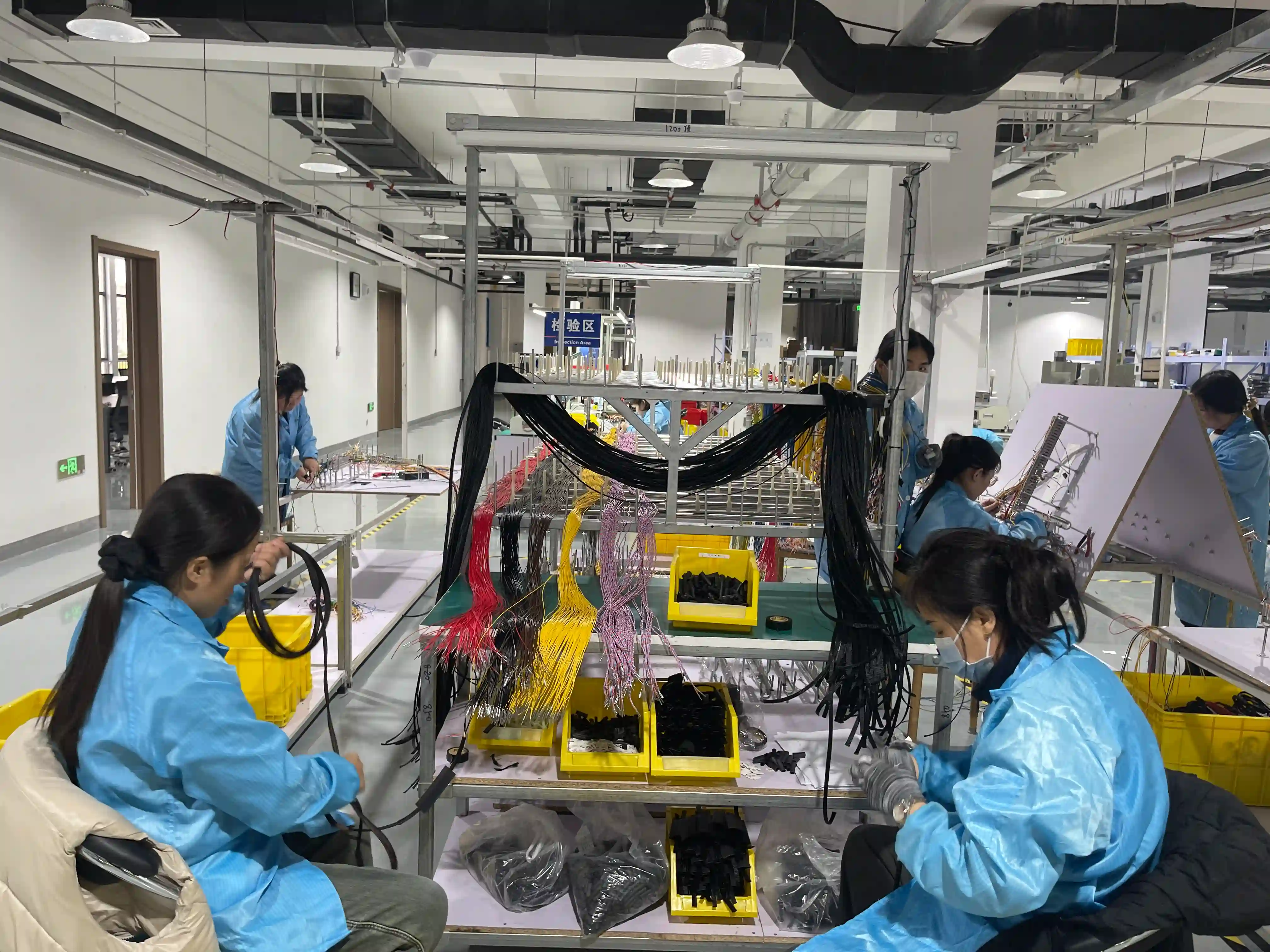
The automotive wire harness—once considered the "nervous system" of vehicles—is undergoing a revolutionary transformation. Electrification, autonomy, and connectivity are fundamentally changing how vehicles are wired, creating both challenges and opportunities for harness suppliers who can adapt.
In 2025, these changes accelerate further. The transition from 400V to 800V architectures, the shift from domain-based to zonal E/E topologies, and the explosion of sensor and data connections for ADAS are reshaping every aspect of automotive wire harness design and manufacturing.
Automotive Wire Harness Market 2025
$75B
Global market value
6.2%
Annual growth rate (CAGR)
5+ km
Average wire per luxury EV
EV harness premium
EVs use 2-3× more copper than ICE vehicles
ECU consolidation
100+ ECUs reduced to 3-5 zonal computers
800V Architecture Becomes the Premium Standard
The transition from 400V to 800V battery architecture has moved beyond early adopters like Porsche Taycan and Hyundai Ioniq 5. By 2025, virtually every new premium EV platform launches with 800V capability, driven by the compelling advantages in charging speed and efficiency.
| Parameter | 400V System | 800V System | Impact |
|---|---|---|---|
| Peak Charging Power | 150-250 kW | 350-500+ kW | 2× faster charging |
| Current for Same Power | 500A @ 200kW | 250A @ 200kW | 50% less current |
| Cable Gauge (DC Fast) | 35-50mm² | 16-25mm² | Smaller, lighter cables |
| Transmission Losses | Baseline | ~50% reduction | Better efficiency |
| Insulation Rating | 600V standard | 1000-1500V required | New cable specs |
| Connector Requirements | Standard HV | Enhanced safety | New interlock systems |
For harness suppliers, the 800V transition demands new cable specifications, upgraded connector systems with enhanced arc protection, and rigorous testing protocols. Learn more about high-voltage cable requirements in our comprehensive EV high-voltage cable guide.
"The 800V transition is like the shift from carburetors to fuel injection—inevitable and irreversible. Suppliers who don't invest in high-voltage manufacturing capabilities now will find themselves locked out of premium EV programs by 2026. We're already seeing OEMs require 800V capability as a prerequisite for new platform bids."
— OurPCB Engineering Team
Case Study: 800V Battery Pack Harness
See how we designed and manufactured high-voltage harnesses for an 800V EV battery pack, addressing thermal management, safety interlock systems, and production scaling challenges in our detailed EV battery harness case study.
Zonal E/E Architecture Transforms Wiring Topology
Perhaps the most significant architectural change in automotive electrical systems is the transition from domain-based to zonal E/E architecture. Traditional vehicles organized ECUs by function (powertrain, body, chassis, ADAS)—each with dedicated harness branches radiating to sensors and actuators throughout the vehicle.
Zonal architecture instead organizes by physical location. Three to five zonal computers (ZCs) manage all functions within their physical zone, connecting to a central vehicle computer via high-speed backbone. This fundamentally changes harness topology from a star to a more distributed mesh.
Domain Architecture (Legacy)
- •80-120+ ECUs per vehicle
- •Point-to-point wiring to each ECU
- •Complex harness with many branches
- •2-4 km of wiring typical
- •40-60 kg harness weight
- •Multiple gateway ECUs
Zonal Architecture (Future)
- 3-5 zonal computers + central compute
- Local connections within each zone
- Simplified trunk harness structure
- 30-50% weight reduction potential
- Ethernet backbone (up to 10Gbps)
- Modular production and service
Supplier Implications
Zonal architecture shifts value from harness assembly to zonal computer modules. Traditional harness suppliers must evolve from "cut, strip, and crimp" to provide integrated zone modules with embedded electronics—or risk becoming commoditized component providers.
For suppliers, this transition requires new capabilities in electronics integration, high-speed data cable manufacturing, and modular harness design. Our wire harness design guide covers modern design methodologies that support modular architectures.
High-Speed Data Networks Replace Legacy Buses
Autonomous driving, infotainment systems, and connected vehicle services generate unprecedented data volumes. The traditional automotive network stack—CAN (500 kbps), LIN (20 kbps), and FlexRay (10 Mbps)—cannot meet the bandwidth demands of Level 3+ autonomy and 8K displays.
| Network Type | Speed | Cable Type | Application |
|---|---|---|---|
| LIN | 20 kbps | Single wire | Seat, mirror, sensor modules |
| CAN/CAN-FD | 1-5 Mbps | Twisted pair | Powertrain, chassis, body |
| 100BASE-T1 | 100 Mbps | Shielded twisted pair | ADAS sensors, diagnostics |
| 1000BASE-T1 | 1 Gbps | Single twisted pair | Camera data, zonal backbone |
| 10GBASE-T1 | 10 Gbps | High-speed twisted pair | Central compute trunk |
| GMSL/FPD-Link | 4-12 Gbps | Coaxial / STP | High-res camera, display links |
High-Speed Cable Manufacturing Challenges:
- Signal Integrity: Precise impedance control (100Ω ±5%) throughout the cable and connector system to prevent reflections and data errors
- EMC Performance: Comprehensive shielding to meet automotive EMC standards (CISPR 25) while maintaining cable flexibility
- Connector Systems: High-frequency connectors rated for automotive environments (-40°C to +125°C, vibration, sealed)
- Process Control: Advanced testing beyond continuity—S-parameter validation, eye diagram analysis, BER testing
High-speed data cable manufacturing demands precision that exceeds traditional wire harness production. Learn about the quality requirements in our IPC/WHMA-A-620 standards guide.
ADAS/AD Sensor Integration Drives Complexity
Advanced driver assistance systems (ADAS) and autonomous driving (AD) features require an explosion of sensors—cameras, radar, LiDAR, ultrasonics—each with specific wiring requirements for power, data, and environmental sealing.
Typical L2+ ADAS Sensor Suite
- 8-12 cameras (surround view, forward facing)
- 5-8 radar units (corner, front, rear)
- 12+ ultrasonic sensors (parking assist)
- Multiple in-cabin monitoring cameras
L4/L5 AD Sensor Suite
- 15-20+ cameras (perception, mapping)
- 3-5 LiDAR units (360° coverage)
- 6-10 radar units (redundancy)
- V2X antennas (communication)
- High-precision GPS/IMU
Each sensor type has unique wiring requirements. LiDAR units demand high-power connections (10-50W) plus high-speed data links. Cameras need clean power for image quality. Radar requires careful routing to avoid interference. The harness design must accommodate all these requirements while meeting weight, cost, and assembly constraints.
ADAS integration is a complex wiring challenge because each sensor type has different data, power, and environmental sealing requirements. The complete system must operate reliably, and many programs require ISO 26262 functional safety documentation down to the wire harness level.
Proper cable routing is essential for ADAS reliability. Our routing optimization guide covers techniques for managing complex sensor harness layouts.
Weight Reduction Becomes Non-Negotiable
Every kilogram of vehicle weight impacts EV range, performance, and battery cost. With wire harnesses weighing 40-80 kg in traditional vehicles—and potentially more in sensor-rich EVs—weight reduction is a primary engineering focus.
Weight Reduction Strategies:
40-60 kg
Traditional ICE harness weight
60-80+ kg
Current EV harness weight
30-40 kg
Zonal architecture target
Weight reduction must balance against cost, manufacturability, and reliability. Our cost reduction strategies article covers how to optimize designs without sacrificing quality.
Regional Supply Chain Restructuring
Pandemic disruptions, geopolitical tensions, and new regulations are reshaping automotive supply chains. Wire harness manufacturing—traditionally dominated by low-cost labor regions—is increasingly moving closer to final assembly plants.
| Factor | Traditional Model | 2025 Trend |
|---|---|---|
| Manufacturing Location | Concentrated in low-cost regions | Regional hubs near OEM plants |
| Labor Strategy | Maximize labor arbitrage | Automation + skilled labor balance |
| Inventory Model | Just-in-time, global sourcing | Just-in-case, regional redundancy |
| Content Requirements | None / voluntary | Regional content mandates (IRA, EU regs) |
| Carbon Footprint | Secondary concern | Tracked and reported (Scope 3) |
The U.S. Inflation Reduction Act (IRA) requires significant North American content for EV tax credit eligibility, directly impacting battery pack and HV harness sourcing. European regulations on carbon footprint reporting incentivize regional manufacturing to reduce transportation emissions.
Our Regional Capabilities
We maintain manufacturing facilities in key regions to support OEM localization requirements. Whether you need harnesses produced in Asia for global efficiency or regional production for IRA compliance, our network can meet your sourcing needs. Contact us about our automotive wire harness solutions.
Architecture Comparison: Legacy vs. Next-Gen
| Attribute | 2020 ICE Vehicle | 2025 Premium EV | 2027+ Zonal EV |
|---|---|---|---|
| ECU Count | 70-100 | 100-150 | 5-10 |
| Voltage Architecture | 12V only | 400V/800V + 12V | 800V + 48V + 12V |
| Network Backbone | CAN, LIN | CAN-FD, 100Mbps Ethernet | 10Gbps Ethernet |
| Harness Weight | 40-50 kg | 60-80 kg | 30-40 kg (target) |
| Wire Length | 2-3 km | 4-5 km | 2-3 km |
| Connector Count | 1,500-2,000 | 2,000-3,000 | 1,000-1,500 |
"The automotive harness industry is at an inflection point. Suppliers who view these trends as threats will struggle. Those who see them as opportunities—investing in high-voltage capabilities, high-speed data expertise, and modular manufacturing—will thrive. The winners will be those who can deliver complete zone modules, not just cable bundles."
— OurPCB Engineering Team
Frequently Asked Questions
What is zonal E/E architecture in automotive?
Zonal electrical/electronic (E/E) architecture organizes vehicle computing by physical location rather than function. Instead of separate ECUs for powertrain, body, chassis, and ADAS, 3-5 zonal computers manage all functions within their physical zone (front-left, front-right, rear, etc.), connected by a high-speed backbone to a central vehicle computer. This reduces wiring complexity, weight, and cost while enabling software-defined vehicle features.
Why are EVs moving from 400V to 800V systems?
800V systems enable faster DC charging (350kW+ vs 150-250kW), reduce current for the same power level (enabling smaller cables), and improve overall system efficiency through reduced transmission losses. While 800V adds complexity in insulation and safety requirements, the charging speed advantage is compelling for premium EVs. See our detailed EV high-voltage cable comparison.
What is automotive Ethernet and why does it matter for harnesses?
Automotive Ethernet (100BASE-T1, 1000BASE-T1, 10GBASE-T1) provides the high bandwidth needed for ADAS cameras, displays, and zonal architecture communication. Unlike IT Ethernet, automotive variants use single twisted pair cables rated for extreme temperatures and vibration. Harness suppliers must ensure precise impedance control and proper shielding for reliable data transmission.
How does the Inflation Reduction Act affect wire harness sourcing?
The IRA requires increasing percentages of battery component value (including high-voltage harnesses) to be sourced from North America or FTA countries for EV tax credit eligibility. This is accelerating investment in regional harness manufacturing capacity and reshaping supply chains that previously centered on low-cost labor regions.
Will aluminum replace copper in automotive wiring?
Aluminum is increasingly used in high-current applications where its 65% weight advantage outweighs its larger diameter requirement. It's common in battery interconnects and some main power distribution. However, copper remains dominant for signal wiring, high-flex applications, and termination reliability. Most vehicles will use both materials strategically based on application requirements.
Related Resources
EV High-Voltage Cables
Complete guide to 400V vs 800V cable construction, shielding, and standards.
Read article800V Battery Harness Case Study
Real-world design and manufacturing of EV battery pack harnesses.
Read articleAutomotive Harness Solutions
Our comprehensive automotive wire harness capabilities and certifications.
Learn moreAbout the Author
OurPCB Engineering Team brings over 15 years of combined experience in automotive cable assembly design and manufacturing. The team tracks industry trends closely and helps OEM customers navigate the transition to electric and autonomous vehicle platforms.