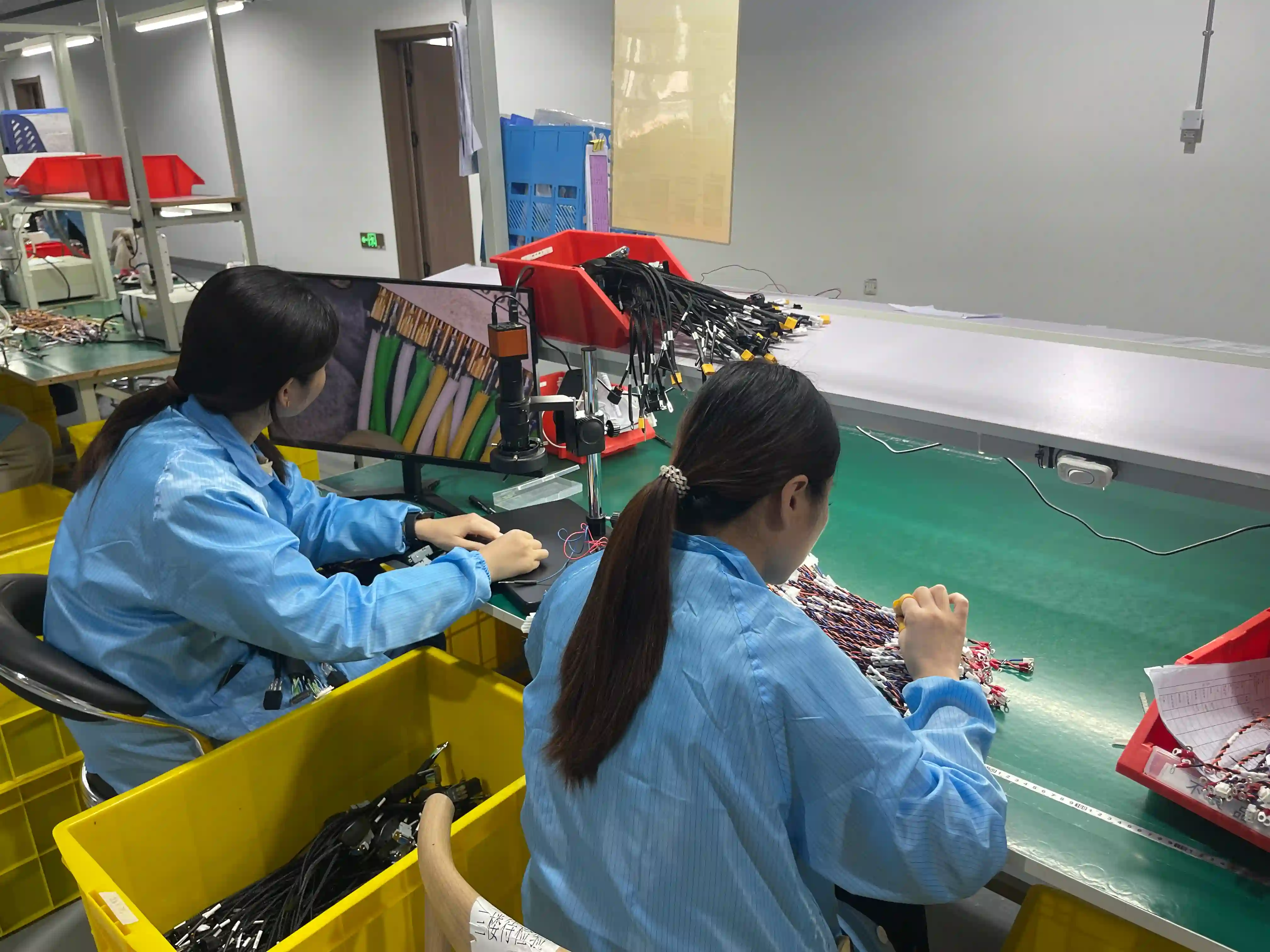
A low-PPM defect rate can still produce a meaningful number of field failures across high annual harness volumes. Each escape can stop a vehicle, disrupt a medical device, or halt industrial equipment.
For industry reference, see cable harness and IPC standards.
Testing is not just a production checkbox. A sound test plan requires understanding why each test matters, not just how to run it.
In This Article
Why Wire Harness Testing Matters More Than Ever
Modern vehicles contain 40+ kilometers of wiring and 3,000+ individual circuits. Medical devices rely on harnesses for life-critical functions. Aerospace systems can't exactly pull over when something fails at 35,000 feet.
The complexity has exploded, but tolerance for failure has dropped to zero. Our China manufacturing entity (Hebei Cloom) holds an ISO 9001-certified quality system with multiple test stations, under IATF 16949. Here are the seven testing methods that actually matter.
1. Continuity Testing: The Foundation of Electrical Verification
If there's one test you absolutely cannot skip, it's continuity. This simple but critical test verifies that electrical current can flow through each circuit—confirming that every wire is connected where it should be, with no breaks, shorts, or mis-wires.
What Continuity Testing Catches
- Open circuits — Broken wires, unterminated connections
- Short circuits — Wires touching where they shouldn't
- Mis-wires — Correct wires in wrong positions
- High resistance joints — Poor crimps, cold solder joints
Test Parameters
| Parameter | Typical Value | Notes |
|---|---|---|
| Test Current | 10-100 mA | Low current prevents damage |
| Pass Threshold | <10Ω (typical) | Varies by wire length/gauge |
| Test Speed | 50-500 points/second | Automated systems |
| Failure Mode | Open >1MΩ, Short <10Ω | Between non-connected circuits |
Our continuity testing stations check every single circuit—100% inspection, no sampling. For a 50-circuit harness, that's 1,225 potential short circuit combinations we're verifying in under 3 seconds.
2. HiPot (High Potential) Testing: Insulation Integrity Under Stress
Continuity tells you electricity flows where it should. HiPot testing tells you it doesn't flow where it shouldn't—even under extreme voltage stress. We apply high voltage (typically 500-1500 VDC) between isolated circuits and monitor for leakage current.
Why HiPot Testing is Critical
A wire might pass continuity testing perfectly while having microscopic insulation damage that'll fail six months into service. HiPot testing finds these latent defects before they become field failures—pinhole damage, contamination, improper stripping that nicked the insulation.
| Application | Test Voltage | Max Leakage | Duration |
|---|---|---|---|
| Low Voltage Harness | 500 VDC | <5 µA | 1 second |
| Automotive Standard | 1000 VDC | <5 µA | 1-2 seconds |
| Medical Grade | 1500 VAC | <0.5 mA | 60 seconds |
| EV High Voltage | 2500 VDC | <10 µA | 1 second |
A harness can pass continuity while damaged insulation remains invisible to visual inspection. HiPot testing exposes dielectric weaknesses that continuity testing cannot detect.
3. Insulation Resistance (IR) Testing: Quantifying Insulation Quality
While HiPot is a pass/fail stress test, insulation resistance (IR) testing provides a quantitative measurement of insulation quality. We apply a lower voltage (typically 500V) and measure the actual resistance between isolated conductors—usually looking for values in the megohm or gigohm range.
IR Testing vs. HiPot: What's the Difference?
IR Testing
- • Measures actual resistance value
- • Lower voltage (250-1000V)
- • Quantitative result (MΩ/GΩ)
- • Tracks degradation over time
- • Non-destructive measurement
HiPot Testing
- • Pass/fail stress test
- • Higher voltage (1000-2500V)
- • Binary result (pass/fail)
- • Finds latent defects
- • More aggressive screening
For high-voltage EV harnesses, we run both tests. IR testing during incoming inspection establishes a baseline, and HiPot testing after assembly confirms nothing was damaged during manufacturing.
4. Pull Force Testing: Mechanical Integrity Verification
Electrical tests verify the connection works. Pull force testing verifies it'll stay working under mechanical stress. We apply calibrated tension to crimped terminals and measure the force required to cause separation or wire pullout.
USCAR-21 Pull Force Requirements
The automotive industry follows USCAR-21 standards for crimp validation. Here's what that looks like in practice:
| Wire Gauge (AWG) | Min Pull Force (N) | Min Pull Force (lbf) | Test Rate |
|---|---|---|---|
| 22 AWG | 22 N | 5.0 lbf | 100 mm/min |
| 20 AWG | 35 N | 7.9 lbf | 100 mm/min |
| 18 AWG | 50 N | 11.2 lbf | 100 mm/min |
| 16 AWG | 70 N | 15.7 lbf | 100 mm/min |
| 14 AWG | 100 N | 22.5 lbf | 100 mm/min |
| 12 AWG | 160 N | 36.0 lbf | 100 mm/min |
Pull testing is destructive—the tested samples are scrapped. That's why we use statistical process control with first-article testing and periodic sampling rather than 100% testing. For IPC/WHMA-A-620 Class 3 products, we test samples from each crimp setup and document the results.
5. Crimp Height Analysis: Real-Time Process Monitoring
If pull force testing tells you the crimp is good, crimp height analysis tells you it will be good—before you've even finished the harness. This non-destructive measurement monitors the physical dimensions of each crimp in real-time.
How Crimp Height Monitoring Works
Every terminal manufacturer specifies a target crimp height with tolerances (typically ±0.05mm). Our automated crimping machines measure every crimp and compare it to specification. Drift outside tolerance triggers an immediate stop and alert.
This catches problems the moment they start—worn tooling, incorrect terminal batch, wrong wire gauge—before you've built 500 bad harnesses. Combined with crimp force monitoring (CFM), we get a complete picture of crimp quality without destroying product.
6. Functional Testing: Real-World Simulation
Continuity and HiPot verify the harness is built correctly. Functional testing verifies it actually works in the intended application. This means connecting the harness to test loads and simulating actual operating conditions.
What Functional Testing Covers
- Load testing — Actual current draw through power circuits
- Signal integrity — For data cables and communication harnesses
- Switching operations — Relay and fuse functionality
- Sensor simulation — Resistance and voltage verification
- CAN/LIN bus communication — For automotive harnesses
For complex automotive harnesses, functional testing might involve dozens of simulated sensor inputs and verification of proper voltage at each output. For medical device cables, it includes leakage current testing to patient safety standards.
7. Environmental Testing: Surviving the Real World
A harness that tests perfectly at room temperature might fail catastrophically at -40°C or after 1,000 hours of humidity exposure. Environmental testing subjects harnesses to the conditions they'll face in service—and verifies they survive.
| Test Type | Conditions | Duration | Purpose |
|---|---|---|---|
| Thermal Cycling | -40°C to +125°C | 100-500 cycles | Temperature stress |
| Humidity | 85°C, 85% RH | 500-1000 hours | Moisture resistance |
| Salt Spray | 5% NaCl, 35°C | 48-500 hours | Corrosion resistance |
| Vibration | 10-2000 Hz sweep | Per customer spec | Mechanical fatigue |
| Flex Life | ±90° bend | 10K-10M cycles | Cable durability |
Environmental testing is typically done during design validation (PPAP for automotive), not 100% production testing. But for IP67-rated waterproof harnesses, we do run sample immersion tests from each production lot.
Wire Harness Testing Methods: Complete Comparison
| Test Method | What It Finds | Destructive? | 100% Test? | IPC Class 3 |
|---|---|---|---|---|
| Continuity | Opens, shorts, miswires | No | Yes | Required |
| HiPot | Insulation defects | No* | Yes | Required |
| IR Testing | Insulation quality | No | Optional | As specified |
| Pull Force | Crimp strength | Yes | No (sample) | Required |
| Crimp Height | Crimp dimension | No | Yes | Required |
| Functional | Operational issues | No | Optional | As specified |
| Environmental | Long-term reliability | Yes** | No (validation) | Per customer |
* HiPot can degrade insulation if overapplied. ** Environmental test samples are typically not used in production.
IPC/WHMA-A-620 Testing Requirements by Class
IPC/WHMA-A-620 defines three product classes with increasing testing requirements:
1Class 1 - General
Consumer electronics, non-critical applications
- • Continuity: Required
- • Visual: Workmanship
- • Pull test: Per drawing
2Class 2 - Dedicated
Industrial equipment, commercial products
- • All Class 1 tests
- • HiPot: Often required
- • Pull test: Per setup
3Class 3 - High Reliability
Aerospace, medical, military applications
- • All Class 1 & 2 tests
- • 100% HiPot required
- • Pull test: Documented
- • Crimp height: Monitored
A test plan should address safety-critical failure modes, not only convenient checks. Continuity verifies circuit mapping, while dielectric testing is needed to reveal insulation damage that visual inspection can miss.
"7 Essential Wire Harness Testing Methods: From Continuity to Environmental Testing only becomes production-ready after measurable validation. That usually means 100% continuity, a defined insulation threshold such as 500 VDC, and one application-specific check tied to IEC 60529, UL, or the customer's own spec."
Frequently Asked Questions
Do you test every harness or just samples?
Electrical tests (continuity, HiPot) are 100%—every harness gets tested. Mechanical tests (pull force) are destructive, so we use statistical sampling per IPC-A-620 requirements. Crimp height monitoring is 100% on automated equipment.
What test equipment do you use?
Our primary electrical testers are Cirris and CableEye systems capable of testing up to 1,024 points with HiPot up to 1500VDC. Pull testers are Mecmesin units with calibrated load cells. All equipment is calibrated annually per ISO 9001 requirements.
Can you provide test reports with each shipment?
Yes, we provide test data documentation as part of our standard quality package. For automotive and aerospace customers, we can provide individual test records with serial number traceability.
What if my harness fails testing?
Failures are segregated immediately and analyzed to determine root cause. For continuity failures, we often can repair and retest. HiPot failures typically mean scrapping the harness. Either way, we investigate the cause to prevent recurrence—that's how we maintain our <50 PPM defect rate.
How quickly can you test custom harnesses?
Custom test fixture development typically takes 3-5 days for complex harnesses, faster for simple point-to-point cables. Our 48-hour prototype service is available for standard, ready-to-build designs with available materials; exact timing is confirmed at quote and includes basic electrical verification.
Building Quality Into Every Connection
Testing isn't something we do at the end of production—it's woven throughout our entire manufacturing process. From incoming wire inspection to final electrical verification, every step is designed to catch problems before they become your problems.
The seven testing methods covered here—continuity, HiPot, insulation resistance, pull force, crimp height, functional, and environmental—form a comprehensive quality assurance system that keeps our defect rate below 50 PPM.
Need harnesses built to the highest testing standards? Whether you're targeting IPC Class 3 for aerospace or IATF 16949 for automotive, we have the testing capabilities to match your requirements.
Related Resources
About OurPCB Engineering Team
OurPCB Engineering Team brings 15+ years of combined experience in connector engineering and quality systems. The team oversees our testing protocols and leads continuous improvement initiatives that have driven our defect rate below 50 PPM.