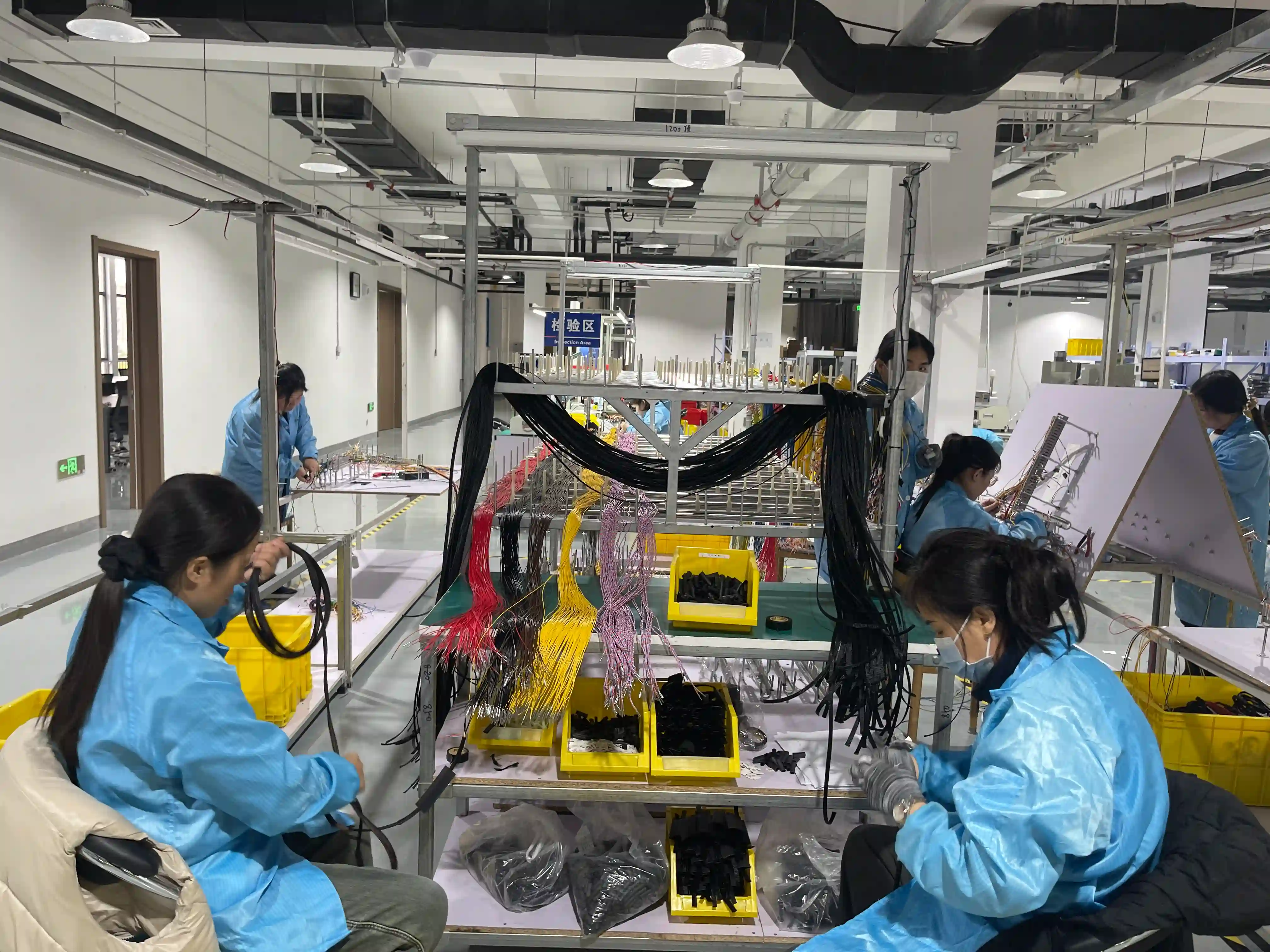
Every wire harness operates inside a hostile environment. Engine bays reach 150°C. Factory floors expose cables to cutting oil and metal chips. Agricultural equipment drags harnesses through mud and gravel. Without the right protective covering, copper conductors abrade through insulation in months, not years.
The protection method you choose affects more than durability. It drives harness weight, assembly labor time, serviceability, and per-unit cost. A 30-conductor automotive engine harness wrapped in cloth tape weighs 10% less than one routed through convoluted tubing. But that same tape offers almost no cut-through resistance in an off-road application. Choosing wrong means either over-engineering (wasted cost) or under-protecting (field failures).
This guide covers the six primary protection families used in wire harness manufacturing: tape wrapping, convoluted tubing, braided sleeving, spiral wrap, heat shrink, and specialty conduit. For each method, you get material properties, temperature ratings, abrasion class, installation labor, and the specific applications where each one excels. If you need a refresher on the harness construction that sits underneath these coverings, start with our 12-step manufacturing process guide.
Of harness weight can come from protection materials in heavy-duty applications
Weight savings from cloth tape vs convoluted tubing on equivalent harness bundles
Maximum continuous temperature for high-grade PET cloth tape in engine applications
More abrasion resistance in PET braided sleeving vs standard polyester expandable sleeve
Why Wire Harness Protection Matters
Wire insulation alone cannot handle the abuse a finished harness encounters after installation. Insulation protects individual conductors from each other. Harness protection does a different job: it guards the entire bundle against the operating environment—mechanical abrasion, thermal exposure, chemical attack, and UV degradation.
The Four Threats to Unprotected Harnesses
- Abrasion: Wire bundles rubbing against sheet metal edges, brackets, or other harnesses wear through insulation in 6–18 months
- Heat: Proximity to exhaust manifolds, motors, or process equipment degrades PVC insulation above 105°C
- Chemical attack: Engine oil, brake fluid, hydraulic fluid, and cleaning solvents dissolve standard insulation materials
- UV & moisture: Outdoor-routed harnesses without UV-stabilized protection crack within 2–3 years
Protection also determines serviceability. Tape-wrapped harnesses are easy to open for rework or field repair. Convoluted tubing requires cutting and replacing an entire section. Split braided sleeving offers a middle ground—it can be opened and re-closed without destroying the covering. These factors shape total cost of ownership far beyond the initial BOM price.
Tape Wrapping: PVC, Cloth, Felt, Foam & Foil
Tape is the most widely used wire harness protection method globally. The automotive sector alone consumes millions of meters per year. Tape wrapping serves four distinct engineering functions: bundling, abrasion protection, noise damping (NVH), and EMI shielding. Each function calls for a different backing material.
| Tape Type | Backing | Temp Range | Primary Function | Typical Application |
|---|---|---|---|---|
| PVC (Vinyl) | Polyvinyl chloride | −10°C to 105°C | Bundling, spot taping | Interior harnesses, general wiring |
| Cloth (PET) | Woven polyester | −40°C to 150°C | Abrasion protection | Engine bay, underbody harnesses |
| Fleece (Felt) | Nonwoven PET | −40°C to 125°C | NVH damping | Instrument panel, door harnesses |
| Foam | PVC or PE foam | −20°C to 80°C | Rattle prevention | Harness-to-body contact points |
| Aluminum Foil | Aluminum + adhesive | −40°C to 150°C | Heat reflection, EMI shielding | Near exhaust, sensor cables |
Wrapping Techniques
Two standard wrapping patterns handle most applications. Spiral wrapping overlaps each turn by 50%, creating double-layer coverage. This method uses more tape but prevents gaps when the harness bends. Spot taping uses short pieces at intervals of 50–100mm to bundle wires without full coverage, cutting tape consumption by 60–70%. Spot taping suits interior areas with no abrasion risk; spiral wrapping is mandatory where the harness contacts metal surfaces.
Tape Wrapping Advantages
- Lowest cost per meter of any protection method
- Lightest weight—10% savings vs tubing on same harness
- Conforms to irregular bundle shapes and branch points
- Easy to open for rework or field repair
- Hand-tearable varieties eliminate tool requirements
Tape Wrapping Limitations
- Low cut-through resistance—no protection against sharp edges
- PVC adhesive degrades above 105°C and leaves residue
- Manual wrapping is labor-intensive on long harness runs
- Inconsistent coverage depends on operator technique
- Not liquid-tight—fluids wick along wrapped bundles
"We see engineers default to convoluted tubing everywhere because it feels safer. But in 70% of interior automotive harness routes, PET cloth tape delivers equal abrasion protection at half the weight. The key distinction is cut-through risk—if the harness contacts a stamped sheet metal edge, tape alone is not enough."
OurPCB Engineering Team
Convoluted Tubing (Corrugated Loom)
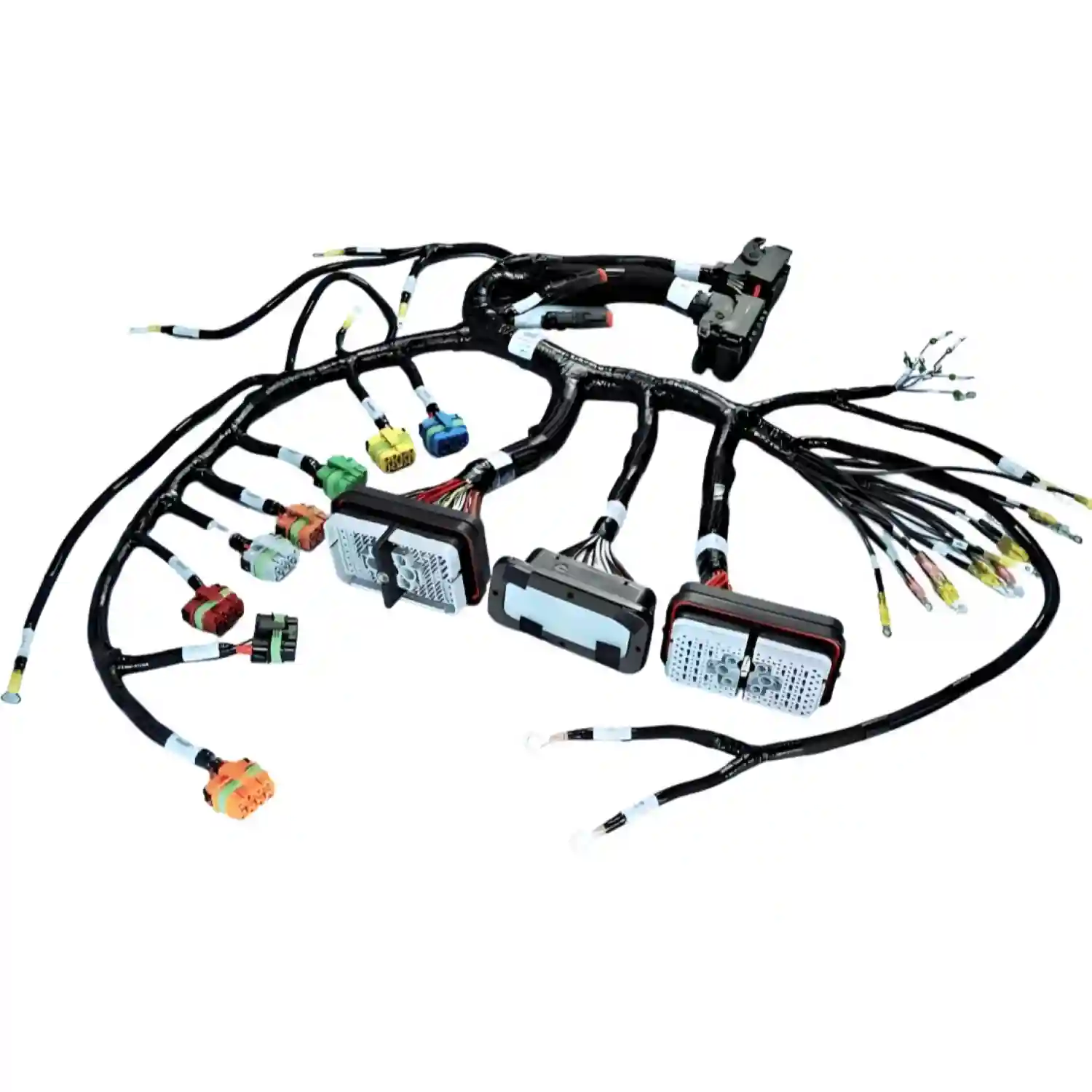
Convoluted tubing—the ribbed plastic conduit found under the hood of nearly every modern vehicle—is the most common rigid protection method for wire harnesses. Its corrugated wall structure provides high crush resistance while maintaining enough flexibility to route around engine components.
Material Options
| Material | Temp Range | Chemical Resistance | UV Resistance | Relative Cost |
|---|---|---|---|---|
| Polypropylene (PP) | −40°C to 120°C | Good (fuel, oil) | Fair | $ |
| Polyamide 6 (PA6) | −40°C to 150°C | Excellent | Good | $$ |
| Polyamide 12 (PA12) | −60°C to 150°C | Excellent (zinc chloride) | Good | $$$ |
| PVDF (Fluoropolymer) | −40°C to 175°C | Outstanding | Excellent | $$$$ |
Split vs Non-Split Convoluted Tubing
Split convoluted tubing has a longitudinal slit that allows wires to snap in from the side. Installation is fast—no need to thread wires through from one end. The trade-off is reduced liquid protection since the slit can open under pressure. Use split tubing for harness sections that need occasional service access.
Non-split (closed) tubing must be threaded over the wire bundle during harness assembly. This adds labor time but delivers full 360° protection with liquid-tight performance when combined with proper end seals. Non-split tubing is standard for underbody and engine bay harnesses where splash exposure is unavoidable.
Convoluted Tubing Advantages
- Highest crush and cut-through resistance of any covering
- Liquid-tight when sealed (non-split variants)
- Wide temperature range with PA6 and PA12 grades
- Standardized sizes (NW 4.5 to NW 95) fit any harness diameter
- Automotive OEM-approved and UL-recognized material options
Convoluted Tubing Limitations
- Heaviest option—adds significant weight to harness
- Rigid diameter makes branch points difficult to manage
- PP grades become brittle after 3–5 years of heat exposure
- Cannot conform to tight bend radii (minimum 2× OD)
- Higher material cost than tape wrapping
Braided Sleeving: PET, Nylon & Metal
Braided sleeving weaves filaments into a tubular mesh that expands to fit over connectors and contracts to grip the cable bundle. This expansion property makes braided sleeving uniquely suited to harnesses with inline connectors or varying diameters—situations where rigid tubing requires T-fittings or size transitions.
| Material | Temp Range | Abrasion Rating | Best For |
|---|---|---|---|
| PET (Polyester) | −50°C to 150°C | Excellent (300% vs standard) | Bus, truck, rail harnesses |
| Nylon (PA) | −50°C to 120°C | Good | General-purpose, data centers |
| Nomex (Aramid) | −70°C to 300°C | Outstanding | Aerospace, military |
| Stainless Steel | −70°C to 650°C | Outstanding | Exhaust-adjacent, EMI shielding |
Expandable vs Self-Closing Braided Sleeving
Expandable braided sleeving stretches open to slide over connectors and contracts to grip. Installation requires threading from one end—time-consuming on pre-terminated harnesses. This style delivers the cleanest appearance and tightest fit.
Self-closing (wrap-around) braided sleeving has an overlapping edge that wraps around the cable bundle from the side. No threading required. The overlap provides 25% coverage redundancy and allows side-entry for branches. This variant saves 40–50% installation labor on retrofit and field applications.
PET braided sleeving sees heavy use in bus, truck, and rail applications where harnesses need to flex through door hinges and articulating sections. The transportation industry favors PET braid because it maintains full flexibility at −50°C—a temperature where convoluted tubing stiffens considerably.
Spiral Wrap Tubing
Spiral wrap is a helically-cut strip of plastic that winds around a cable bundle like a barber pole. Unlike convoluted tubing, spiral wrap allows wires to enter and exit at any point along its length—a feature that makes it the default choice for harnesses with multiple breakout points or branches.
Spiral Wrap Advantages
- Multi-point cable entry and exit without fittings
- Available in polyamide (PA) and polyethylene (PE)
- Color coding for high-voltage identification (orange for HV)
- Flexible—no minimum bend radius concerns
- Reusable—can be unwound and re-applied during service
Spiral Wrap Limitations
- Gaps between wraps expose wires—not liquid-tight
- Lower crush resistance than convoluted tubing
- Time-consuming to apply on long harness runs
- Can unwind if not secured at endpoints
- Appearance is less clean than braided sleeving
Spiral wrap dominates in aerospace applications where weight savings and branch accessibility outweigh liquid protection concerns. Aircraft harness designers use polyamide spiral wrap rated to 150°C, combined with spot ties at 50mm intervals to prevent unwinding during airframe vibration.
"Spiral wrap gets dismissed for looking messy, but in harnesses with 8–12 breakout points, nothing else works as well. Try routing those breakouts through convoluted tubing—you end up with a spaghetti junction of T-fittings that weighs three times as much and takes twice as long to build."
OurPCB Engineering Team
Heat Shrink Tubing for Harness Protection
Heat shrink tubing shrinks to 50% of its original diameter when heated, creating a tight, conformal barrier around wire bundles. While more commonly associated with individual wire terminations, large-diameter heat shrink (up to 100mm+) protects entire harness sections, especially at branch points and connector transitions where other methods leave gaps.
Adhesive-lined (dual-wall) heat shrink adds a hot-melt glue layer that creates a moisture seal rated to IP67. This makes it the preferred option for sealing harness entry points in waterproof connector assemblies and transition zones between different protection methods. A common pattern: convoluted tubing along the main trunk, with adhesive heat shrink at every branch point and connector backshell.
| Heat Shrink Type | Shrink Ratio | Temp Range | Sealing | Use Case |
|---|---|---|---|---|
| Standard Polyolefin | 2:1 | −55°C to 135°C | Non-sealed | Bundling, insulation |
| Adhesive-Lined (Dual-Wall) | 3:1 or 4:1 | −55°C to 135°C | IP67 moisture seal | Branch points, connector seals |
| Fluoropolymer (PTFE/FEP) | 1.3:1 to 2:1 | −65°C to 260°C | Chemical resistant | Aerospace, mil-spec harnesses |
| Silicone Rubber | 1.7:1 | −65°C to 200°C | Flexible seal | High-temp flex applications |
Full Comparison: All Protection Methods
| Property | PVC Tape | Cloth Tape | Convoluted Tubing | Braided Sleeve | Spiral Wrap | Heat Shrink |
|---|---|---|---|---|---|---|
| Abrasion Resistance | Low | Medium | High | High | Medium | Low |
| Cut-Through Protection | None | Low | High | Medium | Low | None |
| Max Temperature | 105°C | 150°C | 175°C (PVDF) | 650°C (steel) | 150°C (PA) | 260°C (PTFE) |
| Liquid Protection | None | None | Full (sealed) | None | None | Full (adhesive) |
| Weight Impact | Minimal | Minimal | Heavy | Light | Light | Minimal |
| Install Labor | Medium | Medium | Low (split) | Medium | High | Medium |
| Serviceability | Easy | Easy | Cut & replace | Easy (self-closing) | Unwind | Cut & replace |
| Relative Cost | $ | $$ | $$–$$$ | $$–$$$$ | $ | $$ |
"Most production harnesses use two or three protection methods on different sections. The engine-side trunk gets PA6 convoluted tubing. Interior routing uses cloth tape. Branch points and connectors get adhesive heat shrink. Treating it as one decision for the whole harness is the most expensive mistake you can make."
OurPCB Engineering Team
How to Choose the Right Protection Method
Start with the operating environment, not the protection material. Answer these five questions for each harness section, then use the decision matrix below to narrow options.
5 Selection Questions
- Maximum temperature exposure? Measure the actual surface temperature at the harness routing path, not the ambient room temperature. A 25°C engine bay has 150°C zones near exhaust manifolds.
- Mechanical threat type? Abrasion against flat surfaces (tape is fine) vs sharp edge contact (needs rigid tubing) vs pinch/crush risk (convoluted tubing required).
- Fluid exposure? Splash (sealed tubing needed) vs vapor (tape acceptable) vs submersion (potted or encapsulated assembly).
- Service access requirements? Field-serviceable harnesses need tape, self-closing braid, or spiral wrap. Sealed tubing and heat shrink require cutting to access.
- Weight and cost targets? Cost-driven programs favor tape. Weight-critical applications (aerospace, EV) favor braided sleeving or spiral wrap.
Industry-Specific Recommendations
| Industry | Primary Method | Secondary Method | Reason |
|---|---|---|---|
| Automotive (Engine) | PA6 convoluted tubing | Cloth tape at branches | Heat, oil, vibration exposure |
| Automotive (Interior) | Fleece/felt tape | Foam tape at contact points | NVH damping required |
| Aerospace | Spiral wrap (PA) | Nomex braided sleeving | Weight savings, branch access |
| Bus/Truck/Rail | PET braided sleeving | Convoluted tubing at wheel wells | Flex at hinges, cold-weather flexibility |
| Industrial/Robotics | Self-closing braided sleeve | Spiral wrap at articulation | Continuous flex, service access |
| Marine/Outdoor | Sealed convoluted tubing | Adhesive heat shrink at joints | UV, salt spray, submersion |
Frequently Asked Questions
What is the cheapest wire harness protection method?
PVC vinyl tape is the lowest-cost option per meter, followed by spiral wrap tubing. PVC tape works well for general bundling and interior routing where abrasion and temperature exposure are minimal. For applications needing actual mechanical protection, polypropylene split convoluted tubing offers the best value.
Can I use convoluted tubing in an engine bay?
Yes, but only with PA6 (polyamide 6) or PA12 grade tubing rated to 150°C continuous. Polypropylene (PP) convoluted tubing—the cheapest option—becomes brittle and cracks after 3–5 years of heat cycling in engine environments. Always match the tubing material to the actual temperature at the mounting location, not the general engine bay spec.
What protection method weighs the least?
Tape wrapping (PVC or cloth) adds the least weight to a harness. PET cloth tape on a 30-conductor bundle weighs approximately 10% less than the same bundle routed through convoluted tubing. For applications where weight matters but mechanical protection is still needed, PET braided sleeving provides the best strength-to-weight ratio.
How do I protect a wire harness at branch points?
Branch points (Y-junctions) are the most vulnerable zone on any harness. The standard approach uses adhesive-lined heat shrink tubing (3:1 or 4:1 shrink ratio) to seal the transition. First tape the branch area, slide heat shrink over the junction, then shrink with a heat gun. For non-sealed applications, cloth tape wrapped in a spiral pattern over the branch provides adequate bundling and moderate abrasion protection.
Is braided sleeving better than convoluted tubing?
Each excels in different conditions. Braided sleeving outperforms convoluted tubing in flexibility, cold-temperature performance, and weight. Convoluted tubing wins on crush resistance, cut-through protection, and liquid sealing. If the harness contacts sharp edges or needs splash protection, convoluted tubing is the better choice. If the harness needs to flex through hinges or operate below −40°C, braided sleeving is superior.
What tape do automotive OEMs specify for engine harnesses?
Major automotive OEMs specify T3 (125°C) or T4 (150°C) rated PET cloth tape for engine bay harness wrapping. Brands like Tesa, Coroplast, and 3M supply tapes specifically formulated for automotive harness applications. PVC tape is only approved for interior routing where temperatures stay below 105°C. Felt/fleece tape is specified for instrument panel and door harnesses where NVH performance matters.