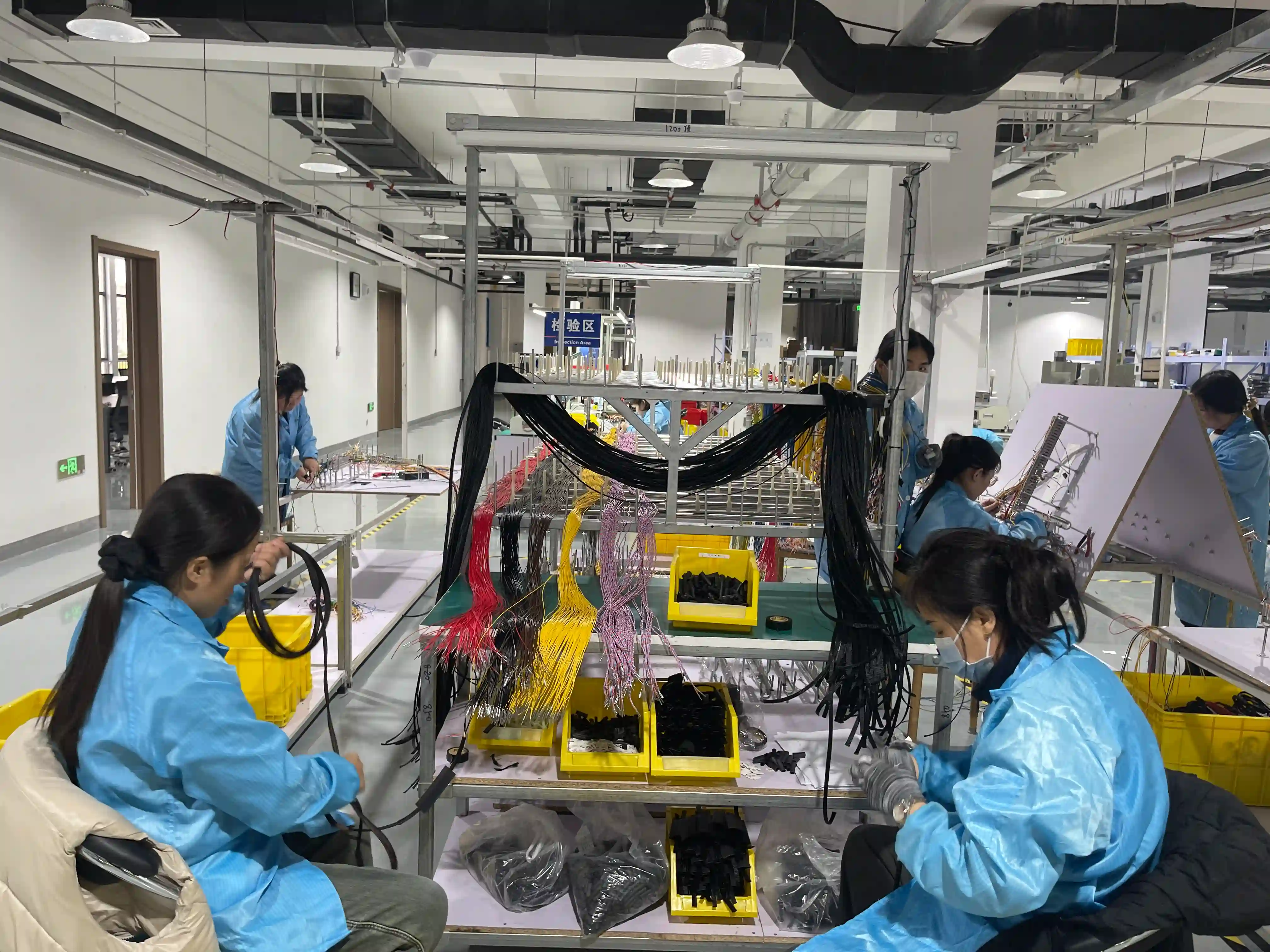
An IP67 label alone does not prove that a connector is suitable for every wet environment. Reliability depends on the actual test conditions and whether the sealing method matches the application's immersion, spray, pressure, chemical, and temperature exposure.
For industry reference, see cable harness and IPC standards.
The following sections explain the practical requirements for selecting waterproof connectors for waterproof wire harnesses and cable assemblies.
In This Article
IP Ratings Decoded: What Those Numbers Actually Mean
IP stands for "Ingress Protection"—a standardized rating system (IEC 60529) that tells you exactly how well an enclosure or connector resists dust and water. The two-digit code breaks down like this:
- First digit (0-6) — Solid particle protection (dust, debris)
- Second digit (0-9K) — Liquid ingress protection (water)
A connector rated IP68 means: "6" = completely dust-tight, "8" = protected against continuous immersion beyond 1 meter.
Dust Protection Ratings (First Digit)
| Rating | Protection Level | Description |
|---|---|---|
| 0 | None | No protection |
| 1-4 | Partial | Protection against objects >1mm to >50mm |
| 5 | Dust Protected | Limited dust ingress, won't affect operation |
| 6 | Dust Tight | Complete protection against dust |
Water Protection Ratings (Second Digit)
| Rating | Protection Level | Test Conditions |
|---|---|---|
| 0 | None | No protection |
| 1-3 | Dripping/Spraying | Vertical drips to 60° spray |
| 4 | Splash Proof | Splashing from any direction |
| 5 | Water Jet | Low pressure jets (6.3mm nozzle) |
| 6 | Powerful Jet | High pressure jets (12.5mm nozzle) |
| 7 | Immersion (1m) | 30 min at 1 meter depth |
| 8 | Immersion (>1m) | Continuous, depth per manufacturer |
| 9K | High-Pressure Steam | 80°C water at 100 bar |
IP67 vs IP68 vs IP69K: Head-to-Head Comparison
IP67
Temporary Immersion
- 1 meter for 30 minutes
- Complete dust protection
- Most cost-effective
- Not for continuous immersion
Best for: Outdoor equipment, occasional water exposure
IP68
PopularContinuous Immersion
- Beyond 1m, per manufacturer
- Extended duration submersion
- Marine applications
- Higher cost than IP67
Best for: Marine, underground, continuous water exposure
IP69K
High-Pressure Washdown
- 80°C water at 100 bar
- Steam cleaning resistant
- Food/pharma hygiene
- Premium pricing
Best for: Food processing, pharmaceutical, agriculture
"Here's what the IP rating doesn't tell you: an IP68 connector tested at 3 meters might fail at 10 meters. Or an IP67 connector might survive years of rain exposure but fail after one pressure washing. Always check the actual test conditions, not just the rating number."
OurPCB Engineering Team
4 Sealing Methods Compared: Gaskets, O-Rings, Overmolding & Potting
The IP rating is only as good as the sealing method. Here's how each approach works and when to use it:
1. O-Ring and Gasket Seals
The most common sealing method. Rubber gaskets (silicone, EPDM, neoprene) are compressed between mating surfaces to create a water-tight barrier. Effective and field-serviceable, but depends heavily on proper mating force and gasket condition.
- Pros: Cost-effective, replaceable, wide temperature range
- Cons: Can degrade over time, requires proper torque
- Best for: Connectors that need regular mating/unmating
2. Overmolding
Overmolding encapsulates the cable-to-connector junction with thermoplastic (PVC, TPE, TPU) that bonds directly to the cable jacket. This eliminates the cable entry point as a potential failure mode—water literally cannot travel along the cable into the connector.
- Pros: Excellent strain relief, permanent seal, professional appearance
- Cons: Not field-repairable, requires tooling investment
- Best for: High-volume production, harsh environments
3. Potting and Encapsulation
Potting fills the connector interior with epoxy or silicone compound, completely surrounding all electrical contacts. For applications that will never be serviced, this provides the most reliable IP68 protection.
- Pros: Maximum protection, vibration damping, no moisture pathways
- Cons: Permanent (non-repairable), adds weight, longer cure time
- Best for: Underwater, high-vibration, permanent installations
4. Threaded Coupling with Multiple Seals
High-reliability connectors combine threaded mating with multiple O-ring positions—one at the shell interface and one at each contact. Used in marine and subsea applications where single-point seal failure could be catastrophic.
| Method | IP Rating | Cost | Repair | Best Application |
|---|---|---|---|---|
| Gasket/O-Ring | IP65-IP68 | $ | Easy | General outdoor |
| Overmolding | IP67-IP68 | $$ | Replace | High-volume production |
| Potting | IP68 | $$ | Replace | Submersion, vibration |
| Multi-Seal | IP68-IP69K | $$$ | Possible | Subsea, critical systems |
Material Selection for Waterproof Connectors
The right IP rating means nothing if the materials can't survive your environment. Here's what to consider:
Shell Materials
| Material | Pros | Cons | Best For |
|---|---|---|---|
| Nylon (PA66) | Lightweight, chemical resistant | Limited UV resistance | Industrial, indoor/covered outdoor |
| PBT | UV stable, dimensional stability | Moderate impact resistance | Outdoor, solar, automotive |
| Stainless Steel | Maximum durability, corrosion resistant | Heavy, expensive, EMI shielding | Marine, subsea, military |
| Aluminum | Lightweight, good shielding | Needs coating for corrosion | Aerospace, defense |
Seal Materials
- Silicone — Wide temperature range (-60°C to +200°C), but limited oil resistance
- EPDM — Excellent weathering, ozone resistance; common in outdoor connectors
- Neoprene — Good oil resistance, moderate temperature range
- Viton (FKM) — Premium chemical/fuel resistance for automotive and industrial
Waterproof Connector Applications by Industry
Automotive & EV
Automotive harnesses face engine bay temperatures, road salt, pressure washing, and years of thermal cycling. Most under-hood connections are IP67 minimum, with EV battery connections at IP67/IP68.
Marine & Offshore
Marine applications demand IP68 with stainless steel or marine-grade aluminum shells. Salt spray corrosion is the primary failure mode—UV-stabilized plastics and sealed contacts are essential.
Outdoor & Agricultural
Agricultural equipment sees dust, mud, pressure washing, and extreme temperature swings. IP69K is increasingly specified for equipment that requires regular washdown.
Food & Beverage
Food processing equipment requires IP69K for steam cleaning and sanitation. Smooth, sealed surfaces prevent bacteria harboring. Stainless steel or FDA-compliant plastics are mandatory.
5 Common Waterproof Connector Mistakes (And How to Avoid Them)
Mistake #1: Ignoring the Unmated Rating
Most IP ratings apply only when the connector is mated. An unmated IP68 connector might be completely open to water. Always check if you need sealing caps for unused ports.
Mistake #2: Forgetting Cable Entry Sealing
Water can wick along the cable jacket and emerge inside the connector—bypassing all your seals. Use appropriate cable glands, overmolding, or potting at cable entry points.
Mistake #3: Wrong Torque on Threaded Connectors
Under-torqued = inadequate seal compression. Over-torqued = gasket damage and seal failure. Always follow manufacturer torque specifications.
Mistake #4: Thermal Cycling Ignorance
Temperature changes cause air to expand/contract inside sealed connectors, potentially pumping water past seals. Breather valves or pressure equalization is needed for large temperature swings.
Mistake #5: Assuming IP67 = IP68
IP67 is temporary immersion at shallow depth. IP68 is continuous immersion at greater depth. They're not interchangeable. Using IP67 for underwater applications will fail.
Proper sealing and overmolding usually cost far less than a field failure. Waterproof connector decisions should be based on lifecycle risk rather than the lowest component price.
Waterproof Connector Selection Checklist
Use this checklist when specifying waterproof connectors:
Selection Checklist
"Waterproof Connector Guide: IP67 vs IP68 vs IP69K - Which Do You Really Need? only becomes production-ready after measurable validation. That usually means 100% continuity, a defined insulation threshold such as 500 VDC, and one application-specific check tied to IEC 60529, UL, or the customer's own spec."
Frequently Asked Questions
Can I use an IP67 connector underwater?
Only briefly. IP67 allows 30 minutes at 1 meter depth—enough for accidental submersion, not continuous underwater use. For underwater applications, specify IP68 with the required depth rating.
Is IP68 automatically better than IP67?
Not always. IP68 is better for immersion, but IP67 may have passed more aggressive jet spray testing. For pressure washing applications, IP69K is actually the best choice. Match the rating to your actual exposure conditions.
How do I seal the cable entry point?
Three options: (1) Cable glands with appropriate sealing grommet, (2) Overmolding the cable-connector junction, or (3) Potting the rear of the connector. For IP68, overmolding or potting is recommended.
Do you provide waterproof testing?
Yes. Our testing capabilities include IP67/IP68 submersion testing and IP69K high-pressure spray verification. We can test to customer-specified depths and durations for design validation.
How much sealing margin should I keep for real-world outdoor use?
Plan beyond the minimum lab target. If the requirement is IP67 at 1 meter for 30 minutes, engineers often validate the full assembly at a higher pressure or a longer dwell time, then add cable-entry protection such as overmolding to preserve that margin after field handling.
Choosing the Right Waterproof Solution
Selecting waterproof connectors isn't just about picking the highest IP rating—it's about matching the protection level to your actual environment. IP67 is sufficient for most outdoor applications. IP68 is essential for submersion. IP69K handles the most aggressive cleaning regimens.
The sealing method matters as much as the rating. Overmolding and potting provide the most reliable protection for permanent installations. Gasket seals work for serviceable connections but require proper maintenance.
Need help specifying waterproof connectors for your application? Our engineering team designs waterproof wire harnesses and sealed cable assemblies for automotive, marine, industrial, and outdoor applications daily. We can recommend the right IP rating, sealing method, and materials for your specific requirements.
Related Resources
About OurPCB Engineering Team
OurPCB Engineering Team has designed waterproof interconnect solutions for marine, automotive, industrial, and outdoor applications across Asia, Europe, and North America.