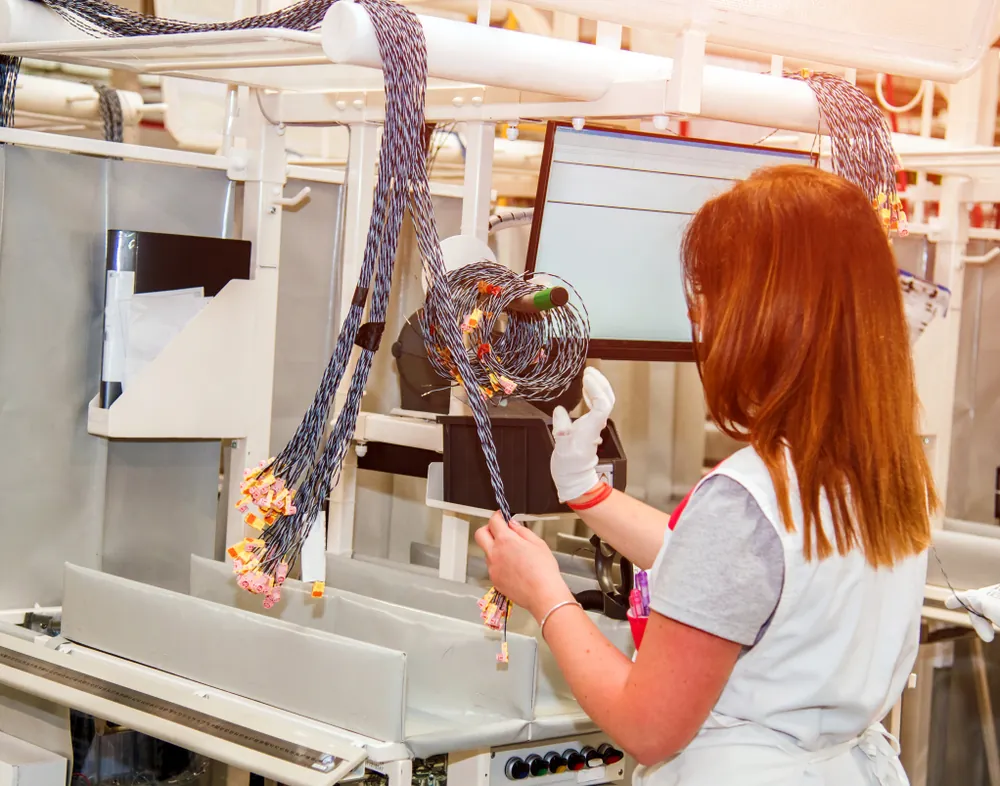
Wire harnesses are critical to the performance, safety, and reliability of modern vehicles and complex electrical systems. For OEM buyers, EV manufacturers, and aerospace primes, partnering with a harness manufacturer that integrates a specialized Manufacturing Execution System (MES) is essential to achieve zero-defect quality, end-to-end traceability, and scalable production.
Phase 1: Digital Design Translation and Automated Production Planning
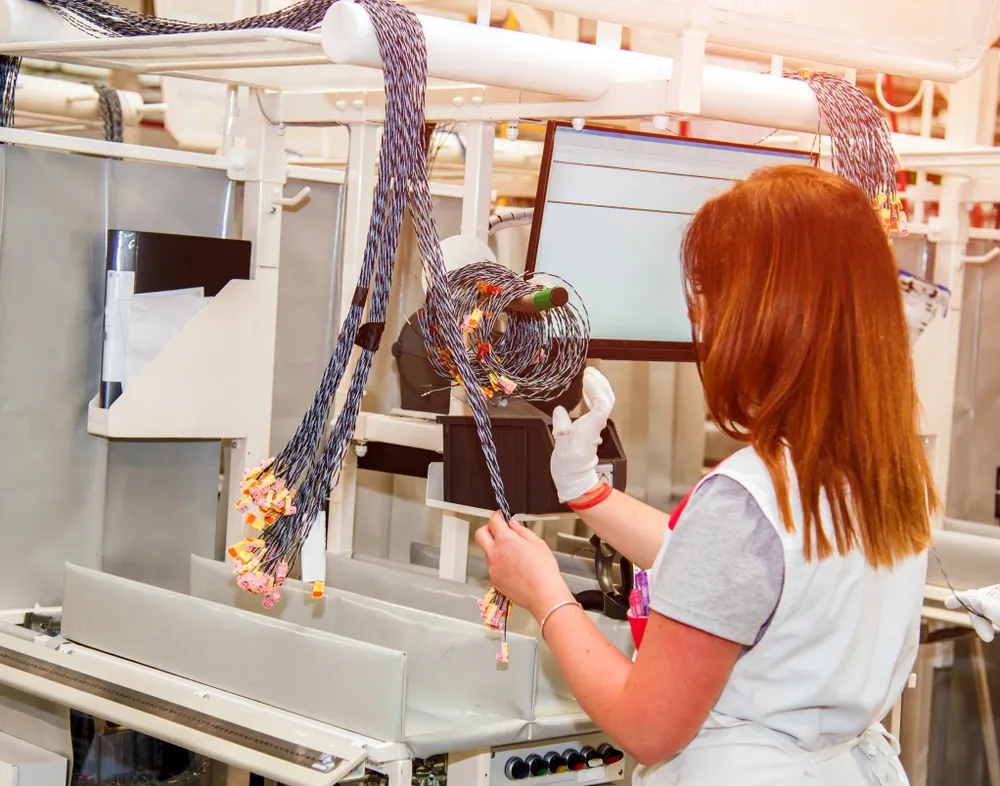
Vehicle manufacturers provide the harness supplier with a 150% drawing of the on-board wiring design, including all variants based on vehicle options. Utilizing a software-controlled planning system, engineers can translate this design into a detailed work plan and parts list with minimal manual effort.
The MES applies configurable rule sets—for example, “If one wire AND 0.35 < cross-section < 6 mm² THEN use standard machine”—to automatically generate production data. This eliminates manual errors, standardizes processes, and enables just-in-time delivery of a batch-size-one harness for a specific vehicle, significantly reducing lead times and work-in-progress.
Phase 2: Manufacturing Execution and Traceability
Beneath the ERP level, the MES controls and documents every production step. Unlike generic MES platforms, a wire-harness-specific system captures the unique technical IT requirements of harness assembly, from material consumption to crimp force monitoring.
Cutting
Automated cutting, stripping, and termination (CST) machines process wires to precise lengths. The MES transfers control data—crimp heights, pull-test requirements—directly to machines and enforces quality gates (barcode validation, tool maintenance cycles). Every wire bundle receives a unique ID, initiating full genealogy tracking.
Pre-Assembly
In this highly manual stage, kits are formed via twisting, crimping, and ultrasonic welding. The MES provides workers with step-by-step digital instructions and records component-level history. New IDs link kits to their constituent parts, enabling granular traceability—critical when scaling production in low-cost regions with high workforce turnover.
Final Assembly
Operators mount wires onto moving assembly boards following MES-guided sequences shown on monitors. The system prompts for confirmations, QA data input, and in-process electrical tests. Completed harnesses carry a comprehensive history: which employee, machine, and tool contributed to every circuit. This traceability isolates defects to specific batches, simplifying recalls and product liability management.
Phase 3: Electrical Testing and Quality Validation
To mitigate field failures and prove compliance, every harness undergoes rigorous electrical testing. Automated test systems are indispensable for complex harnesses—those with high pin counts, high-frequency data cables, or embedded active components (LEDs, diodes, relays).
Manual vs. Automated Testing
Manual testing suffices for simple harnesses but becomes impractical as connector density and data rates rise. Automated electric testers deliver faster, repeatable measurements and can pinpoint fault locations, reducing repair time.
Standard and Advanced Test Capabilities
- Continuity and Resistance: Four-wire Kelvin testing achieves 0.001 Ω accuracy for critical connections.
- Short Circuit and Isolation: High-voltage DC insulation tests identify damaged insulation.
- Dielectric Withstand (Hi-pot): AC/DC leakage tests confirm insulation integrity.
- Capacitance: Prevents signal distortion in twisted-pair and coaxial cables.
- Functional Testing: Simulates loads and sensors to verify active component behavior.
Modern test systems accommodate fuses, resistors, transistors, solenoids, and more. Software-controlled supplies accelerate simulation and measurement, integrating test results directly into the MES history.
Design for Manufacturing (DFM) and Certification Considerations
To achieve consistent quality and regulatory compliance, harness manufacturers must embed DFM principles from the design phase and adhere to industry-specific standards. Collaborative engineering reviews ensure that routing, connector selection, and assembly processes are optimized for manufacturability, reducing cost and scrap rates.
For general harness acceptance, manufacturers follow IPC/WHMA-A-620, which defines workmanship criteria for cable and wire harness assemblies. In the automotive sector—especially for electric vehicle and autonomous driving systems—IATF 16949 certification is mandatory; it drives process control, defect prevention, and continuous improvement within the MES environment. Aerospace primes require AS9100, which extends quality management to risk mitigation, configuration management, and full lot traceability as demanded for flight-critical applications. Medical device OEMs rely on ISO 13485, emphasizing design controls, stringent validation, and process documentation that a specialized MES can seamlessly support.
The MES reinforces these certifications by automating data capture (e.g., crimp forces, test results), enforcing standardized work instructions, and providing an unbroken digital thread from incoming materials to finished product. This ensures that every harness shipped meets the exacting requirements of its intended industry, whether it powers an electric truck, a satellite, or a surgical robot.
Conclusion
As vehicles and industrial systems become increasingly electrified and autonomous, wire harness quality cannot be left to chance. A specialized MES is no longer a luxury but a necessity for achieving the traceability, process control, and compliance that OEM buyers demand. For high-reliability wire harness solutions across automotive, EV, aerospace, and medical sectors, partner with Cable Harness Assembly.
An earlier version of this article first appeared on autowiringpro.com. This version has been rewritten and updated for OEM and procurement audiences.