Bend radius is one of the most critical — and most frequently violated — design parameters in wire harness engineering. When cables are routed too tightly around corners, through conduits, or across moving assemblies, the result is insulation cracking, conductor fatigue, shielding degradation, and ultimately field failures that cost thousands in warranty claims.
This guide covers everything you need to know about minimum bend radius: the formula, the standards that govern it (IPC/WHMA-A-620, NEC, NASA MSFC-SPEC-494, SAE), material-specific multipliers for different cable types, and real-world routing strategies that keep your harness designs within spec. Whether you're designing automotive wire harnesses or aerospace cable assemblies, proper bend radius management is non-negotiable.
Of cable failures linked to bend radius violations
Typical bend radius multiplier range (× cable OD)
Minimum for flexible cables (NASA spec)
Optimum for multi-conductor harness bundles
What Is Bend Radius?
Bend radius is the minimum radius a cable or wire harness can be bent without causing mechanical damage to the conductor, insulation, or shielding layers. It is measured from the inside edge of the bend to the cable's centerline.
When a cable bends, the outer surface stretches while the inner surface compresses. If this deformation exceeds the material's elastic limit, permanent damage occurs — even if it's not immediately visible. The minimum bend radius is the tightest curve that keeps all cable layers within their safe deformation limits.
Static vs. Dynamic Bend Radius
Static bend radius applies to cables installed in a fixed position — the cable bends once during installation and stays there. Dynamic bend radius applies to cables that flex repeatedly in service (robotic arms, drag chains, moving equipment). Dynamic applications typically require 2× the static minimum bend radius to account for fatigue cycles.
Bend radius violations are a common root cause of premature cable failure. The calculation is straightforward, but applying it consistently to every routing path is essential for a reliable harness.
Why Bend Radius Matters
Exceeding the minimum bend radius doesn't always cause instant failure. Often, the damage is latent — the cable passes initial testing but degrades under thermal cycling, vibration, or repeated flexing. Here are the five primary failure modes caused by bend radius violations:
Insulation Cracking
The outer surface of the bend stretches beyond the insulation's elongation limit, creating micro-cracks that worsen over time. These cracks expose conductors to moisture, chemicals, and short circuits.
Conductor Fatigue & Breakage
Individual conductor strands fracture at the bend point. In multi-strand cables, outer strands fail first, increasing resistance and causing localized heating before full open-circuit failure.
Shield Degradation
Braided or foil shields gap open at tight bends, reducing EMI/RFI shielding effectiveness. For shielded cables, the minimum bend radius is typically 12× the outer diameter — 50% more than unshielded cables.
Impedance Changes
In coaxial and differential-pair cables, tight bends alter the conductor-to-shield geometry, changing characteristic impedance. This causes signal reflections, data errors, and increased insertion loss.
According to the Lectromec research on aircraft wire degradation, bend radius violations are a leading contributor to wire system degradation, particularly in aerospace applications where thermal cycling amplifies mechanical stress at bend points.
Minimum Bend Radius Formula
The universal formula for calculating minimum bend radius is straightforward:
Minimum Bend Radius = OD × Multiplier
Where OD = cable outer diameter and Multiplier = factor determined by cable type, material, and applicable standard
Worked Example
Given: A 12mm OD shielded multi-conductor cable for a fixed installation
Standard: NEC requires 12× OD for shielded conductors
Calculation: 12mm × 12 = 144mm minimum bend radius
Practical guidance: Use 150mm or greater in your routing design to provide manufacturing tolerance margin.
The multiplier is the critical variable. It ranges from 3× for small flexible wires up to 15× or more for rigid coaxial or armored cables. The next two sections break down exactly which multiplier applies based on the governing standard and the cable material/construction.
Standards: IPC, NEC, NASA & SAE
Multiple standards govern bend radius requirements depending on the industry. Here's how the major standards compare. For a deeper dive into IPC/WHMA-A-620 standards, see our dedicated article.
| Standard | Scope | Minimum Bend Radius | Notes |
|---|---|---|---|
| IPC/WHMA-A-620F | Cable & wire harness assemblies | 6× OD (bundles), 3× OD (strain relief) | Industry standard for EMS providers; Class 1/2/3 tiers |
| NEC Article 300.34 | Building & power wiring | 8× OD (unshielded), 12× OD (shielded/lead) | Applies to conductors > 4 AWG; NM cable = 5× OD |
| NASA MSFC-SPEC-494 | Aerospace harnesses | 3× OD (min), 10× OD (optimum) | 10 AWG and smaller; fluorocarbon tubing has separate table |
| SAE AS50881 | Aerospace wiring | 3× bundle OD (min), 10× (preferred) | Applies to all aircraft wiring; mil-aero standard |
| NEC 334.24 | NM & NMC cable | 5× cable OD | Residential wiring; straightforward flat cable rule |
| TIA/EIA-568 | Data cabling (Cat5e/6/6a) | 4× OD (UTP), 10× OD (fiber) | Structured cabling for LAN; fiber has tighter rules |
When multiple standards apply to a project (e.g., an EV charging harness that must meet both IPC/WHMA-A-620 and automotive OEM specs), always use the most conservative (largest multiplier) requirement. Check our UL vs CSA vs CE certification guide for how certification marks intersect with these design standards.
Designing toward the recommended bend radius rather than the absolute minimum provides useful reliability margin. The small material cost of a longer routing path is usually minor compared with the risk of a field failure.
Material-Specific Bend Radius Multipliers
The cable's jacket material, insulation type, and shielding construction all affect how tightly it can bend. Here's a practical reference table. For deeper material comparisons, see our PVC vs TPE vs Silicone cable comparison.
| Material / Cable Type | Static Multiplier (×OD) | Dynamic Multiplier (×OD) | Key Consideration |
|---|---|---|---|
| PVC jacket | 6× | 10× | Stiffens below -10°C; avoid cold bending |
| TPE / TPU jacket | 4× | 8× | Good flexibility; UV resistance varies |
| Silicone jacket | 4× | 6× | Excellent flexibility even at -60°C |
| PTFE (Teflon) insulation | 6× | 10× | Rigid; requires careful routing |
| Kapton (polyimide) | 5× | 8× | Thin-wall allows tighter bends |
| Braided shield | 8× | 12× | Shield gaps at tight bends |
| Foil shield (tape) | 10× | 15× | Foil cracks at excessive bends |
| Armored / metal-clad | 12× | Not recommended | Use conduit instead for flex |
| Coaxial cable | 10× | 15× | Impedance shift at tight bends |
| Ribbon / flat cable | 6× | 10× | Bend along flat axis only |
For high-temperature applications comparing Kapton and PTFE performance, see our Kapton vs Teflon insulation guide. Material choice directly affects bend radius — a silicone-jacketed cable with the same OD as a PVC cable can often be routed through tighter spaces while remaining within specification.
Bend Radius by Cable Type & Application
Beyond material, the cable's intended application significantly affects bend radius requirements. High-voltage cables, for example, need larger bend radii to prevent insulation breakdown at voltage stress points.
| Cable Application | Typical OD Range | Min Bend Radius | Governing Standard |
|---|---|---|---|
| Automotive low-voltage harness | 4–15mm | 6× OD | IPC/WHMA-A-620, OEM spec |
| EV HV battery cable (400V+) | 15–35mm | 8× OD | SAE J1654, ISO 19642 |
| Aerospace wire bundle | 5–25mm | 10× OD (optimum) | NASA MSFC-SPEC-494, AS50881 |
| Robotic drag chain cable | 6–20mm | 7.5× OD (dynamic) | Manufacturer spec, IEC 60228 Class 6 |
| Medical device cable | 2–10mm | 5× OD | IEC 60601, IPC-A-620 |
| Coaxial RF cable | 3–12mm | 10× OD | MIL-C-17, TIA-568 |
| Industrial control cable | 8–25mm | 8× OD | IEC 60502, NEC |
| Fiber optic cable | 2–8mm | 10× OD | TIA/EIA-568, ITU-T G.657 |
For EV-specific high-voltage cable design, see our EV 400V vs 800V cable systems comparison. And for robotic applications requiring extreme flex life, our robotic cable assemblies guide covers dynamic bend radius requirements in detail.
7 Common Bend Radius Mistakes
Even experienced engineers make these errors. Each one can pass inspection but cause failures in the field. Understanding these pitfalls is as important as knowing the formula.
Using Static Values for Dynamic Applications
Applying the static bend radius to a cable that flexes in service. Dynamic cables need 1.5–2× the static minimum to survive millions of flex cycles.
Fix: Always confirm whether the installation is static or dynamic before selecting the multiplier.
Ignoring Temperature Effects on Flexibility
PVC and some rubbers stiffen dramatically below 0°C. A cable that routes cleanly in a warm factory may crack at the same bend radius in a -20°C field environment.
Fix: Test bend radius at the lowest expected operating temperature, not room temperature.
Measuring Bend Radius to the Cable Centerline
Standards typically specify the minimum bend radius to the inner edge of the bend, not the centerline. Using centerline measurement gives a falsely generous number.
Fix: Always measure to the inside surface of the bend curve.
Forgetting Connector Back-Shell Constraints
Cables exit connectors at a fixed angle. If the routing path requires an immediate bend after the connector, the effective bend radius at the termination point can violate spec.
Fix: Design a straight service loop of at least 2× cable OD before the first bend after any connector.
Bundling Mixed Cable Types Without Adjusting
A bundle of 5mm and 15mm cables has an overall OD much larger than individual cables. The bend radius must be based on the bundle OD, not the largest individual cable.
Fix: Calculate bundle OD using the bundle diameter formula and apply the multiplier to that total.
Tightening Cable Ties at Bend Points
Over-tightened cable ties at bend points crush cables and create localized stress concentrations. This effectively creates a zero-radius bend at the tie location.
Fix: Use clamps or formed brackets at bend points. If ties are necessary, leave 1–2mm slack.
Not Accounting for Installation Pull Tension
During installation, cables pulled through conduit or harness guides experience temporary bend radii tighter than the final installed position.
Fix: Use pull aids, lubricant, and oversized guide radii during installation. Verify final routing after cables settle.
Cable-tie crushing is a common field-audit finding. Engineers design perfect routing on paper, then the assembly technician cinches a nylon tie right at the apex of a bend. One over-tightened tie can negate an otherwise perfect harness design. Formed brackets at bend points help protect Class 3 builds from this assembly risk.
Routing Best Practices for Optimal Bend Radius
Following these routing principles during the design phase prevents bend radius violations before they reach the production floor. For a comprehensive design methodology, see our 12-step wire harness design guide and routing optimization techniques.
Do
- Design routing paths with 10× OD minimum at all bends
- Use formed bend radii guides or brackets at every turn
- Add 10–15% service loop length for maintenance access
- Specify bend radius on engineering drawings with dimension callouts
- Test prototype harnesses on the actual formboard/fixture
- Separate static and dynamic cable segments with strain relief
- Use gradual S-curves instead of single sharp bends
Don't
- Force cables into 90° corners without radius guides
- Use cable ties as bend radius control — they always slip
- Assume room-temperature flexibility applies at -40°C
- Route through areas where bend radius can't be inspected
- Mix static and dynamic cables in the same bundle
- Pull cables through conduit without verifying internal bend radii
- Rely solely on 3D CAD — verify on physical prototypes

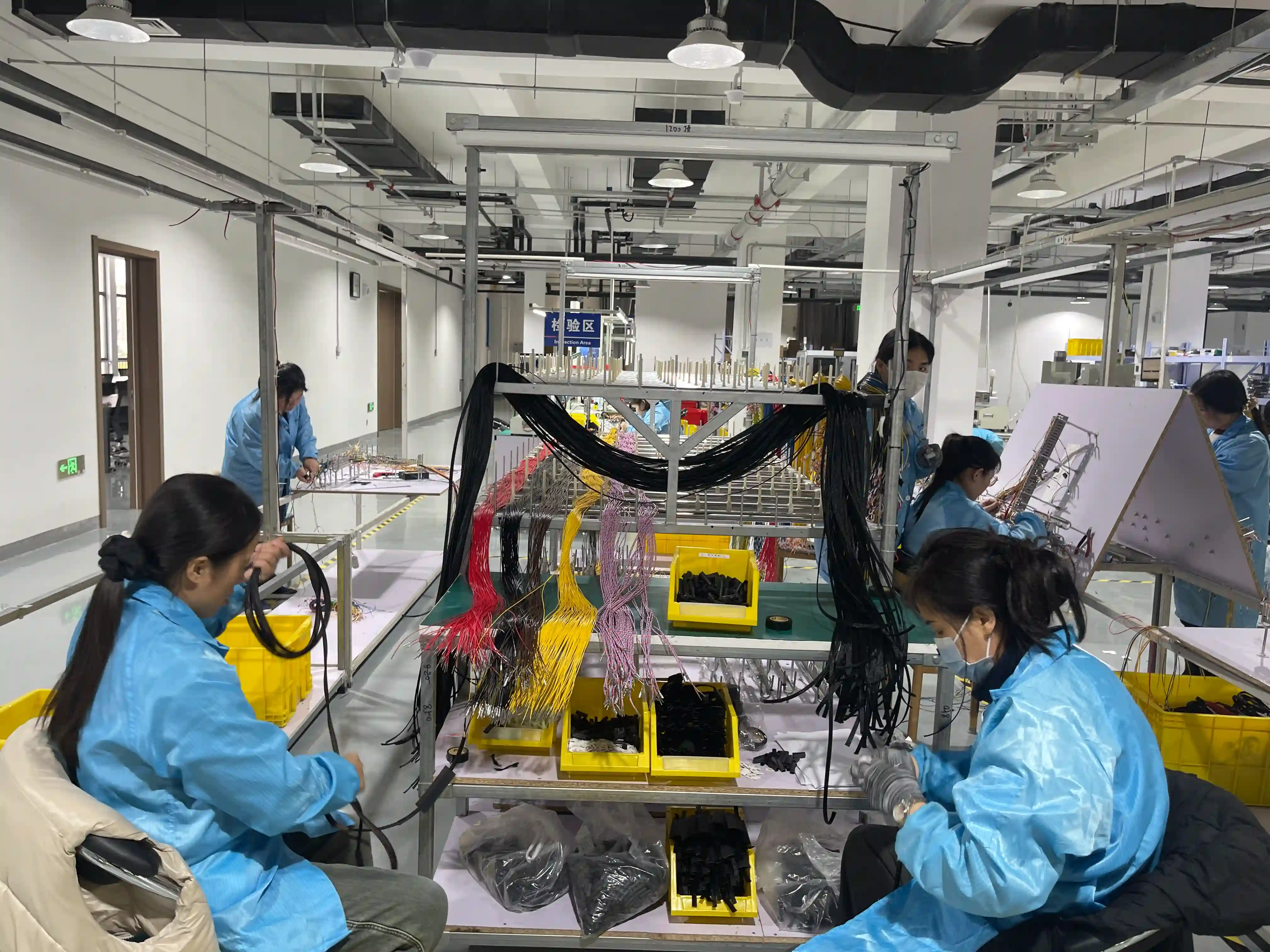
Harness assembly on a formboard, where bend radius templates ensure consistent routing quality
References
- IPC/WHMA-A-620F (2025) — Requirements and Acceptance for Cable and Wire Harness Assemblies. IPC Store
- NASA MSFC-SPEC-494 — Design and Manufacturing Standard for Electrical Harnesses. NASA Standards
- Lectromec — Minimum Bend Radius as Applied to Aircraft Wire System Degradation. lectromec.com
- NEC 2023, Articles 300.34 & 334.24 — Conductor Bending Radius requirements.
- SAE AS50881 — Wiring Aerospace Vehicle (aerospace wiring bend radius requirements).
Frequently Asked Questions
What is the general rule of thumb for minimum bend radius?
For most multi-conductor cable bundles, use 6× the overall cable outer diameter as the minimum for static installations and 10× for dynamic (flexing) applications. When in doubt, 10× OD is a safe conservative target that satisfies most industry standards.
How do I calculate the bend radius for a cable bundle?
First calculate the bundle's overall outer diameter (OD). For a round bundle, use the formula: Bundle OD ≈ d × (1 + 1/sin(π/n)), where d is the largest cable diameter and n is the number of cables. Then multiply the bundle OD by the applicable standard's multiplier (typically 6×–10×).
Does bend radius differ between installation and operation?
Yes. During installation (pulling cables through conduit or harness guides), cables may temporarily experience tighter bends than their final position. Installation bend radius should be at least 1.5× the minimum static bend radius. After installation, verify the cable settles into a compliant routing path.
What happens if I exceed the minimum bend radius?
Consequences include insulation cracking (exposing conductors), conductor strand breakage (increased resistance and heating), shield degradation (reduced EMI protection), and impedance changes in coaxial/data cables. Failures may not be immediate — they often develop over weeks or months of thermal cycling and vibration.
How does temperature affect bend radius?
Cold temperatures stiffen most cable materials. PVC becomes rigid below -10°C and can crack at bends that were safe at 25°C. Silicone remains flexible to -60°C. Always specify and test bend radius at the lowest expected operating temperature for the application.
Do shielded cables need a larger bend radius than unshielded?
Yes. The NEC specifies 12× OD for shielded or lead-covered conductors versus 8× for unshielded. Braided shields can gap open at tight bends, reducing shielding effectiveness. Foil (tape) shields are even more vulnerable to cracking. Plan for at least 50% larger bend radii on shielded cables.