Robotic Cable Assemblies: High-Flex Design for Industrial Automation
Standard cables fail within weeks inside a robot arm. Learn how to design, specify, and source cable assemblies that survive millions of continuous flex cycles in the harshest automation environments.
For industry reference, see cable harness and IPC standards.
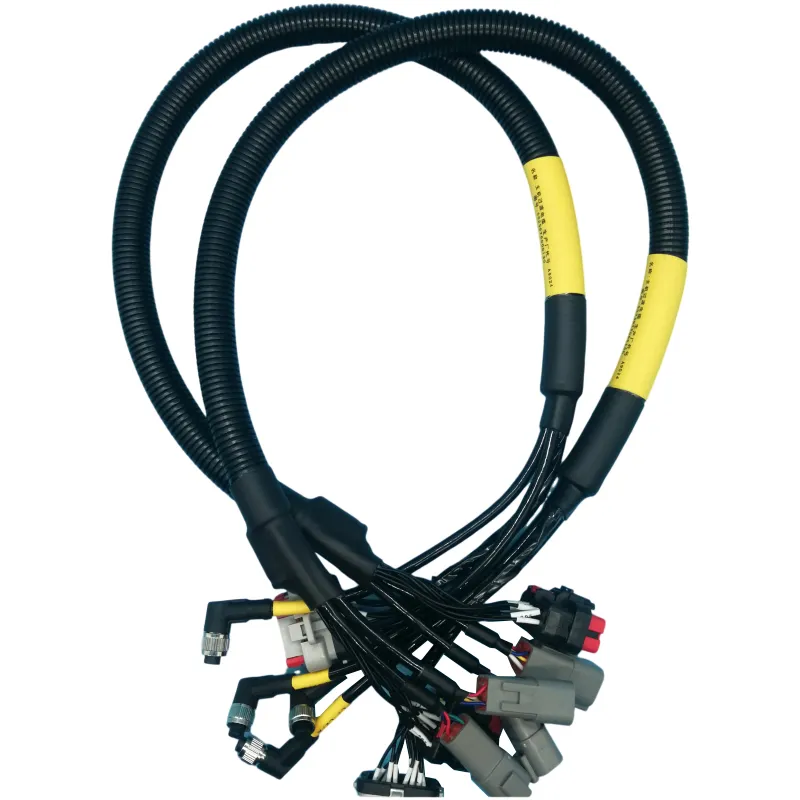
High-flex robotic cable assemblies engineered for continuous motion in 6-axis industrial robot arms
Table of Contents
The global industrial robotics market is projected to exceed $52 billion by 2026, with over 500,000 new robot installations annually. Every one of those robots depends on cable assemblies that must flex, twist, and bend millions of times without failure. Yet cables remain one of the top three causes of unplanned robotic downtime.
Standard cable assemblies—designed for static or semi-static installations—fail catastrophically when subjected to the continuous motion demands of robotic applications. Conductors fatigue, insulation cracks, shields degrade, and jackets wear through. The result is costly production stoppages, quality defects, and safety hazards.
This guide covers everything engineers need to know about specifying robotic cable assemblies: from high-flex conductor design and material selection to drag chain compatibility, robot arm routing strategies, and manufacturer evaluation. Whether you're integrating a new FANUC welding cell or retrofitting an ABB pick-and-place line, the principles here will help you specify cables that last.
$52B
Industrial Robotics Market 2026
10M+
Required Flex Cycles
5mm
Minimum Bend Radius
300°/sec
Max Joint Speed
Robotic cable assemblies operate under demanding conditions. A cable inside a 6-axis robot arm experiences simultaneous torsion, bending, and acceleration forces that can quickly damage standard cable. Robotic harnesses therefore require a defined flex-cycle target based on the application and downtime risk.
Why Standard Cables Fail in Robotics
Understanding the four primary failure modes helps you specify the right cable from the start
Conductor Fatigue & Breakage
Standard conductors use coarse stranding (Class B, 7 strands) that work-hardens with repeated bending. Each flex cycle introduces micro-cracks until individual strands fracture. Resistance increases progressively, causing intermittent signal loss before complete open-circuit failure.
Typical failure: 5,000–50,000 cycles with standard stranding vs. 10M+ cycles with Class 6 fine-strand conductors
Insulation Cracking
PVC and standard polyethylene insulation loses elasticity with repeated flexing. At bend points, the material crazes and cracks, exposing conductors. In oily or chemical-laden factory environments, cracks accelerate as cutting oils and coolants attack compromised insulation.
PVC insulation typically cracks after 100K cycles; TPE and PUR maintain integrity past 5M–10M cycles
Shield Degradation
Standard braided shields use thick, rigid wires that fracture under torsion. As individual braid wires break, EMI shielding effectiveness drops progressively. This causes increasing noise on encoder feedback and communication lines—creating positioning errors before the cable visibly fails.
Shield degradation is insidious: robot accuracy drifts before operators notice any cable damage
Jacket Wear & Abrasion
Cables routed through guide tubes, dress packs, and drag chains experience constant friction. Standard PVC jackets wear through at contact points, especially at sharp bends near robot joints. Once the jacket breaches, internal components degrade rapidly from environmental exposure.
PUR jackets offer 5–8x the abrasion resistance of PVC, critical for drag chain and dress pack applications
High-Flex Cable Design Principles
Every layer of a robotic cable must be engineered for continuous motion—from conductor core to outer jacket
Conductor Stranding Patterns
Fine-Strand Construction
Individual strand diameters of 0.05–0.10mm (compared to 0.25mm+ in standard cables). Finer strands distribute bending stress across more elements, dramatically increasing fatigue life. Class 6 per IEC 60228 is the minimum for robotic use.
Typical strand count
360–2,500+ per conductor
Rope-Lay Construction
Strands are first bundled into sub-groups, then those bundles are twisted together. This "rope-lay" pattern allows each bundle to move independently during bending. The result is significantly lower internal friction and longer flex life compared to concentric stranding.
Flex life improvement
3–5x vs. concentric lay
Bundle Stranding
The highest-flex construction where strands are loosely bundled without a defined geometric pattern. This gives maximum freedom for strand movement during bending and torsion. Required for torsion-capable cables in 6-axis robot arms.
Best for
Torsion ±360°+ applications
Conductor Materials
Bare Copper Class 6 (Standard)
- Fine-strand annealed copper per IEC 60228 Class 6
- Best conductivity (100% IACS) for power and signal cables
- 5–10 million flex cycles at rated bend radius
- Cost-effective choice for most robotic applications
Copper Alloy & Special Options
- Silver-plated copper for high-temperature (200°C+) robotic welding
- Tinned copper for corrosion resistance in washdown environments
- Nickel-plated copper for extreme heat in foundry robots
- CCA (Copper-Clad Aluminum) not recommended—poor flex life
Insulation & Jacket Materials
| Material | Temp. Range | Flex Life | Oil Resistance | Best Use |
|---|---|---|---|---|
| TPE (Thermoplastic Elastomer) | -40°C to +105°C | Excellent | Good | General robotics |
| PUR (Polyurethane) | -30°C to +80°C | Excellent | Excellent | Drag chains, oily environments |
| FRNC (Flame Retardant Non-Corrosive) | -20°C to +70°C | Good | Moderate | Cleanrooms, enclosed areas |
| PVC (Not Recommended) | -5°C to +70°C | Poor | Poor | Static installations only |
| Silicone | -60°C to +200°C | Moderate | Poor | Welding, high-heat robots |
Shielding Designed for Motion
High-Flex Braided Shield
Uses fine tinned copper wires (0.05mm diameter) in a loose braid pattern. The loose braid allows the shield to elongate and compress during bending without fracturing individual wires. Coverage of 85–90% is optimal—higher coverage paradoxically reduces flex life by restricting movement.
Recommended for: EMI-sensitive servo and encoder cables
Spiral (Serve) Shield
Fine wires wrapped spirally around the cable core. Offers lower EMI coverage (70–80%) but superior flex life because spiral construction inherently accommodates bending. Best for power cables where moderate EMI protection is acceptable but maximum flex life is needed.
Recommended for: Robot power cables and motor feeds
Flex Rating Comparison by Cable Class
| Cable Class | Stranding | Flex Cycles | Min Bend Radius | Torsion Capable |
|---|---|---|---|---|
| Standard Flex | Class B (7 strands) | <50,000 | 10x OD | No |
| High Flex | Class 5 (fine strand) | 1–5 million | 7.5x OD | No |
| Continuous Flex | Class 6 (ultra-fine) | 5–10 million | 6x OD | Limited |
| Robotic / Torsion | Class 6 (bundle lay) | 10–30 million | 5x OD | ±360°+ |
Cable Types for Robotic Applications
A typical 6-axis industrial robot requires 5–8 different cable types routed through its arm
Motor Power Cables
Supply AC or DC power to servo motors at each robot joint. Typically 4-conductor (3-phase + ground) with individual and overall shielding to contain VFD switching noise. Gauges range from 10 AWG for large robots to 20 AWG for cobots.
Voltage: 230–600V AC
Shielding: Braid + foil combination
Temp: -30°C to +105°C typical
Encoder / Feedback Cables
Carry position and speed feedback from encoders to the robot controller. Extremely EMI-sensitive—even minor interference causes positioning errors. Use individually shielded twisted pairs with 100Ω characteristic impedance.
Signal type: Differential (RS-485, SSI, EnDat)
Pairs: 2–6 shielded twisted pairs
Impedance: 100Ω ±10%
Ethernet & Fieldbus Cables
Industrial Ethernet (EtherNet/IP, PROFINET, EtherCAT) and fieldbus (PROFIBUS, DeviceNet) cables connect robot controllers to the factory network. Require controlled impedance and precise pair geometry maintained through millions of flex cycles.
Category: Cat 5e / Cat 6A high-flex
Speed: 100Mbps–10Gbps
Impedance: 100Ω ±5%
Welding Cables
High-current cables for MIG, TIG, and spot welding robots. Must handle 200–500A while remaining flexible at the wrist joint. Silicone or EPDM jackets resist spatter and extreme heat. Often bundled with gas hoses in a dress pack.
Current: 200–500A
Gauge: 2/0–4 AWG
Temp: Up to +200°C at torch end
Hybrid Cables (Power + Signal + Air)
Combine electrical conductors with pneumatic hoses in a single cable assembly for gripper-equipped robots. Reduces the number of separate cables in the dress pack, simplifying routing and reducing wear from cable-on-cable contact.
Air pressure: Up to 10 bar
Hose material: PU or nylon
Configuration: Custom per end-effector
Vision & Camera Cables
High-bandwidth cables for robot-mounted cameras and vision sensors. GigE Vision, USB3, or CoaXPress interfaces require precise impedance control and superior EMI shielding to maintain image quality during motion.
Interface: GigE, USB3, CoaXPress
Bandwidth: Up to 12.5 Gbps
Shielding: Double foil + braid
| Cable Type | Conductor Size | Pairs/Cores | Shield Type | Typical OD |
|---|---|---|---|---|
| Motor Power | 10–20 AWG | 4 cores | Braid + Foil | 8–15mm |
| Encoder Feedback | 24–28 AWG | 2–6 pairs | Individual + Overall Braid | 5–9mm |
| Industrial Ethernet | 22–26 AWG | 2 or 4 pairs | Foil + Braid | 6–8mm |
| Welding | 2/0–4 AWG | 1–2 cores | None (power only) | 15–25mm |
| Hybrid (Power+Signal+Air) | Mixed | Custom | Per element | 15–40mm |
Drag Chain Cable Design
Cable carriers (drag chains) protect cables during linear motion but impose specific design requirements
Cable Carrier Requirements
Round cross-section required
Flat or ribbon cables bunch and jam in chain links. Use only round cables with consistent OD tolerance (±5%)
Low-friction outer jacket
PUR jackets with coefficient of friction <0.5 prevent cable-on-cable and cable-on-chain abrasion
Self-supporting stiffness
Cable must maintain its shape without sagging between chain links. Cables that are too limp bunch at the bottom; too stiff cables resist chain movement
No powder or lubricant fillers
Talc-filled cables shed powder that contaminates clean production environments and clogs chain joints
Bend Radius Calculation
Minimum bend radius formula for drag chains:
Rmin = OD × Multiplier
Power cables: Rmin = 7.5× cable OD
Signal cables: Rmin = 6× cable OD
Data cables: Rmin = 10× cable OD
Hybrid cables: Rmin = 10× largest element OD
Cable Arrangement Rules
- Fill drag chain to max 80% of internal cross-section area
- Separate power and signal cables with dividers to prevent EMI coupling
- Heaviest/largest cables in the center; lighter cables on the outer positions
- Maximum unsupported travel distance: 5m for standard chains, up to 50m with glide bars
Self-Supporting Cables
Designed with enough inherent stiffness to span between chain link supports without sagging. Essential for horizontal drag chain runs where gravity would cause cable bunching. The cable jacket and internal construction provide the necessary column strength.
Use for: Horizontal and long-travel applications up to 5m/s
Guide-Supported Cables
Flexible cables that rely on the chain's internal shelves and separators for support. Offer better flex life since they are not fighting their own stiffness during bending. Required for vertical drag chain applications and ultra-long travel distances exceeding 10m.
Use for: Vertical runs and ultra-high flex cycle requirements
Robotic cable production should include flex testing on representative samples from each batch. Samples can be mounted on a test rig that replicates actual robot joint motion—including simultaneous bending and torsion at rated speed—and evaluated against the application's cycle and conductor-resistance acceptance criteria.
Robot Arm Cable Routing
Routing cables through a 6-axis robot arm is one of the most challenging cable management tasks in industrial engineering
6-Axis Routing Challenges
Axes 1–3 (Base & Arm)
Primary motion axes that carry the most weight and move the fastest. Cables experience large-radius bending with high acceleration forces. The main cable bundle runs externally along the upper arm, secured with clamps that allow controlled sliding during motion.
Typical motion
±180° at up to 250°/sec
Axis 4 (Wrist Rotation)
Introduces the first torsion challenge. Cables must accommodate continuous rotation while already bent around the wrist joint. This is where standard cables most commonly fail because torsion and bending combine at a small radius.
Typical motion
±360° continuous torsion
Axes 5–6 (Wrist Bend & Tool)
The tightest bend radii and highest-speed rotation occur at the end effector. Cables must be as small and flexible as possible. This is where cable assembly size directly limits robot tool accessibility and cycle time.
Typical motion
±360° at 300°/sec
Dress Pack Design
A dress pack is the complete cable routing system for a robot arm, including cables, protective conduit, clamps, brackets, and strain relief components. A well-designed dress pack balances cable protection with freedom of movement.
- Use corrugated conduit (NW13–NW29) to bundle and protect cables along the robot arm
- Install strain relief at each joint transition point to prevent cable pull-out
- Allow 15–20% cable slack at each joint for motion absorption
- Use spring-return mechanisms for consistent cable retraction at axes 4–6
Internal vs. External Routing
Internal (Hollow-Wrist) Routing
Cables routed through the robot's hollow arm structure. Offers maximum cable protection and cleaner tool access. Available on newer FANUC, ABB, and KUKA models with hollow wrist designs.
Constraint: Severely limits cable diameter—max OD typically 30–40mm total for all cables
External (Dress Pack) Routing
Cables bundled in conduit along the outside of the robot arm. Allows larger cable bundles and easier maintenance access. Still the dominant approach for welding and heavy payload robots.
Constraint: External cables can snag on fixtures and limit robot reach envelope
Cable Management Strategy by Joint
| Joint | Motion Type | Cable Stress | Management Method |
|---|---|---|---|
| J1 (Base) | Rotation | Low torsion | Loop with strain relief bracket |
| J2 (Shoulder) | Pivot | Large-radius bend | Sliding clamps on upper arm |
| J3 (Elbow) | Pivot | Medium bend | Service loop with guide tube |
| J4 (Wrist Roll) | Continuous rotation | High torsion + bend | Torsion-rated cable, spring retractor |
| J5 (Wrist Bend) | Pivot | Tight radius bend | Minimum-OD cables, internal routing |
| J6 (Tool) | Continuous rotation | Extreme torsion at high speed | Ultra-flex torsion cable, slip ring (optional) |
Applications by Industry
Each robotic application imposes unique demands on cable assembly design
Automotive Assembly
Body-in-white welding lines run 60–80 robots per line, each cycling 24/7 at 40–60 second takt times. Cables must resist weld spatter, high ambient temperatures, and millions of rapid start-stop motions. Dress packs are replaced on a preventive schedule every 12–18 months.
Key: Heat resistance, spatter protection, 10M+ cycles
Electronics Manufacturing
SCARA and 6-axis robots in SMT and assembly lines demand ultra-small cable diameters with low particle generation. Cleanroom-rated cables use FRNC jackets that do not outgas or shed particles. Low cable mass enables the high-speed, precise movements required for component placement.
Key: Low outgassing, small OD, high-speed motion
Welding Robots
MIG/MAG, TIG, and resistance spot welding robots represent the most extreme cable environment. Torch-end temperatures reach 200°C+, spatter impacts the cable jacket, and high welding currents (200–500A) create intense EMI that disrupts encoder signals without proper shielding.
Key: Silicone/EPDM jacket, spatter guard, heavy shielding
Palletizing & Material Handling
4-axis palletizing robots handle heavy payloads (up to 700 kg) with moderate speed. Cable assemblies face high acceleration forces and must supply power to vacuum or mechanical grippers. Hybrid cables combining power, signal, and pneumatic lines simplify the dress pack.
Key: High acceleration rating, hybrid cable, gripper integration
Collaborative Robots (Cobots)
Cobots from Universal Robots, FANUC CRX, and ABB GoFa operate alongside humans without safety fencing. Cable assemblies must be smooth, snag-free, and internally routed to prevent entanglement hazards. ISO/TS 15066 compliance requires no exposed cables that could catch on workers.
Key: Internal routing, smooth jacket, human-safe design
Semiconductor Handling
Wafer handling robots in ISO Class 1–4 cleanrooms require cables with near-zero particle generation. Cables must be degassed and tested for outgassing per ASTM E595. Teflon (PTFE) or specially treated PUR insulation prevents contamination of semiconductor processes.
Key: ISO 14644 cleanroom rated, zero outgassing, ESD safe
Selecting a Robotic Cable Assembly Manufacturer
Not all cable manufacturers can produce robotic-grade assemblies. Use this checklist to evaluate suppliers.
Capability Checklist
In-House Flex Testing
Must have flex test rigs that replicate actual robot motion—not just simple 90° bend testing. Ask for test reports showing cycles to failure with resistance monitoring.
Robot Brand Compatibility
We build cable assemblies compatible with major robot platforms such as those from FANUC, ABB, KUKA, Yaskawa Motoman, Kawasaki, and Universal Robots. Each platform has different connector interfaces, cable lengths, and routing requirements.
Custom Length & Connector Options
Ability to manufacture exact cable lengths (not just standard increments) and terminate with OEM or custom connectors. Robot integrators need precise lengths to avoid excess cable that bunches in the dress pack.
EMC Compliance Testing
Cable assemblies should be tested for EMC compliance per IEC 61000 standards. This is critical for servo and encoder cables that carry sensitive signals near high-power motor feeds.
Additional Evaluation Criteria
Prototype & Small Batch Service
Robotic cable assemblies should be prototyped and tested on the actual robot before production orders. A supplier that offers rapid prototyping with 3–5 day turnaround accelerates integration.
Certifications
Look for UL, CE, and RoHS certifications. For automotive robotics, IATF 16949 quality management is essential. ISO 9001 is the minimum acceptable quality standard.
Dress Pack Assembly
The best robotic cable suppliers can deliver complete dress pack assemblies—not just individual cables. This means cables, conduit, clamps, brackets, and connectors all pre-assembled and tested as a system.
Inventory & Kanban Support
Robot dress packs are consumables that need regular replacement. A supplier with automated production capabilities and inventory programs ensures you never wait for replacement cables during planned maintenance windows.
A semi-custom approach is often appropriate for robotic cables because every robot cell has unique cable lengths, connector orientations, and environmental conditions. A cable that's 200mm too long creates a loop that catches on fixtures. A connector angled 90° wrong adds stress to the termination point. Correct fit can reduce downtime and extend cable life.
Frequently Asked Questions
Common questions about robotic cable assemblies
How is flex life actually tested for robotic cables?
Robotic cable flex testing uses automated test rigs that replicate actual robot motion profiles. The cable is mounted on a fixture that bends it to the minimum rated bend radius while simultaneously applying torsion (for robot-grade cables). During testing, conductor resistance is continuously monitored. The test runs at rated speed—typically 30–60 cycles per minute—until either conductor resistance increases by more than 10% or the cable physically fails. Reputable manufacturers test per IEC 62821 or their own standards derived from real-world robot motion data. Ask your supplier for actual test reports, not just catalog ratings.
Are drag chain cables and robot arm cables interchangeable?
No—they serve different motion profiles. Drag chain cables are designed for linear, planar bending in one direction with no torsion. Robot arm cables must handle simultaneous multi-axis bending plus torsion (±360° or more). Using a drag chain cable inside a robot arm will result in premature failure because drag chain cables are not designed for torsion. Conversely, robot-grade torsion cables work fine in drag chains but cost 2–3x more than necessary. Match the cable to the actual motion type.
How do I know when robot cables need replacement?
Implement a condition-based monitoring approach: (1) Visual inspection every 3 months for jacket cracks, abrasion wear marks, or deformation at bend points. (2) Monitor robot positioning accuracy—if repeatability degrades from ±0.05mm to ±0.1mm or worse, encoder cable degradation is likely. (3) Check for intermittent communication faults on fieldbus/Ethernet lines. (4) Measure insulation resistance annually (should be >100 MΩ). Most facilities also set preventive replacement schedules: 12–18 months for welding robots, 24–36 months for handling robots, based on accumulated cycle counts.
What shielding approach works best for servo motor noise?
Servo motors driven by VFDs generate significant high-frequency switching noise (typically 4–16 kHz PWM with harmonics into the MHz range). The most effective approach is a combination shield: foil (for high-frequency coverage) plus braid (for low-frequency magnetic coupling). For encoder cables running parallel to motor power cables, use individually shielded twisted pairs (ISTP) with a separate overall shield. Ground the shield at both ends for motor power cables, and at the controller end only for encoder cables to prevent ground loops. This dual-shield, differential-signaling approach is standard for all major robot manufacturers.
Should I use custom or off-the-shelf robotic cable assemblies?
Off-the-shelf cables work for standard robot configurations with common connectors and standard lengths. Custom cables are recommended when: (1) Cable lengths need to match your specific cell layout exactly. (2) You use non-standard end effectors with unique connector requirements. (3) Environmental conditions (temperature, chemicals, cleanroom) deviate from standard specifications. (4) You need hybrid cables combining power, signal, and pneumatic lines. (5) You are building multiple identical robot cells and want to optimize cable routing for your specific application. For most production environments, semi-custom (standard cable with custom length and connectors) offers the best balance of cost and performance.
What are typical lead times for robotic cable assemblies?
Standard off-the-shelf robotic cables ship in 1–2 weeks. Semi-custom assemblies (standard cable with custom length and connectors) typically take 2–3 weeks. Fully custom designs—including new cable constructions, special materials, or unique connector configurations—require 4–8 weeks including prototype development and flex testing. For production quantities (100+ pieces), lead times are typically 3–4 weeks after initial approval. We recommend maintaining a safety stock of one complete dress pack set per robot model to cover emergency replacements during unplanned downtime.
Related Articles
Continue learning about cable assembly design and manufacturing
Automated vs Manual Cable Assembly
When automation makes sense for cable assembly production and how it impacts quality and throughput.
Read articleTop 6 EMI Shielding Methods
Compare braided, foil, spiral, and combination shielding approaches for electromagnetic compatibility.
Read articleStranded vs Solid Wire Guide
Understand conductor construction differences and why stranding class is critical for flex life.
Read articleAbout the Author
OurPCB Engineering Team
OurPCB Engineering Team designs and manufactures cable assemblies for industrial automation, including robotic cable solutions compatible with major robot platforms across automotive, electronics, and semiconductor industries. The team specializes in high-flex cable design, torsion-rated assemblies, and complete dress pack engineering for 6-axis robot arms.
Need High-Flex Robotic Cable Assemblies?
From single prototypes to production volumes, we engineer robotic cable assemblies that survive 10M+ flex cycles. Get a custom quote for your robot model and application.