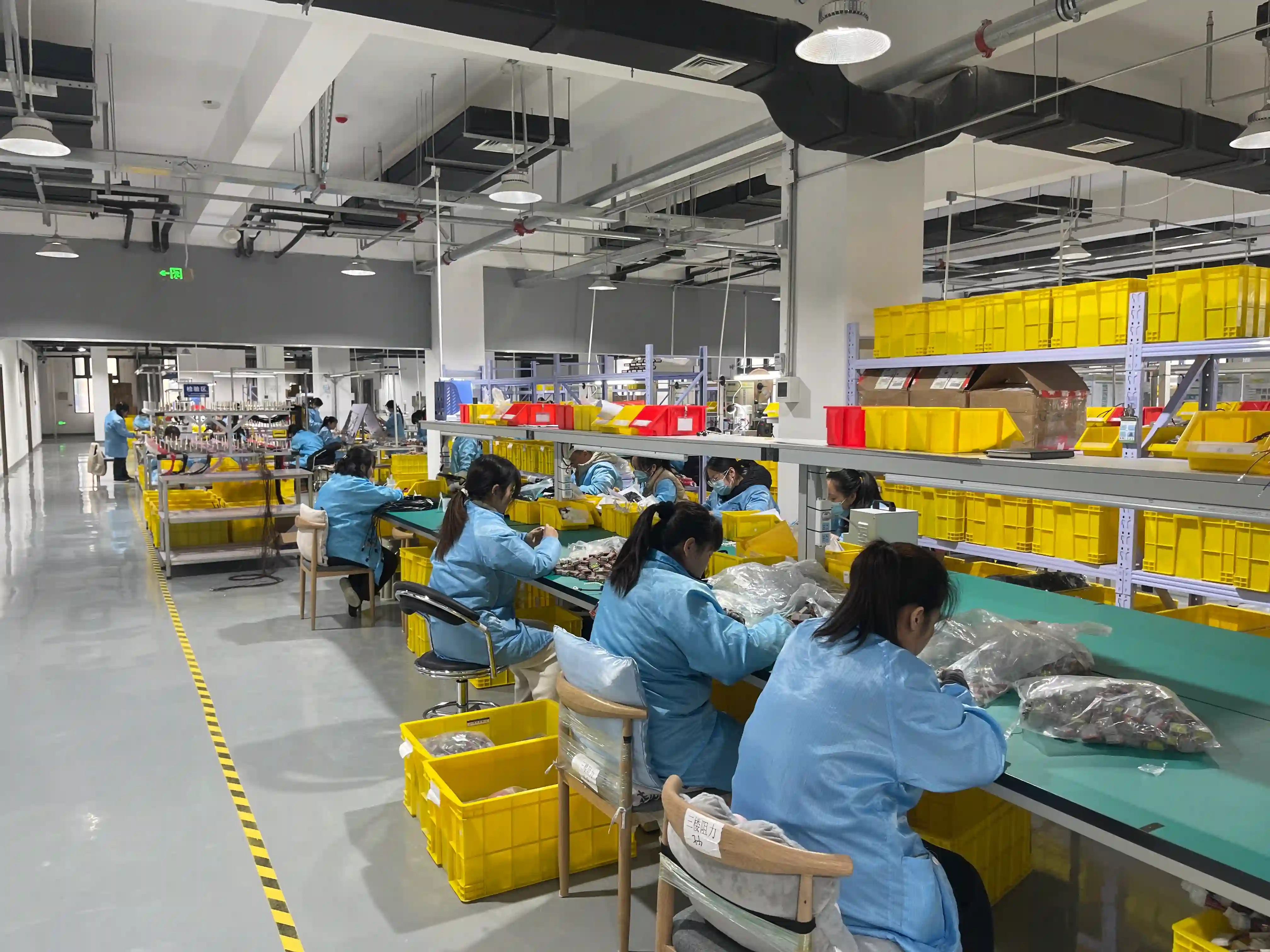
The wire harness industry faces a paradox: despite decades of automation advances, it remains one of the most labor-intensive manufacturing sectors. Unlike PCB assembly—where automated pick-and-place machines dominate—wire harness manufacturing still relies heavily on human hands for complex routing, bundling, and connector insertion.
The question isn't "should we automate?" but "which processes should we automate, and which benefit from skilled manual work?" The answer depends on volume, complexity, labor costs, and quality requirements. Getting this balance wrong can mean either unnecessary capital expenditure or inefficient production that erodes margins.
Automated Assembly
Machines handle wire cutting, stripping, crimping, and testing with perfect consistency. Up to 4,000 wires per hour with near-zero variation.
Manual Assembly
Skilled technicians perform complex routing, 3D bundling, and custom work that machines cannot replicate. Flexible and adaptive to changes.
In This Guide
1Why Wire Harnesses Resist Full Automation
While PCB assembly is 95%+ automated, wire harness assembly typically remains 60-80% manual. This isn't due to lack of technology investment—it's fundamental to the product's nature:
3D Complexity
Unlike flat PCBs, wire harnesses are three-dimensional. They must navigate around mechanical structures, through grommets, and along curved paths. Robots struggle with this spatial variability.
Flexible Materials
Wires are floppy, unpredictable materials. They don't hold position like rigid components. Handling wire bundles, maintaining tension, and preventing tangling requires human dexterity.
High Customization
Many harnesses are custom-designed or have multiple variants. Setting up automation for each variation often costs more than the manual labor it replaces.
Assembly Techniques
Operations like tape wrapping, cable tie installation, and loom insertion require fine motor skills and judgment that robots cannot easily replicate.
A robotic cell can take longer to route a wire than a properly trained operator while producing comparable quality. Automation is justified by volume and consistency, not by the equipment alone.
2Processes That Should Be Automated
Certain wire harness operations are clearly better suited for automation. These share common characteristics: high repetition, precision requirements, and consistent input/output parameters.
| Process | Automation ROI | Speed Gain | Key Benefit |
|---|---|---|---|
| Wire cutting | Excellent | 20-50x faster | Perfect length accuracy |
| Wire stripping | Excellent | 10-20x faster | No conductor damage |
| Terminal crimping | Excellent | 5-10x faster | Consistent crimp quality |
| Electrical testing | Excellent | 100%+ coverage | Zero missed defects |
| Wire marking/labeling | Good | 5-8x faster | Legible, consistent |
| Seal/grommet insertion | Moderate | 2-4x faster | Proper seating verified |
| 3D wire routing | Poor | Often slower | Limited flexibility |
| Tape/loom wrapping | Poor | Comparable | Setup time dominates |
Our cutting and stripping operations use fully automated equipment that processes up to 4,000 wires per hour. This represents an 20-50x speed improvement over manual cutting with perfect consistency—no wire is 1mm too long or too short.
Similarly, automated crimping ensures every terminal meets pull-force specifications. Crimp height monitors verify each crimp in real-time, catching defects that even experienced operators might miss.
3When Manual Assembly Wins
Despite automation advantages, many scenarios favor skilled manual assembly:
Low-Volume Production
Below 1,000-5,000 units annually, automation setup costs exceed labor savings. Manual assembly requires minimal setup—just train the operator and start building.
High-Mix Environment
When producing 50+ different harness variants, changeover time for automated equipment can exceed actual production time. Skilled operators adapt instantly.
Complex 3D Routing
Harnesses that navigate complex mechanical structures—engine bays, aircraft fuselages, medical devices—require human judgment for optimal routing.
Prototype & Development
During product development, designs change frequently. Manual assembly allows immediate incorporation of engineering changes without costly automation reprogramming.
4Cost Analysis: Breaking Down ROI
The decision between automated and manual assembly ultimately comes down to total cost per unit. Here's how to calculate the true comparison:
| Cost Factor | Automated | Manual | Notes |
|---|---|---|---|
| Equipment investment | $50K-500K+ | $2K-20K | Automated: Full line; Manual: Tools only |
| Setup/programming | $5K-50K per SKU | $500-2K per SKU | Jigs, programs, fixtures |
| Direct labor per unit | $0.50-3.00 | $5.00-30.00 | Depends on complexity |
| Changeover time | 30-120 min | 5-15 min | Between product variants |
| Maintenance | $5K-50K/year | $500-2K/year | Parts, calibration, service |
| Training | $5K-20K | $2K-10K | Operators, programmers |
| Scrap/rework rate | 0.1-0.5% | 1-5% | Operator skill dependent |
Break-Even Analysis Example
These figures vary significantly based on labor costs, harness complexity, and equipment selection.
Automation ROI calculations often overlook changeover time. If you're producing 20 different harnesses and switching every 50 units, you'll spend more time changing fixtures than actually producing. Automation performs best with high volumes of identical units rather than many small, varied batches.
5Quality Comparison: Consistency vs Adaptability
Quality considerations differ between automated and manual assembly, and neither is universally "better"—they excel in different areas:
| Quality Metric | Automated | Manual |
|---|---|---|
| Consistency (unit-to-unit) | Excellent (99.9%+) | Good (95-99%) |
| Dimensional accuracy | ±0.5mm typical | ±2-5mm typical |
| Crimp quality | Verified 100% | Sample verified |
| Defect detection | In-line, real-time | Post-assembly inspection |
| Handling non-conformance | Stops production | Operator adjusts |
| Material variation handling | Requires recalibration | Operators adapt |
| Traceability | Automatic logging | Manual recording |
6The Hybrid Approach: Best of Both Worlds
The most effective wire harness manufacturing combines automated and manual processes strategically. This "hybrid" approach uses automation for high-value, repetitive operations while leveraging human skills for complex assembly tasks.
Typical Hybrid Production Flow
Human-Robot Collaboration (Cobots)
Collaborative robots (cobots) represent an emerging middle ground. Unlike traditional industrial robots requiring safety cages, cobots work alongside human operators. They handle repetitive sub-tasks while operators manage complex routing and quality decisions.
Research shows that HRC (Human-Robot Collaboration) enabled workstations can improve productivity 15-30% while reducing operator fatigue. The cobot handles repetitive connector insertion while the operator routes wires and verifies quality.
7Emerging Technologies (2025-2026)
Several technologies are changing the automation landscape:
AI-Powered Vision
Machine learning enables robots to handle wire variability that defeated earlier automation. AI vision systems can now track floppy wires and adapt gripper positioning in real-time.
Modular Assembly Lines
Quick-change fixture systems reduce changeover from hours to minutes. This makes automation viable for lower volumes and higher product mix than previously possible.
Advanced Cobots
Next-generation collaborative robots offer force feedback, vision guidance, and AI learning. They can assist with tasks like connector insertion that were previously manual-only.
Digital Thread
CAD-to-production integration enables automatic programming of automated equipment from design files. Design changes automatically update production instructions.
The future of assembly combines robotic consistency with human judgment. Operators can become harness supervisors who manage multiple automated cells, stepping in for complex tasks while machines handle repetitive work, shifting the skill requirement from manual dexterity toward process management.
8Decision Framework
Use this framework to determine the right automation level for your production needs:
Automation Decision Matrix
Automate when:
- • Volume exceeds 5,000-10,000 units/year of same design
- • Process is repetitive with consistent inputs
- • Precision requirements exceed human capability
- • 100% testing/verification is required
- • Labor costs are high and availability is limited
Keep manual when:
- • Volume is below 1,000-5,000 units/year
- • High product mix with frequent changeovers
- • Complex 3D routing or bundling required
- • Designs are still evolving (prototype/NPI phase)
- • Process requires judgment or problem-solving
Use hybrid approach when:
- • Medium volume (2,000-20,000 units/year)
- • Mix of simple and complex operations
- • Quality requirements vary by process step
- • Budget allows partial automation investment
- • Workforce availability is uncertain
Frequently Asked Questions
What's the typical ROI timeframe for wire harness automation?
For high-volume production (50,000+ units/year), ROI typically occurs within 18-24 months. Medium volume (10,000-50,000) might see ROI in 3-4 years. Below 5,000 units/year, automation may never achieve positive ROI compared to optimized manual processes.
Can automation handle custom harnesses?
Modern automation can handle customization if variants share common base processes. However, truly custom, one-off harnesses are still most cost-effective with manual assembly. The key is whether automation setup time can be amortized across sufficient volume.
What processes should we automate first?
Start with wire preparation (cutting, stripping, crimping) and testing. These offer the highest ROI, consistency improvement, and don't require solving the complex 3D routing challenges that make full automation difficult.
How does automation affect workforce requirements?
Automation changes—not eliminates—workforce needs. You'll need fewer assemblers but more equipment technicians, programmers, and quality engineers. Total headcount typically reduces 30-50%, but required skill level increases.
What defect reduction should we expect from harness automation?
For stable, high-volume programs, automated cutting, stripping, crimping, and test systems often cut workmanship defects by 50-80% while improving traceability. The exact gain depends on process capability and whether IPC/WHMA-A-620 controls are enforced on both manual and automated stations.
Related Articles
References and Further Reading
- •IPC/WHMA-A-620: Requirements and Acceptance for Cable and Wire Harness Assemblies
- •ISO/TS 16949 - Automotive Quality Management Systems
- •Wiring Harness News - Industry automation trends
- •Komax Group - Wire processing automation research