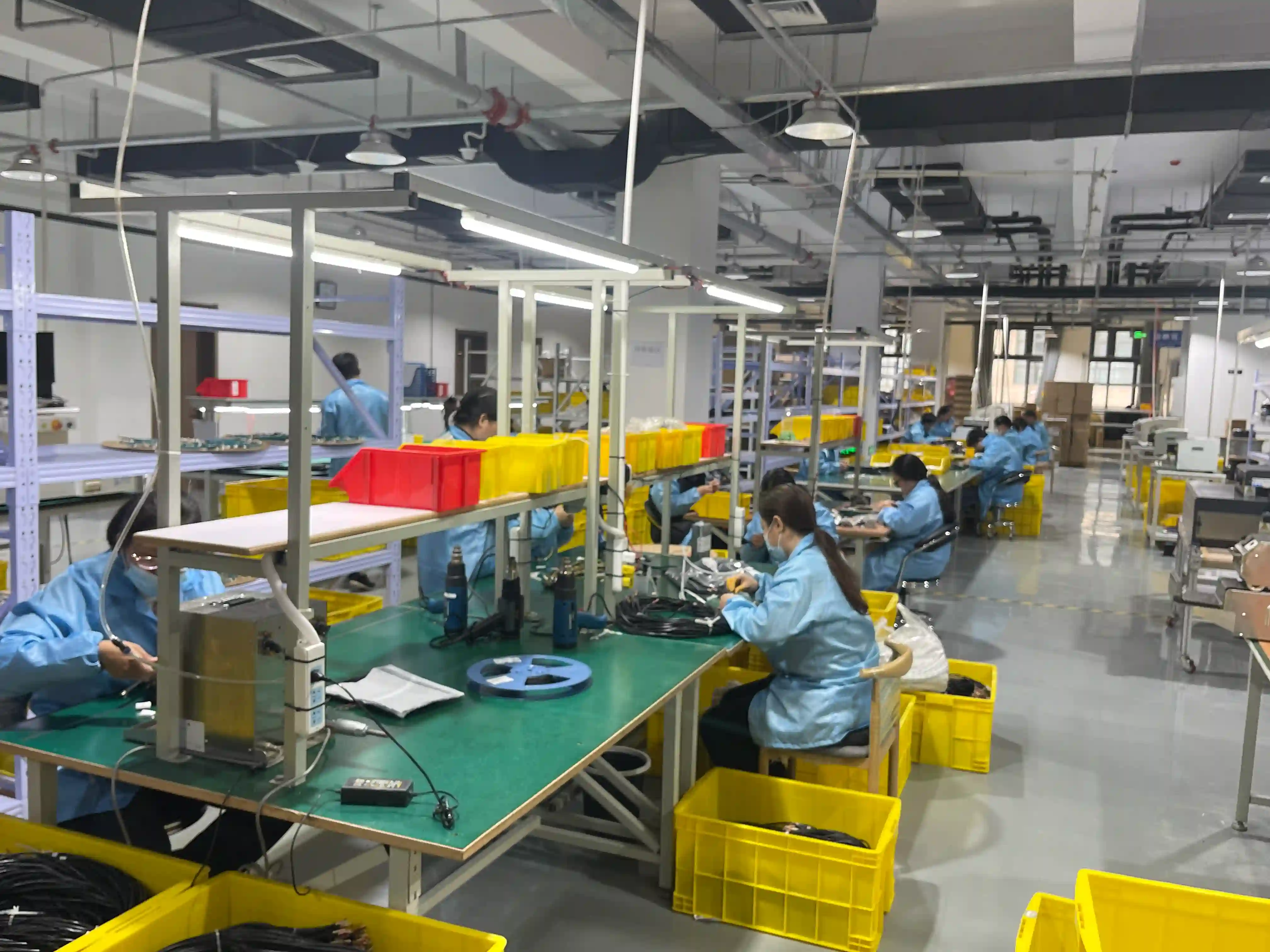
A robotics integrator in Michigan spec'd off-the-shelf PVC multi-conductor cable for a 6-axis welding cell. After 400,000 flex cycles — roughly 8 months of two-shift production — the outer jacket cracked, coolant seeped in, and the entire line went down for 36 hours. A competitor across the state used PUR-jacketed cable rated for 10 million cycles on the same robot model. Three years later, that cable is still running.
The difference was not budget. Both cables cost within $0.15/ft of each other. The difference was specification — matching the jacket, shielding, conductor stranding, and bend radius to the actual operating conditions. This guide covers every decision point in selecting flexible multi-conductor cable for wire harness and cable assembly applications.
What Is a Multi-Conductor Cable?
A multi-conductor cable contains two or more individually insulated conductors bundled inside a single outer jacket. Conductor counts range from 2 to 61 or more, with each conductor carrying a separate signal, power feed, or ground path. The “flexible” designation means the cable is built for repeated bending — either during installation in tight spaces or during continuous motion in drag chains, robotic arms, and automated equipment.
Per NEC Article 725, multi-conductor cables used in control circuits must meet specific listing requirements based on their voltage class and installation environment. The most common listings for flexible types are UL 2587 (industrial flex) and UL 1277 (Type TC-ER tray cable).
Flexible multi-conductor cable bridges two worlds: it provides the wiring density of a bundled harness with the mechanical protection and signal integrity of a single jacketed assembly. That combination makes it the default choice for control cable assemblies in factory automation, robotics, HVAC, and mobile equipment.
"The most expensive cable is the one that fails in production. We push every customer to define three parameters before selecting a multi-conductor cable: total flex cycles, minimum bend radius, and worst-case chemical exposure. Get those three right and the rest of the specification falls into place."
OurPCB Engineering Team
Construction & Anatomy of a Flexible Multi-Conductor Cable
Every flexible multi-conductor cable has four structural layers, and each layer directly impacts flex life, signal quality, and environmental resistance. Changing one layer affects the performance of the others.
Conductors
Fine-stranded bare or tinned copper per ASTM B172/B174. Higher strand counts (Class K or M) increase flexibility. A 24 AWG conductor with 42/40 stranding flexes 5× longer than a 7/32 stranding of the same gauge.
Insulation
Each conductor is individually insulated with PVC (general use), PP (low capacitance), PE (data signals), or XLPE (high temperature to 125°C). Insulation thickness follows UL 758 AWM style tables — thinner walls improve flexibility but reduce voltage withstand.
Shielding
Optional layer for EMI/RFI protection. Foil (aluminum/polyester) blocks high-frequency noise above 1 MHz. Braid (tinned copper, 65–95% coverage) handles low-to-mid frequency noise. Spiral serves continuous-flex applications where braid would fatigue.
Outer Jacket
The outermost layer determines abrasion resistance, chemical compatibility, flame rating, and operating temperature. PVC, PUR, and TPE are the three dominant materials — covered in detail below. Jacket thickness per UL ranges from 15 mil (0.38 mm) to 60 mil (1.52 mm).
Between the conductors and the outer jacket, manufacturers may add a separator tape (polyester or non-woven) and a drain wire (for foil-shielded designs). In cables with more than 12 conductors, conductors are typically organized in concentric layers twisted in alternating directions — called planetary cabling — which distributes bending stress evenly across the cross-section and prevents individual conductors from being permanently loaded on the tension or compression side.
Jacket Materials: PVC vs PUR vs TPE
Jacket material is the single most impactful specification choice for flexible cable. It sets the ceiling on flex life, temperature range, and chemical resistance. The wrong jacket in the right application fails faster than the right jacket in the wrong gauge.
| Property | PVC | PUR (Polyurethane) | TPE (Thermoplastic Elastomer) |
|---|---|---|---|
| Flex Cycles | 1–3 million | 5–10+ million | 3–8 million |
| Temperature Range | −5°C to +105°C | −40°C to +90°C | −40°C to +105°C |
| Oil Resistance | Moderate | Excellent | Good to Excellent |
| Abrasion Resistance | Moderate | Excellent | Good |
| UV Resistance | Poor (degrades) | Good | Good |
| Flame Rating | VW-1 / FT1 | VW-1 / FT1 | VW-1 / FT1 |
| Relative Cost | 1.0× (baseline) | 1.8–2.5× | 1.4–1.8× |
| Best For | Stationary / low flex | Drag chains, robots | Cold environments, food & beverage |
PVC remains the default for stationary installations and light-duty flexing applications per our PVC vs TPE vs silicone comparison. It costs less, terminates easily, and meets VW-1 flame requirements. But PVC stiffens below −5°C and develops micro-cracks after repeated bending, making it a poor fit for continuous-flex or cold-storage environments.
PUR dominates drag-chain and robotic cable applications. Its molecular structure resists micro-cracking under repeated flex stress, and it shrugs off cutting oils, hydraulic fluid, and most industrial solvents. The 1.8–2.5× cost premium over PVC is typically recovered within the first year through avoided downtime — the Michigan welding cell example from the introduction is a textbook case.
Shielding Options & EMI Protection
Shielding choice depends on two factors: the frequency of the interference source and whether the cable moves during operation. A foil shield that performs well in a static cable tray will fracture within weeks inside a drag chain.
Foil Shield (Aluminum/Polyester Tape)
100% coverage, lightweight, effective above 1 MHz. Best for stationary data/signal cables. Requires a drain wire for termination. Not suitable for continuous-flex applications — aluminum fatigues and cracks with repeated bending.
Braid Shield (Tinned Copper)
65–95% coverage depending on braid density. Effective from DC to 100 MHz. Handles moderate flexing, but eventually work-hardens in high-cycle applications. Per electromagnetic shielding principles, 85% braid coverage provides about 40 dB of attenuation at 100 MHz — sufficient for most industrial analog signals.
Spiral (Serve) Shield
Tinned copper wires wound in a single direction at a controlled lay angle. The gaps between turns flex without fatiguing, making spiral the only shield type rated for 10+ million flex cycles. Coverage is lower (70–85%), limiting effectiveness above 1 MHz. Ideal for motor power cables and sensor cables in robotic arms.
Individual Pair Shielding
Each twisted pair gets its own foil or braid shield. Required when mixing analog 4–20mA signals with 24V digital I/O inside the same cable — our EMI shielding methods guide covers this crosstalk problem in depth. Adds 15–25% to cable diameter and cost.
The Over-Shield Trap: Specifying braid + foil on a continuous-flex cable sounds like better protection, but the foil layer will fracture after 500,000–1,000,000 cycles even while the braid survives. The foil fragments create intermittent shorts against the drain wire. If your cable flexes, choose spiral or braid alone — never foil.
"We see the same mistake every quarter: an engineer specifies a foil-plus-braid shielded cable for a robot arm because the datasheet looks impressive. Six months later they're back with intermittent signal faults. A spiral shield at half the shielding spec on paper would have lasted the life of the machine. Match the shield to the motion profile, not the EMI datasheet."
OurPCB Engineering Team
Flex Life & Bend Radius Ratings
Flex life measures how many bend cycles a cable endures before conductor or jacket failure. Bend radius defines the tightest curve the cable can make without permanent damage. These two specs are interdependent: tighter bends reduce flex life, and higher flex-life cables tolerate tighter radii.
| Application Type | Min. Bend Radius | Flex Cycles | Conductor Class |
|---|---|---|---|
| Stationary / fixed install | 10×D | N/A | Class B or C |
| Occasional flex (doors, panels) | 7.5×D | 50,000–500,000 | Class K |
| Continuous flex (drag chains) | 5×D | 1–5 million | Class K or M |
| High-flex (robotic arms) | 4–5×D | 5–10+ million | Class M |
| Torsion (robotic joints) | 4×D | 5+ million at ±360° | Class M + special lay |
D refers to the cable's outer diameter. A 10 mm OD cable with a 5×D bend radius can bend to a 50 mm (2-inch) radius. Per IEC 60228, Class K stranding uses 50–100 strands per conductor, while Class M uses 100+ strands. The additional copper surface area increases cost by 8–15% but multiplies flex life by 3–5×.
For detailed bend radius engineering guidance, see our dedicated guide. The key point for multi-conductor specification: always derate flex life by 30–40% when the cable operates near its minimum bend radius. Manufacturer ratings assume ideal test conditions — a clean 180° bend over a smooth mandrel. Real installations involve side loads, twist, and vibration that accelerate fatigue.
Standards: UL 2587, UL 1277 & More
The applicable UL standard depends on where and how the cable is installed. Specifying the wrong listing can trigger code violations during facility inspection, regardless of how well the cable performs electrically.
| Standard | Cable Type | Voltage | Typical Use |
|---|---|---|---|
| UL 2587 | Industrial Flex Cable | 300–600V | Machine wiring, automation equipment |
| UL 1277 | TC-ER Tray Cable | 600V | Cable trays, industrial buildings |
| UL 758 (AWM) | Appliance Wiring Material | 30–600V | Internal OEM equipment wiring |
| UL 1063 | MTW Machine Tool Wire | 600V | Machine tool enclosures per NEC 670 |
| CSA C22.2 | Canadian Listed | Varies | Equipment exported to Canada |
For equipment sold in both the US and Canada, dual-listed cables (cULus or cURus marked) eliminate the need for separate cable inventories. European markets require CE marking and compliance with EN 50525 (harmonized cable standards). Machines destined for multiple continents benefit from our UL vs CSA vs CE certification comparison to navigate multi-market listing requirements.
Single-Conductor vs Multi-Conductor: When Each Wins
Multi-conductor cable is not universally better than single-conductor. Each excels in different scenarios, and the choice affects installation time, signal integrity, and total cost.
Multi-Conductor Advantages
- 40–60% faster installation — one cable pull replaces 4–20 individual runs
- Smaller conduit fill — 4×18AWG multi-conductor uses 35% less cross-section than four individual 18AWG cables
- Built-in EMI cancellation through twisted-pair geometry
- Organized, traceable wiring reduces troubleshooting time
- Single connector termination point with standard multi-pin housings
When Single-Conductor Wins
- High-current power feeds above 10 AWG — multi-conductor gets too rigid and heavy
- VFD motor leads where each phase needs individual shielding and grounding
- Runs requiring different temperature ratings on individual conductors
- Extreme high-voltage applications (>1000V) where dielectric separation is critical
- Single-point replacement needs — one damaged conductor means replacing the entire multi-conductor cable
The breakpoint is around 10 AWG. Below 10 AWG (thinner conductors), multi-conductor cable offers clear advantages in density, installation speed, and signal integrity. Above 10 AWG, the cable becomes stiff enough to negate flexibility benefits, and individual conductors are easier to route and terminate. For stranded vs solid conductor selection, our comparison guide covers the decision in detail.
Application Selection Matrix
Use this matrix to narrow cable specifications based on your application. Start with the application row and read across for recommended specs. Every recommendation assumes standard industrial conditions; extreme environments (cleanroom, subsea, explosive atmosphere) require additional review.
| Application | Conductors | Jacket | Shield | Flex Rating | Standard |
|---|---|---|---|---|---|
| PLC I/O wiring | 4–25, 18–22 AWG | PVC | Overall foil | Stationary | UL 2587 |
| Drag chain (linear) | 4–12, 16–20 AWG | PUR | Spiral | 5M+ cycles | UL 2587 |
| Robotic arm (6-axis) | 4–8, 18–24 AWG | PUR | Spiral | 10M+ cycles | UL 758 AWM |
| HVAC controls | 2–8, 18–22 AWG | PVC | None or foil | Stationary | UL 1277 TC |
| Food & beverage | 4–12, 16–20 AWG | TPE | Braid | 1–3M cycles | UL 2587, NSF |
| Sensor/encoder cable | 4–12, 22–26 AWG | PUR | Individual pair + overall | 5M+ cycles | UL 2587 |
| Cable tray / riser | 2–37, 14–22 AWG | PVC | Overall braid | Stationary | UL 1277 TC-ER |
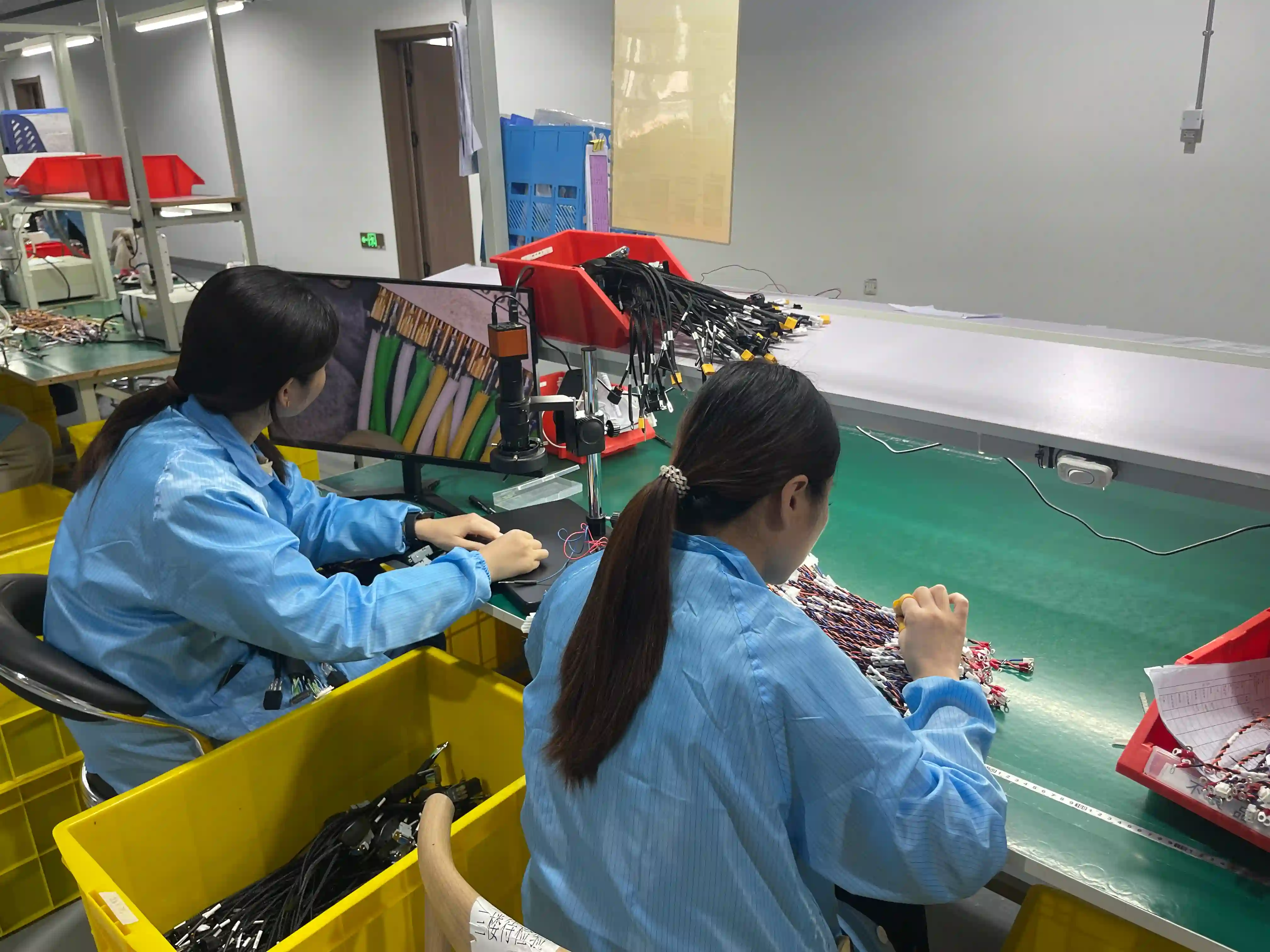
Multi-conductor cable assemblies undergo continuity, insulation resistance, and high-potential testing before shipment.
Cable Assembly Considerations for Multi-Conductor Cable
Selecting the right cable is half the job. How that cable is terminated, routed, and secured in the final assembly determines whether it delivers its rated service life or fails prematurely.
Termination Methods
Fine-stranded Class K and M conductors require crimped ferrules before screw-terminal or push-in connections. Bare fine strands deform under screw pressure, creating high-resistance joints that overheat. Use DIN 46228 ferrules sized to the conductor gauge. For high-vibration environments, proper crimping technique is essential — a poorly crimped ferrule introduces more resistance than a bare wire.
Strain Relief
Multi-conductor cable is heavier per foot than equivalent single-conductor runs. A 12-conductor 18 AWG PUR cable weighs roughly 95 lb/1000ft. Without proper strain relief at connector entry points, cable weight creates pullout forces that exceed crimp retention over time. Use cable glands rated to the cable OD range, and always specify a minimum 6-inch service loop at termination points to prevent direct stress on connectors. See our strain relief solutions guide for detailed selection criteria.
Routing in Drag Chains
Cables inside drag chains (cable carriers) must be free to slide laterally within the chain link. Fix both ends but leave the cable free along the entire travel length. Never bundle multi-conductor cables tightly with zip ties inside a drag chain — this creates stress concentration points. Drag chain manufacturers like igus specify inner height fill ratios (typically 60–70% max) for a reason: exceeding the fill ratio prevents cables from finding their natural lay during flexing.
"About 60% of our custom multi-conductor cable assembly orders involve replacing a stock cable that the customer bought off a distributor website. The cable itself was fine — the problem was always in the termination or routing. A cable assembly partner who understands the mechanical environment saves more money than the cheapest cable on the market."
OurPCB Engineering Team
When Flexible Multi-Conductor Cable Is Not the Right Choice
Multi-conductor cable excels at bundling low-to-medium power and signal conductors in a single run. It is not suited for every application.
- High-current power distribution (>10 AWG per conductor): The cable becomes rigid and heavy enough to negate flexibility benefits. Use individual power cables with separate routing.
- Mixed signal types with vastly different voltage levels: Running 480V power alongside 4–20mA analog in the same jacket violates NEC separation requirements and creates EMI coupling even with individual shielding.
- Outdoor direct burial: Standard flexible cables lack the crush resistance and moisture barrier for direct-burial installation. Use UL 493 or UFMC-rated cables instead.
- Single-point replacement needs: If one conductor fails, you replace the entire cable. In applications where individual conductor replacement must be possible, run separate wires through conduit.
References
Frequently Asked Questions
What is the difference between multi-conductor cable and multi-core cable?
They are the same product. “Multi-conductor” is the North American term used in NEC and UL standards. “Multi-core” is the European/IEC term. Both describe a cable with two or more individually insulated conductors inside a single outer jacket. When specifying across markets, reference the specific UL or EN standard number to avoid confusion.
I need a 12-conductor cable for a drag chain running 2 million cycles — what should I specify?
For a 12-conductor cable at 2 million flex cycles, specify PUR jacket with Class K (minimum) or Class M stranding, spiral shield if EMI protection is needed, and a minimum bend radius of 5×D. UL 2587 listing covers most North American industrial installations. Request a cable sample and verify the actual flex life rating on the manufacturer's datasheet — “flexible” on a catalog page does not guarantee drag chain suitability.
Can I run 24V digital signals and 4–20mA analog signals in the same multi-conductor cable?
Technically yes, but only with individually shielded pairs for the analog circuits. Solenoid switching on the 24V circuits creates inductive spikes that couple into unshielded analog conductors, causing measurement errors of 1–3% or more. Use a cable with individually shielded twisted pairs for analog and unshielded conductors for digital I/O, all inside a common overall shield. Ground each pair shield at one end only to prevent ground loops.
How much does flexible multi-conductor cable cost compared to running individual wires?
The cable itself costs 20–40% more per foot than equivalent individual wires. But installed cost — including conduit, labor, connectors, and testing — is typically 30–50% lower for multi-conductor. A 4-conductor 18 AWG PVC cable costs roughly $0.25–0.45/ft, while four individual 18 AWG THHN wires cost about $0.20–0.30/ft but require a conduit ($0.40–0.80/ft) and 2–3× the installation labor.
Our machine needs to operate in a −30°C cold storage facility — which jacket material should we use?
PVC is not an option — it becomes brittle and cracks below −5°C. Both PUR and TPE maintain flexibility down to −40°C. TPE has a slight advantage in cold-flex performance and is preferred in food and beverage cold storage because it resists washdown chemicals and meets FDA contact requirements. PUR is the better choice if the cable also needs to withstand cutting oils or solvents during operation.