Table of Contents
Author and factory context
This article covers wire harness and cable assembly sourcing, supplier release, and production troubleshooting for connectorized harnesses moving from prototype to production under ISO 9001, IATF 16949-style traceability, IPC/WHMA-A-620 workmanship expectations, and UL 758 wire material controls.
Reader context: when retention belongs in the RFQ
This guide is for engineers, quality managers, and procurement teams who already know the connector family but need a supplier to build it repeatably. The buying stage is usually between first article inspection and pilot production: the pinout works, the connector mates, and the drawing calls out the terminal series, but the RFQ does not yet define how terminal back-out will be checked.
The objective is specific: prevent a crimped terminal from moving inside the housing after final test. The key result is a release package that separates crimp strength, terminal seating, secondary lock closure, and electrical continuity into visible controls. That separation matters because each check catches a different defect.
"On connectorized harnesses, terminal retention is a separate release gate from crimp pull force. IPC/WHMA-A-620 workmanship review establishes termination acceptance, while the housing lock still has to prove it holds."
If your program uses sealed automotive connectors, M8/M12 circular connectors, compact JST or Molex housings, Deutsch DT/DTM/DTP connectors, or mixed-signal harnesses, retention should be defined before production launch. Related controls are covered in our pull-force testing guide, connector assembly capability, and connector seal and cavity plug guide.
Terminal retention test method comparison
| Method | What it proves | Typical use | Risk if skipped |
|---|---|---|---|
| Primary lock pull check | Confirms the terminal lance or locking tang holds inside the cavity | Prototype, pilot, and periodic production sampling | Terminal backs out during mating or vibration |
| Push-back probe check | Applies controlled force from the mating face to find shallow terminals | Dense sealed connectors and field-service plugs | Continuity passes before the connector is fully mated |
| TPA or wedgelock inspection | Verifies the secondary lock reaches final position | Automotive, off-highway, and outdoor assemblies | A half-closed lock hides a terminal seating defect |
| Connector face height check | Compares terminal tips against a go/no-go reference plane | Multi-cavity connectors with small terminals | One cavity sits recessed by 0.5-1.0 mm |
| Post-mating retention review | Checks the connector after controlled mating and unmating cycles | Serviceable harnesses and field-replaceable modules | Terminal shifts after the first installation |
| Failure teardown | Separates crimp, terminal, housing, and operator-route causes | Any retention miss during FAI, pilot, or lot release | Corrective action fixes the symptom, not the root cause |
The correct method depends on connector geometry and the risk you need to control. A production supplier should not choose between pull, push-back, TPA inspection, and face-height review by habit. Each method answers a different question about the terminal, housing, seal, and assembly sequence.
Factory scenario: continuity passed, retention failed
First-hand pilot build review
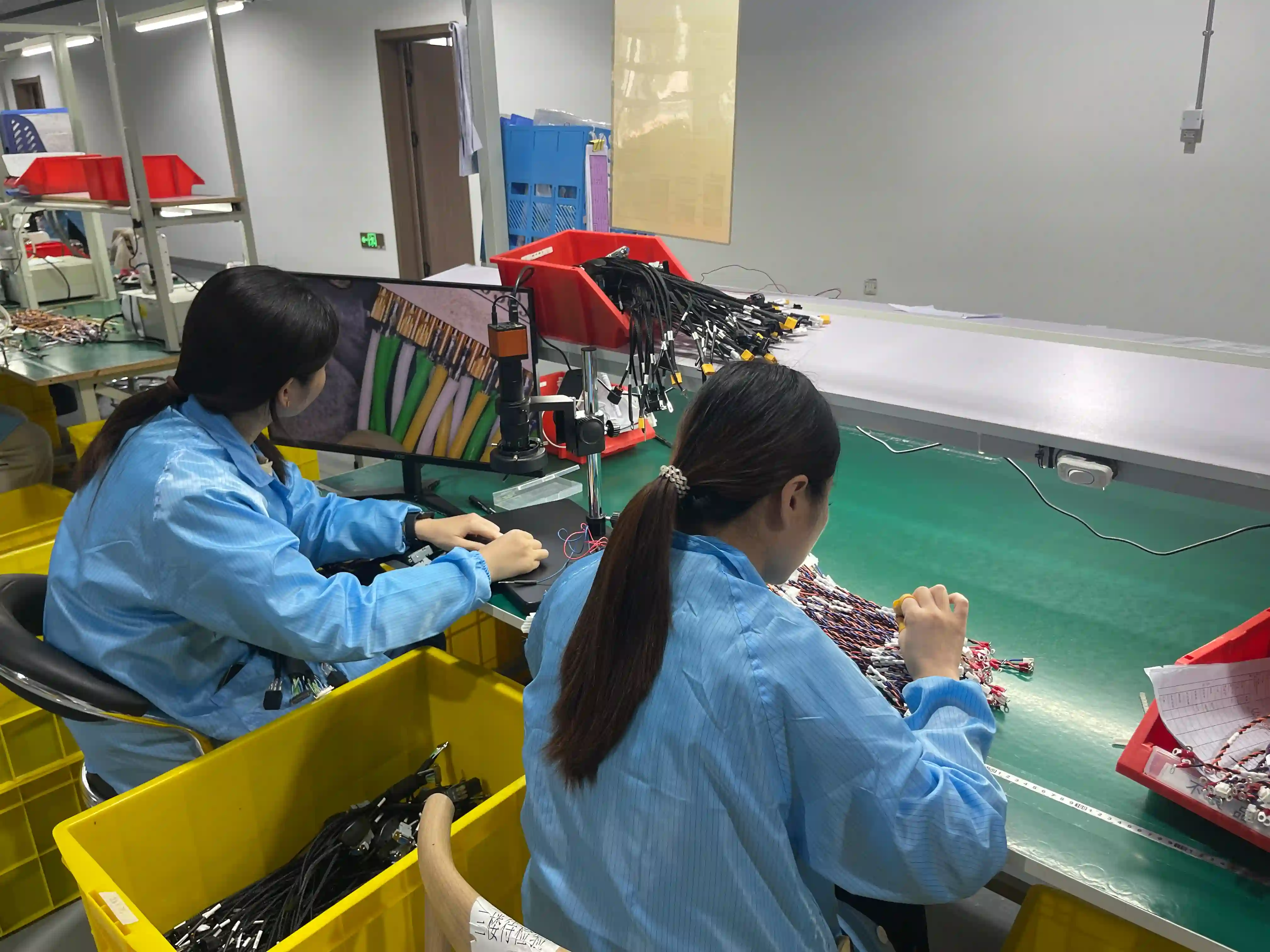
During a pilot run for an outdoor control module harness, our factory team found a problem that standard continuity testing could not see. The circuit was electrically correct, but some terminals were not fully locked inside the sealed connector housing.
- Representative program: a pilot lot of sealed-connector harnesses for a battery-powered outdoor control module, each with two sealed multi-way connectors.
- Initial pilot result: a small number of connector positions showed shallow seating during push-back checks, while 100% continuity still passed.
- Measured pattern: most misses were on thicker silicone-insulated leads whose larger insulation OD created higher seal drag during insertion.
- Correction: pre-seat the seal, add a tactile insertion check, inspect the TPA before closure, and add connector sampling per lot.
- Next lot result: no terminal push-back rejects in the sampled positions, with the same wire, terminal, and housing families.
The weak RFQ sentence was "100% continuity test required." That sounds complete, but it only validates the circuit at the moment of test. We rewrote it as: "Perform 100% continuity, inspect terminal face height before TPA closure, and sample push-back retention on 5 connectors per 100-piece lot for sealed 12-way housings." That concrete substitution changed the build from an electrical-only release to a mechanical-and-electrical release.
"In one pilot lot, continuity found zero defects, but push-back checks still caught a handful of shallow terminals. That is why a connector can pass electrically and still be unready for vibration service."
Release rules for terminal retention
Separate crimp strength from housing retention
A strong crimp does not prove the connector lock is engaged. Track crimp pull data and terminal retention data as two different release records.
Test the highest-risk cavities first
Small terminals, sealed cavities, short leads, tight bend exits, and repinned connectors deserve more sampling than low-density power housings.
Control wire seal drag
A thicker insulation OD can make the insertion click harder to feel. That is a process-control issue even when the electrical schematic did not change.
Do not hide shallow terminals with locks
TPA and wedgelock parts should confirm a good insertion sequence, not compensate for missed primary lock engagement.
A practical retention plan starts with connector family risk. Large power terminals in open housings usually give operators strong tactile feedback. Small signal terminals, sealed cavities, short lead lengths, and high-density housings give less feedback and deserve tighter release checks. When one harness mixes connector systems, do not apply one generic sample size across every cavity.
Define changes that reopen retention review. A wire insulation OD change, terminal plating substitution, applicator change, new connector revision, seal supplier change, or depinning rework can alter seating force even when the circuit and BOM line look nearly identical to purchasing.
Standards, sampling, and records
Wire harness workmanship is commonly reviewed against IPC electronics standards, including IPC/WHMA-A-620 acceptance practices for cable and wire harness assemblies. Material selection can also reference UL requirements such as UL 758 for appliance wiring material, while automotive programs often add IATF 16949 procedures for lot traceability, nonconforming material control, and corrective action.
For environmental connectors, retention also interacts with sealing and vibration. An IP-rated connector family may be described using the IEC 60529 IP Code, but a finished harness still depends on correct terminal seating, seal compression, cavity plug installation, and strain relief. For high-vibration vehicle programs, retention records should sit next to crimp data, visual inspection, and final electrical test data.
"When wire insulation OD changes, engineering should review seal drag and retention sampling. UL 758 material changes can look harmless on the BOM and still change insertion feel at the bench."
Supplier release data to request
Ask for the connector family, terminal part number, wire size and insulation OD, crimp height range, pull-force results, retention sample size, failed-sample photos, and any TPA or wedgelock inspection record. That data makes a retention result auditable instead of anecdotal.
Inspection checklist before production
- Confirm terminal series, cavity family, seal range, and applicator setup before the first article build.
- Record crimp height, pull-force sampling, and terminal retention sampling as separate quality checks.
- Inspect wire seal position before terminal insertion when seal drag can mask a shallow click.
- Close TPA, CPA, wedgelock, or secondary locks only after the cavity map is verified.
- Add retention sampling after any terminal substitution, housing substitution, wire OD change, or depinning rework.
- Keep failed samples for teardown photos so engineering can distinguish lance damage from insertion error.
What engineering should freeze
Freeze terminal series, wire OD range, connector cavity map, seal part number, secondary lock part number, and retention method before the first article lot. A drawing that only shows pinout leaves too much mechanical risk with the assembler.
What production should record
Record insertion route, TPA closure check, retention sample count, failed cavity location, corrective action, and retest result. For high-risk lots, keep photos of cavity face height before and after the secondary lock is closed.
FAQ: terminal retention testing
What is terminal retention testing in a wire harness?
Terminal retention testing checks whether a crimped terminal stays locked inside the connector housing under a defined axial force. For many production programs, the check is run after terminal insertion and before final packout, with acceptance tied to the connector maker's value and IPC/WHMA-A-620 workmanship expectations.
Is terminal retention the same as crimp pull-force testing?
No. Crimp pull-force testing checks the wire-to-terminal crimp joint, while terminal retention testing checks the terminal-to-housing lock. A harness can pass a 40 N crimp pull check and still fail if the terminal lance is damaged or the TPA is not seated.
How often should connector terminal retention be tested?
Use 100% visual and electrical verification on every harness, then add sample retention testing by connector family, cavity type, and risk level. A common pilot plan is 5 pieces per cavity family per lot, then reduced sampling after stable first-pass results across 3 consecutive lots.
Can a TPA or secondary lock replace terminal retention testing?
No. A TPA or secondary lock reduces back-out risk, but it does not prove the primary terminal lock is undamaged. We verify the insertion click, inspect TPA closure, and sample retention force before release on high-vibration or sealed connector programs.
What standards apply to terminal retention checks?
Wire harness workmanship is commonly reviewed against IPC/WHMA-A-620, while wire material selection may reference UL 758 for appliance wiring material. Automotive programs often add IATF 16949 controls for traceability, sampling records, and corrective action after any retention failure.
What causes terminal back-out after a harness passes continuity?
Common causes include a bent locking lance, wrong terminal series, shallow insertion, wire seal drag, TPA closed over a partially seated terminal, or a connector cavity damaged during depinning. Back-out as small as 1 mm can create intermittent contact under vibration.
Need connector retention reviewed before production?
Send your connector family, terminal part numbers, wire OD list, sealing plan, and expected production quantity. We can review the retention risk, sampling plan, and release data before pilot or repeat manufacturing.
Request a connector review