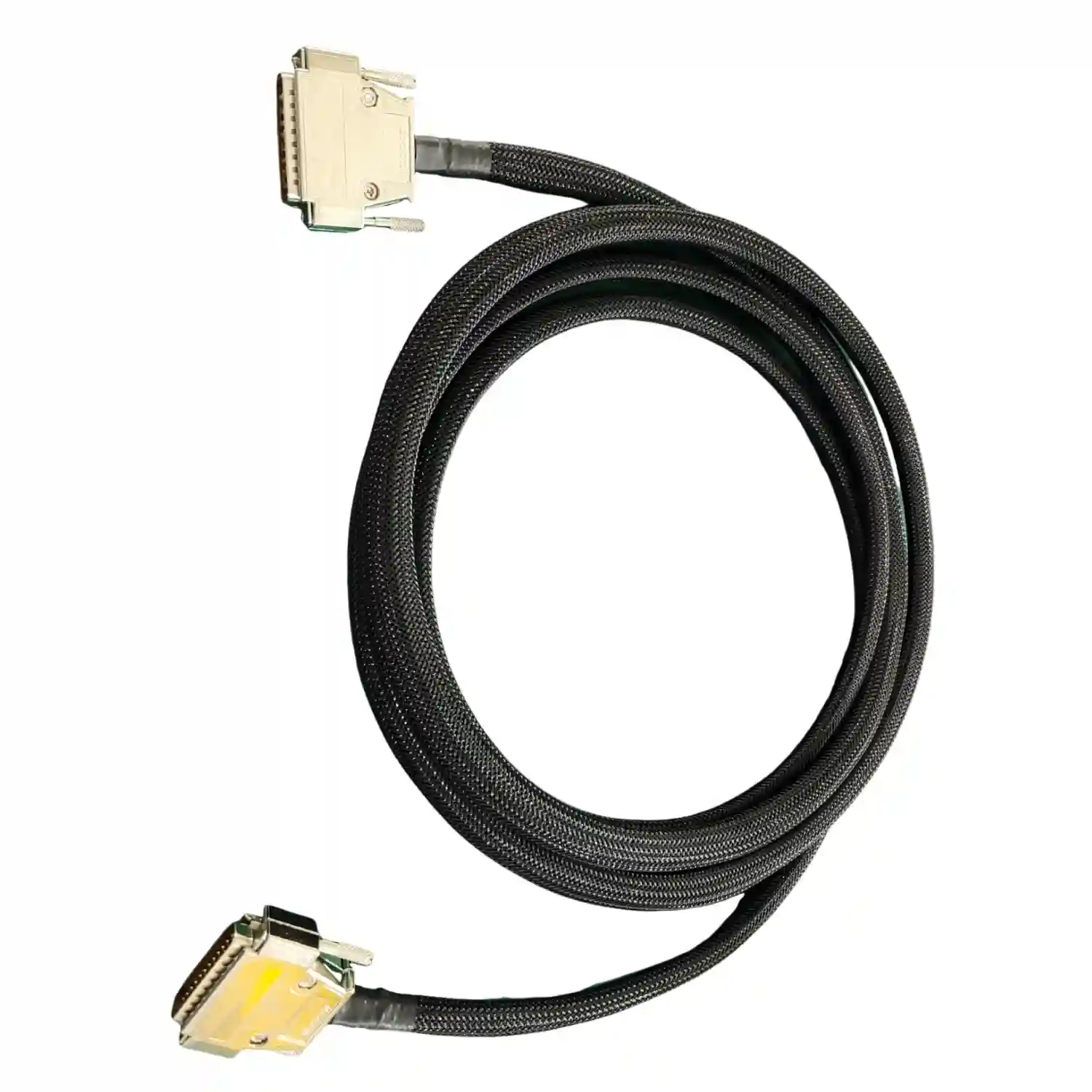
Portable cord is the flexible power cable class defined by UL 62 and governed by NEC Article 400—used for pendant drops, portable tools, crane festoons, stage lighting, welders, and temporary construction power. Unlike building wire, it is designed to be moved, flexed, and terminated with cord grips rather than stapled to a stud. The jacket stamp (SOOW, SJOOW, SJTW, STOW, SEOOW) tells you the voltage class, jacket chemistry, oil resistance, and weather rating in six characters or fewer.
Most specification errors come from two sources: treating portable cord as interchangeable with fixed building wire, and reading the letter code as marketing rather than compliance data. This guide decodes every letter, compares the five most common types against NEC requirements, reproduces the ampacity values from NEC 400.5(A)(1), and gives you a decision matrix that maps real environments (oil, cold, UV, submersion) to specific cord types.
Max rating (S/SO/SOOW)
Junior cords (SJ family)
TPE/rubber cold limit
Governing standard
What Is Portable Cord?
Portable cord is a multi-conductor flexible cable engineered for connecting equipment that moves, vibrates, or needs frequent disconnection. Each cord contains stranded copper conductors (typically 34-65 strands per AWG size), individual insulation (EPDM, thermoplastic elastomer, or PVC), paper or nylon separators, and a jacket that must withstand mechanical abuse. The stranding is what gives portable cord its name—solid conductors would fatigue and fracture within weeks of repeated flexing.
Per UL 62 / CSA C22.2 No. 49, a portable cord must pass jacket tear tests, deformation tests at elevated temperature, flex fatigue cycling, and cold-bend tests at the rated minimum temperature. These tests distinguish portable cord from SPT zip cord or SJT lamp wire, which look similar but carry far lower ratings.
The most important mental model: portable cord lives on the equipment side of a cord cap. Its job starts at the plug and ends at a cord grip on the motor, tool, or junction box. Any run that is stapled, concealed behind drywall, or routed through conduit has crossed into fixed-wiring territory and should be THHN or multi-conductor tray cable instead.
The single most expensive mistake A common issue is buyers make is specifying SJTW for a job that will live outdoors below freezing. SJTW is weather-resistant, not cold-resistant—the T means thermoplastic PVC, which cracks below -20°C. The SJOOW two aisles over costs 30% more and survives -50°C. That 30% is cheap compared to a pump fire.
OurPCB Engineering Team
The Letter Code Decoder
Every portable cord marking is a stack of single letters where position and count change meaning. "SJOOW" is not a product name—it is a compliance fingerprint. Here is the complete decoder that UL and CSA use:
| Letter | Meaning | What It Guarantees |
|---|---|---|
| S | Service / Severe | 600V rated, standard portable cord |
| SJ | Service Junior | 300V rated, lighter construction |
| T | Thermoplastic | PVC jacket, max 60°C, cold-sensitive |
| E | Elastomer (TPE) | Thermoplastic elastomer, lightweight, cold-flex |
| O | Oil-resistant jacket | Jacket only survives oil exposure |
| OO | Oil-resistant jacket & insulation | Both layers oil-resistant |
| W | Weather / water-resistant | Approved for wet locations and sunlight |
| H | Heat-resistant | Extended temperature up to 90°C |
| N | Nylon outer jacket | Abrasion-resistant overbraid |
| P | Parallel construction | Flat zip-cord geometry |
Decode "SJOOW" from left to right: S (Service, 600V) + J (Junior, drops to 300V) + OO (jacket and insulation oil-resistant) + W (wet location / sunlight approved). Decode "SEOOW": Service + E (elastomer TPE jacket) + OO + W. The E variant weighs 30% less than an equivalent SOOW and performs better in cold weather—at a 10-15% price premium.
SOOW vs SJOOW vs SJTW vs STOW: Side-by-Side
These four types cover 80% of industrial portable cord purchases. The differences look subtle on paper but translate to dramatic gaps in cold-weather survival, weight, and permitted application. This table reproduces the specs from published UL 62 datasheets:
| Spec | SOOW | SJOOW | SJTW | STOW |
|---|---|---|---|---|
| Voltage | 600V | 300V | 300V | 600V |
| Jacket material | Thermoset rubber / CPE | Thermoset rubber / CPE | Thermoplastic PVC | Thermoplastic PVC |
| Max temp | 90°C (105°C peak) | 90°C | 60°C | 60°C |
| Min temp (flex) | -40°C | -40°C | -20°C | -20°C |
| Oil resistance | Jacket + insulation | Jacket + insulation | Jacket only (limited) | Jacket only |
| Wet location / sun | Yes | Yes | Yes | Yes |
| Typical use | Heavy industrial, welders, compressors | Light-medium duty, stage, pumps | Outdoor extension cords | Indoor/dry factory tools |
| Relative price | $$$ | $$ | $ | $$ |
The core trade-off is jacket chemistry. Thermoset rubber (SOOW/SJOOW) stays flexible from -40°C to +90°C and shrugs off oil, but costs more and weighs more. Thermoplastic PVC (SJTW/STOW) is cheaper and more abrasion-resistant at room temperature but turns brittle below -20°C and deforms above 60°C. There is no "best" option—only the right match for the operating envelope.
For applications that move between extremes (outdoor construction equipment, arctic service tools), SEOOW with a thermoplastic elastomer jacket is the practical compromise. It combines the cold flex of rubber with lighter weight and lower cost than traditional SJOOW.
Jacket Materials: Thermoset vs Thermoplastic vs TPE
Competitor articles treat "rubber jacket" as a single category. In reality, portable cord jackets split into three distinct material families with different failure modes. Understanding which family sits under the letter code lets you predict how a cord will age in your environment.
Thermoset Rubber
EPDM, CPE, or neoprene cross-linked during manufacture. Chemical bonds are permanent—the jacket will not melt or deform at temperature.
- -40°C to +90°C continuous
- Excellent oil/ozone resistance
- Heavy, higher cost
Found in: SOOW, SJOOW, SEOW
Thermoplastic (PVC)
PVC compound that softens when heated. Easy to extrude, cheap, smooth surface. Below -20°C it becomes glass-like and shatters on impact.
- Lowest cost per meter
- Superior abrasion at room temp
- Cracks below -20°C
- Deforms above 60°C
Found in: SJTW, STOW, SJT
Thermoplastic Elastomer
TPE blends (SBS, TPU families) that behave like rubber at service temperature but process like thermoplastic. Newest jacket class, introduced in the 2000s.
- -50°C flex survival
- 30% lighter than rubber
- Premium vs thermoplastic
Found in: SEOOW, SJEOOW
The jacket choice interacts with the environment in nonlinear ways. A PVC jacket that works perfectly on an assembly-line tool will crack the first morning it sees -25°C on an outdoor pump. A rubber jacket that shrugs off hydraulic fluid in a machine shop will age under prolonged UV in a rooftop installation unless the formulation includes carbon black. Matching chemistry to stressors is the entire selection problem—which brings us to the NEC rules.
NEC 400.7 Permitted Uses and NEC 400.8 Prohibitions
NFPA 70 (the National Electrical Code) dedicates Article 400 to flexible cords and cables. Two sections do the heavy lifting: 400.7 lists where you can use portable cord, and 400.8 lists where you cannot. No competitor article puts both lists side-by-side, which is why most electricians memorize one and guess the other.
NEC 400.7: Permitted Uses
- • Pendants and drop cords
- • Wiring of luminaires (where allowed)
- • Connection of portable lamps, appliances, tools
- • Elevator cables
- • Cranes and hoists
- • Stationary equipment where frequent interchange is needed
- • Equipment subject to vibration
- • Data processing cables (under 645.5)
- • Connection of moving parts
- • Temporary wiring per Article 590
NEC 400.8: Prohibited Uses
- • Substitute for fixed building wiring
- • Run through holes in walls, ceilings, or floors
- • Run through doorways, windows, or similar openings
- • Attached to building surfaces
- • Concealed by walls, floors, or ceilings
- • Installed in raceways (with limited exceptions)
- • Where subject to physical damage
The most abused of these rules is the ban on running cord through wall holes. A facility manager who staples SOOW along a steel beam and pokes it through a concrete block wall to feed a compressor has violated 400.8(1), (2), and (4) simultaneously. The fix is not thicker cord—it is pulling appropriate building wire in conduit for the fixed run and terminating in a junction box, then using portable cord only for the final whip to the moving equipment.
For additional context, the OSHA letter of interpretation (2003-01-16) explicitly ties the 29 CFR 1926.405(a)(2)(ii)(J) construction standard back to NEC 400.8 language. On federal job sites the OSHA citation adds financial teeth to what would otherwise be a code violation.
Ampacity Table: NEC 400.5(A)(1) Values
NEC Table 400.5(A)(1) gives ampacity for flexible cords and cables with no more than three current-carrying conductors in a 30°C (86°F) ambient. These values apply to types S, SJ, SO, SOOW, SJOOW, SJTW, STOW, and the rest of the "portable cord" family. Competitor articles reference the table but almost never transcribe the numbers. Here they are:
| Conductor AWG | Ampacity (60°C col) | Ampacity (75°C col) | Typical load example |
|---|---|---|---|
| 18 AWG | 10 A | — | Small tools, fans |
| 16 AWG | 13 A | — | Light-duty tools |
| 14 AWG | 18 A | — | Portable lighting |
| 12 AWG | 25 A | — | General-purpose tools, small compressors |
| 10 AWG | 30 A | — | Welders (light), submersible pumps |
| 8 AWG | 40 A | — | Stick welders, RV shore power |
| 6 AWG | 55 A | — | Stage power feeders |
| 4 AWG | 70 A | — | Temporary service feeders |
| 2 AWG | 95 A | — | Large compressors, industrial pumps |
The 110.14(C) Termination Temperature Trap
SOOW is rated 90°C on the insulation, but NEC 110.14(C)(1) forces most field terminations (circuits ≤100A) to the 60°C column regardless of the cord's own rating. This is why the table above shows 60°C values. Do not size your conductor off the 90°C jacket rating—the lug on the other end has the final say.
When more than three conductors share a jacket, NEC Table 400.5(A)(3) adjustment factors apply: 80% for 4-6 conductors, 70% for 7-9, 50% for 10-20, down to 35% at 41+. For ambient temperatures above 30°C, additional derating per NEC Table 310.15(B)(2)(a) stacks on top. Both corrections together can knock a 12 AWG SOOW cord from 25A to 14A in a hot multi-conductor installation.
Common Myths: Direct Burial, Concealed Runs, Terminations
Three myths about portable cord appear on nearly every electrician forum. They all stem from misreading a single letter or section of the code.
Myth 1: "The W means I can bury it"
The W letter means the cord has passed UL sunlight resistance and wet-location tests. It does not authorize direct burial. Burial puts mechanical and chemical stresses (soil abrasion, root intrusion, hydrocarbon leach) that a jacket test cannot represent. For buried runs, use direct-burial rated power cable such as USE-2 or Type UF, not SOOW.
Myth 2: "I can run SOOW inside a wall for a permanent feed"
NEC 400.8(1) and 400.8(5) forbid using portable cord as a substitute for fixed building wiring, and 400.8(2) forbids running it concealed. The code does not care that the cord is rated 600V or has an oil-resistant jacket. Permanent runs need conduit and building wire. Portable cord starts at the cord cap and ends at the equipment.
Myth 3: "The 90°C rating means I can use the 90°C ampacity column"
NEC 110.14(C)(1)(a) limits the terminations on most equipment rated ≤100A to the 60°C column of the ampacity table. Unless the terminals are specifically listed for 75°C or 90°C use, the higher column is off-limits. The cord can handle 90°C—the lug cannot. This is the #1 mistake in owner-builder motor wiring.
"When an inspector red-tags a facility for flexible cord misuse, the paperwork almost always cites 400.8(1): substitute for fixed wiring. The fix is structural, not a product swap. You cannot cord-shop your way out of a code violation—you have to rewire the permanent portion and save the portable cord for the last few feet where it belongs."
OurPCB Engineering Team
Selection Matrix by Environment
Pick the dominant stressor in your environment, then match it to the cord type in the right column. When two stressors compete (cold + oil), choose the type that satisfies the worse constraint (SEOOW or SJOOW).
| Environment / Stressor | Recommended Cord | Why |
|---|---|---|
| General indoor, >-15°C | SJTW | Lowest cost, adequate for room-temp tools |
| Outdoor construction, cold | SJOOW or SEOOW | Rubber/TPE stays flexible below -20°C |
| Machine shop, oil exposure | SOOW or SJOOW | Double-O = oil-resistant insulation and jacket |
| Stage and theater | SJOOW 12/3 | Flexible, quiet handling, 300V adequate |
| Welding, high current | Type W or SOOW heavy gauge | Type W rated to 2,000V for arc welders |
| Submersible pumps | SOOW or pump-duty cord | Wet location + oil resistance + flex |
| Arctic / refrigeration | SEOOW | TPE jacket flexes to -50°C |
| Automotive / mobile | SJOOW or SAE J1127/J1128 battery cable | Vibration, flex, oil exposure |
For related selection decisions on jacket chemistry alone, see our breakdown of PVC vs TPE vs silicone cable. For flexible industrial wiring in fixed conduit runs (where portable cord is not permitted), our flexible multi-conductor cable guide covers the alternatives.
5 Field Mistakes That Destroy Portable Cord
The cord itself is rarely the cause of a field failure. Application errors—installation, terminations, routing—account for the majority of warranty returns we see on industrial cable assemblies.
1. Daisy-chaining extension cords
Linking three SJTW 16/3 cords to reach 150 feet stacks voltage drop and GFCI trip issues, and OSHA 1926.405 flags it as improper use. The fix is one continuous cord of proper gauge sized for the run length.
2. Cord-cap strain relief failure
Stripping the jacket back too far inside a cord cap, then clamping on individual conductor insulation, transfers pulling forces directly to the terminal screws. The result is a pulled-loose conductor and an arc fault on the first tug. Always clamp on the outer jacket.
3. Undersizing for distance / voltage drop
A 12 AWG cord at 20A running 100 feet drops 6.4V on a 120V circuit—past the 3% limit. Motors stall, heaters underperform, and controllers trip. Use a voltage drop calculator and upsize for long runs.
4. Running through pinch points
Slamming a forklift door, closing a roll-up gate, or pinching cord under a pallet jack crushes the conductors inside the jacket. The damage is invisible until a short-to-jacket causes a GFCI trip months later. Use cord protectors at crossings.
5. Ignoring repair limits on industrial cords
Vulcanized repair splices are permitted on temporary construction cord per NEC 590, but permanent production cords with field repairs should be retired. OSHA 1910.334 also requires damaged portable cord to be removed from service until repaired or replaced.
References
"Portable Cord Types Explained SOOW, SJOOW, SJTW & NEC Compliance Guide only becomes production-ready after measurable validation. That usually means 100% continuity, a defined insulation threshold such as 500 VDC, and one application-specific check tied to IEC 60529, UL, or the customer's own spec."
Frequently Asked Questions
What does SOOW actually stand for?
SOOW decodes to: S (Service, 600V), O (oil-resistant jacket), O (oil-resistant insulation), W (weather/water-resistant and sunlight-rated). The double-O is the key differentiator from plain SOW—both layers of polymer resist oil exposure, not just the outer jacket. SOOW uses a thermoset rubber or CPE jacket that stays flexible from -40°C to +90°C.
I need a 50-foot feeder for an outdoor construction generator in a Minnesota winter—what cord should I spec?
Choose SJOOW or SEOOW sized for the generator's full-load amps plus voltage-drop margin. SJTW is off the table: its PVC jacket cracks below -20°C and Minnesota construction sites routinely see -25°C to -35°C. For a 30A 240V generator over 50 feet, 10 AWG SJOOW keeps voltage drop under 3%. If the cord will be dragged across rough terrain, step up to SOOW for the thicker jacket.
Can I use portable cord as permanent wiring for a garage subpanel?
No. NEC 400.8(1) explicitly prohibits flexible cord as a substitute for fixed wiring, and 400.8(2) prohibits concealed runs. A subpanel feed must be in conduit with building wire (THHN/THWN-2) or an NEC-listed cable assembly such as NM-B or MC. Inspectors cite this violation more than any other in residential garages, and fixing it after drywall is expensive.
What is the difference between SJOOW and SJEOOW?
Both are 300V junior cords with oil-resistant jacket and insulation. SJOOW uses a thermoset rubber (EPDM/CPE) jacket; SJEOOW uses a thermoplastic elastomer (TPE). TPE is lighter by roughly 30%, flexes to -50°C versus -40°C for rubber, and costs 10-15% more. For applications where operator fatigue matters (stage, trade-show, long hand-held runs), SJEOOW is worth the premium. For purely machine-side installations, standard SJOOW is the economical choice.
We build 500 custom portable cord assemblies per month for industrial customers—should we stock raw cord and crimp our own ends, or outsource?
At 500 assemblies/month, in-house production makes sense if you already have industrial crimping capability and UL cord-cap listed tooling for each connector family. If not, the outsourcing math wins: an experienced cable assembly partner carries the UL 2238 listings, SAE/CSA test equipment, and bulk cord inventory. We produce SOOW/SJOOW/SEOOW assemblies with pre-tested continuity, hi-pot, and pull-test documentation. Contact us for a volume quote.
What is Type W cable and when do I need it?
Type W is a single-conductor (or multi-conductor) portable power cable rated for 2,000V, designed for mining, arc welding, and heavy industrial power distribution. It uses a thermoset rubber jacket over EPR-insulated conductors and is the go-to choice for high-current generator and transformer connections. If your application exceeds 600V phase-to-phase, you are out of the S/SO/SOOW family and into Type W territory.