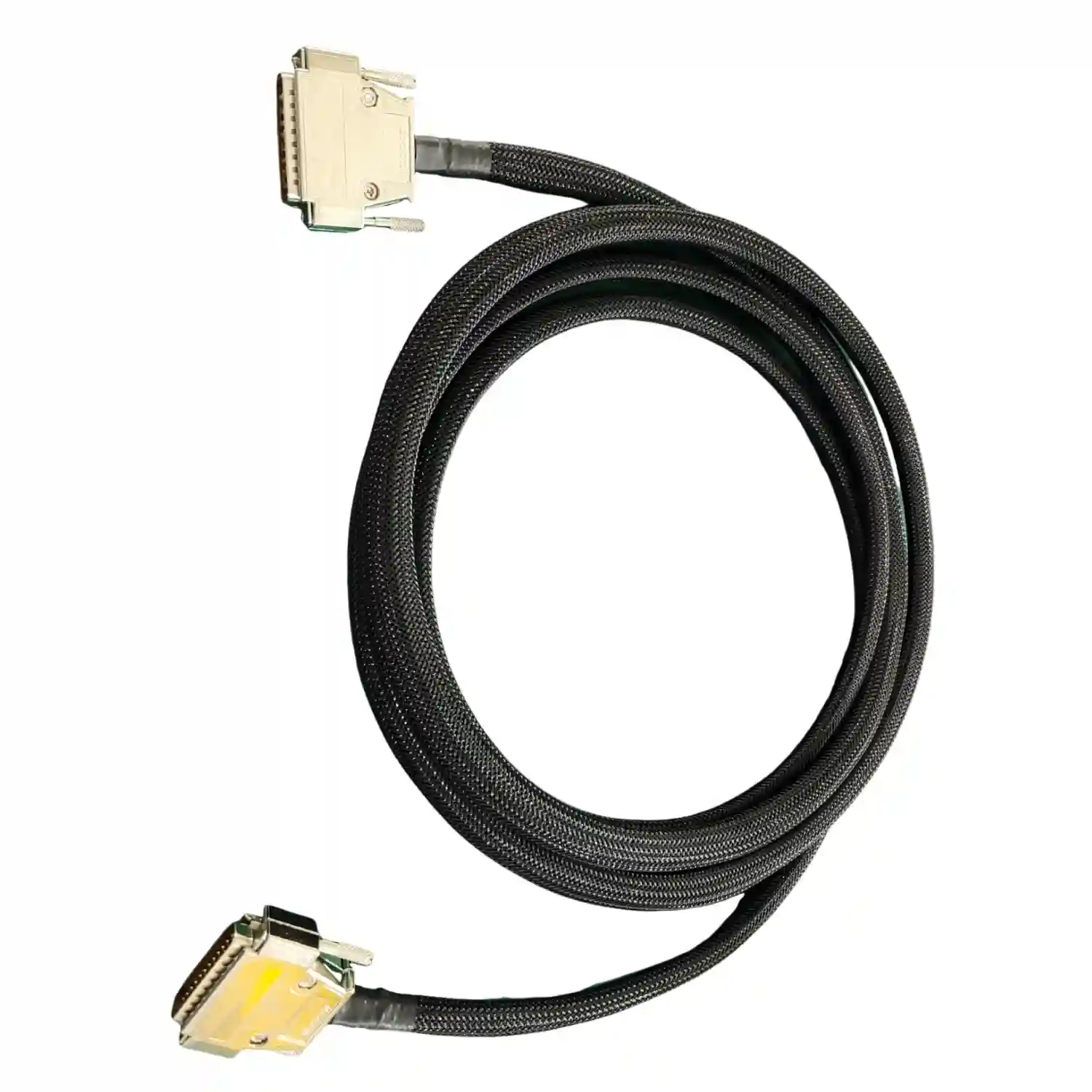
When buyers search for a network cable color code, they usually want one simple answer: what order do the eight conductors go into an RJ45-style 8P8C plug? The practical answer is that Ethernet assemblies follow one of two recognized pinout schemes defined under ANSI/TIA-568: T568A or T568B. Both work when used correctly. Most failures happen when a technician mixes them, splits a twisted pair, or untwists too much conductor during termination.
On a wire harness and cable assembly site, this topic matters because Ethernet cables are still cable assemblies. The process uses the same discipline you see in our Ethernet cable assembly and data cable programs: controlled stripping, pair management, contact inspection, strain relief, and electrical test before release. The difference is that a network cable can pass a simple continuity check and still fail at 1 Gbps or PoE load if pair geometry is poor.
This guide focuses on practical factory-floor decisions: how to read the color order quickly, when T568A vs T568B should be selected, how crossover cables differ from straight-through cables, and what test steps actually prevent RMAs in commercial, data center, and industrial networking.
8
Conductors in a standard Ethernet plug
4 Pairs
Twisted pairs used by 1000BASE-T
100 ohm
Nominal balanced impedance target
90 W
Upper PoE++ power class often referenced in builds
In This Article
Quick Answer: What Is the Network Cable Color Code?
The two accepted Ethernet color codes are T568A and T568B. T568B from pin 1 through pin 8 is white-orange, orange, white-green, blue, white-blue, green, white-brown, brown. T568A is white-green, green, white-orange, blue, white-blue, orange, white-brown, brown. If both ends use the same scheme, the cable is straight-through. If one end uses A and the other uses B, the cable is a crossover cable.
Electrically, neither standard is inherently faster. Performance is determined by pair integrity, conductor quality, category compliance, shielding where required, and test results. For that reason, a cleanly terminated T568A cable will outperform a poorly terminated T568B cable every time.
"On Cat6 production, the biggest hidden defect is not wrong color order. It is correct color order with the pairs untwisted too far back. Once you open the pair more than roughly 13 mm near the plug, your NEXT margin starts disappearing."
— OurPCB Engineering Team
T568A vs T568B RJ45 Pinout Table
Read the plug with the contacts facing you and the latch facing away, then count pin 1 on the left through pin 8 on the right. The table below is the fastest way to verify the wire order before crimping or during incoming inspection.
| Pin | T568A | T568B | Pair Position | Inspection Note |
|---|---|---|---|---|
| 1 | White/Green | White/Orange | Transmit pair position | Must stay twisted with pin 2 mate |
| 2 | Green | Orange | Transmit pair position | Pin 1 and 2 are a matched pair |
| 3 | White/Orange | White/Green | Receive pair position | Must stay twisted with pin 6 mate |
| 4 | Blue | Blue | Blue pair | Same in both standards |
| 5 | White/Blue | White/Blue | Blue pair | Same in both standards |
| 6 | Orange | Green | Receive pair position | Pin 3 and 6 are a matched pair |
| 7 | White/Brown | White/Brown | Brown pair | Same in both standards |
| 8 | Brown | Brown | Brown pair | Same in both standards |
Notice that the blue pair on pins 4 and 5 and the brown pair on pins 7 and 8 never move. Only the green and orange pairs swap. That is why technicians often remember T568B as "orange pair first" and T568A as "green pair first." The shortcut is useful, but the safer habit is to verify every position before pressing the plug.
When to Choose T568A, T568B, or Crossover Wiring
For modern network cable assembly orders, the rule is simple: follow the released drawing or the site standard. Many North American patch cords use T568B. Some structured-cabling and government projects still specify T568A for consistency. What matters is not which one you like; it is whether both ends and the rest of the installation match.
| Cable Type | End A | End B | Typical Use | Main Risk |
|---|---|---|---|---|
| Straight-through T568B | T568B | T568B | Most patch cords, switches, routers, PCs | Low if both ends match exactly |
| Straight-through T568A | T568A | T568A | Legacy structured cabling or spec-driven installs | Low if the whole site uses A consistently |
| Crossover cable | T568A | T568B | Older direct device-to-device links | High mismatch risk if ordered unintentionally |
| PoE patch cable | A or B | Same as end A | Cameras, APs, VoIP phones up to 90 W class | Heat and contact resistance matter more than color alone |
| Industrial Ethernet assembly | RJ45 or M12 | RJ45, M12, or open end | PROFINET, EtherNet/IP, machine networks | Pinout conversion errors at mixed interfaces |
| Field-terminated plug | Installer chosen | Installer chosen | Repair, custom length, low-volume service work | Highest split-pair and untwist error rate |
Crossover cables once mattered more because older switches and PCs often lacked auto MDI-X. Today, many devices can compensate automatically, but crossover assemblies still appear in industrial maintenance, legacy controls, and special test fixtures. If a buyer does not explicitly request crossover, do not assume it. Confirm it on the drawing and label it clearly in production.
"If the customer says only 'RJ45 cable' and the print does not show A, B, or crossover, the job is not defined well enough to release. A 30-second clarification prevents a full lot sort later."
— OurPCB Engineering Team
Factory Controls That Protect Ethernet Performance
Ethernet terminations look simple, but good network cable production is about geometry control. On the assembly floor, we focus on five areas. First, keep each twisted pair married all the way into the contact zone. Second, preserve jacket capture so the plug strain relief grips the jacket rather than loose conductors. Third, match conductor size and insulation diameter to the exact plug design. Fourth, verify shield termination on FTP or STP constructions. Fifth, test the cable with equipment appropriate to its category target.
This is especially important on high-density or higher-risk programs such as data center cable assemblies and shielded industrial runs. A network cable that only needs 100 Mbps in a cabinet may survive workmanship drift that would fail instantly on a Cat6A patch cord or a high-noise machine environment. That is why network cables should be manufactured with the same discipline we apply to other controlled assemblies, not treated as casual hand-crimp jobs.
For PoE and PoE++, current sharing across pairs matters in addition to signal integrity. The principles behind Power over Ethernet mean that poor contact penetration or high resistance on one position can create localized heating even when the wire map passes. That is also why many buyers pair Ethernet builds with our cable testing capability and, where needed, shielding guidance.
Production Controls to Keep
- Match plug type to conductor gauge and cable OD.
- Keep pair untwist short and consistent on every build.
- Verify full contact penetration on all 8 positions.
- Capture the outer jacket under the plug strain relief.
- Run wire map and category-appropriate electrical tests.
Shortcuts That Cause Failures
- Flattening pairs too early to "make the colors easier."
- Using the same plug for stranded and solid wire.
- Approving by continuity alone on Cat6A builds.
- Leaving the shield foil floating on a shielded assembly.
- Skipping labeling on crossover or custom pinout cables.
"For PoE camera and access-point cables, I care about contact resistance almost as much as wire map. Once you push toward 60 W or 90 W classes, a marginal crimp turns into heat, and heat turns into intermittent field failures."
— OurPCB Engineering Team
Common Network Cable Wiring Mistakes
The most common mistake is the split pair. That happens when the color order looks nearly correct, but one conductor from the green pair is matched with one conductor from the orange pair. Basic continuity can still pass because every pin reaches the expected position. Signal quality fails because the pair geometry is broken. This problem is one reason experienced manufacturers use real cable testers instead of trusting visual inspection alone.
The second common mistake is using the wrong plug for the conductor type. Solid and stranded Cat cable often require different contact designs. The third mistake is poor jacket capture. If the strain-relief tab bites only the conductors, flexing quickly transfers stress to the IDC contacts. The fourth mistake is mixed labeling: the operator builds a perfectly acceptable crossover cable, but the packout label still says straight-through. The fifth mistake is assuming color sequence is universal across non-RJ45 interfaces. In mixed-interface industrial products, M12-to-RJ45 transitions must follow the released pin map, not an installer shortcut.
If you need broader guidance on high-noise environments, environmental stress, or industrial networking conditions, our pages on telecommunications and M12 cable assemblies help extend this topic beyond standard office patch cords.
Frequently Asked Questions
What is the correct network cable color code for T568B?
T568B from pin 1 to pin 8 is white-orange, orange, white-green, blue, white-blue, green, white-brown, brown. It remains the most common commercial patch-cable scheme in North America for Cat5e, Cat6, and Cat6A assemblies.
What is the difference between T568A and T568B?
The blue pair on pins 4 and 5 and the brown pair on pins 7 and 8 stay the same in both schemes. The orange and green pairs swap positions. Electrically, a properly made T568A cable and a properly made T568B cable perform the same when both ends match.
When should I use T568A instead of T568B?
Use T568A when the customer drawing, building standard, or installed infrastructure already specifies it. In many government and structured-cabling projects, consistency across the site matters more than which scheme you prefer. Mixing A on one end and B on the other creates a crossover cable.
Do Gigabit Ethernet cables use all 8 wires?
Yes. 1000BASE-T uses all 4 twisted pairs across all 8 positions. Older 10BASE-T and 100BASE-TX links use two pairs for data, but Gigabit and PoE applications require correct termination of every pair to maintain 100 ohm balanced transmission and current sharing.
Can the wire colors be correct but the cable still fail?
Yes. A cable can have the right color order and still fail because of split pairs, excessive untwist, weak contact penetration, or jacket placement outside the strain-relief area. On Cat6 and Cat6A assemblies, keeping pair untwist to about 13 mm or less near termination is a common production target.
What test should be done after crimping an RJ45 cable?
At minimum, run wire map and continuity verification on all 8 positions. For production or critical links, add length, NEXT, return loss, and resistance checks with a cable certifier or Ethernet tester matched to the category target, such as Cat5e, Cat6, or Cat6A.