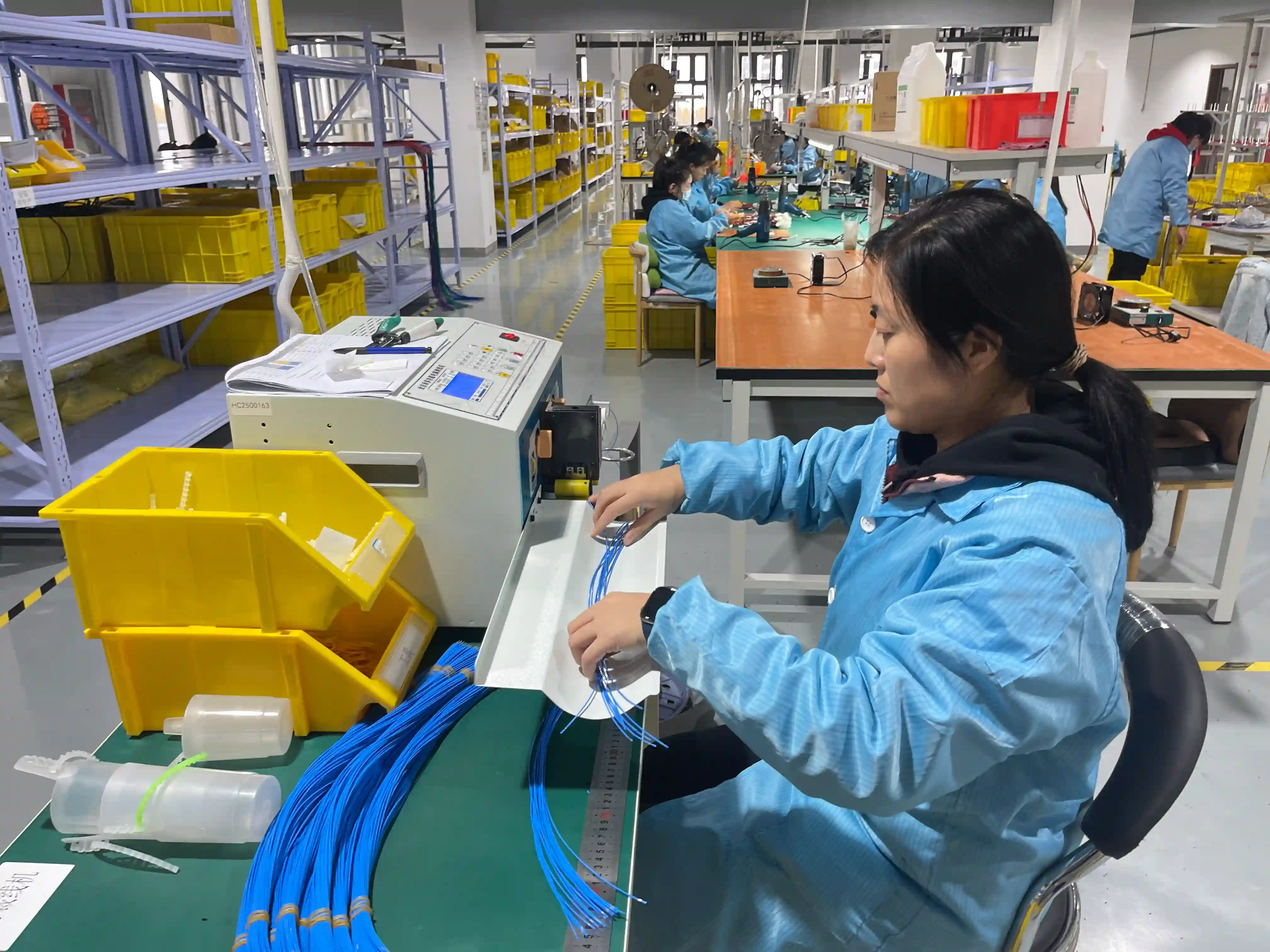
A 600 V wire can still be wrong for a 24 V harness. In our factory, that mistake usually appears when a drawing says "18 AWG red" but omits the wire family, temperature class, and approval path. The purchasing team may buy available THHN, the prototype technician may build with AWM, and the final product may need SAE J1128 TXL because it sits in a vibrating vehicle dashboard.
This chart is written for buyers and engineers specifying a custom wire harness or custom cable assembly. It separates building wire, machine-tool wire, appliance wiring material, automotive primary wire, and high-temperature specialty wire. The goal is not to memorize every style number. The goal is to stop a harmless-looking substitution from creating a failed crimp, a compliance gap, or a hot bundle.
The wire-name trap
A wire type is not only insulation material. It is a bundle of assumptions: standard, voltage, temperature, wall thickness, flame behavior, oil resistance, bend performance, marking, and allowed use. Two PVC insulated 18 AWG wires can belong in completely different products.
Electrical Wire Types Chart
Use this electrical wire types chart as a first-pass filter. The final selection still needs a drawing review, terminal compatibility check, and approval review against the target market. The American Wire Gauge number only defines conductor size. It does not define where the wire is allowed to operate.
| Wire type | Typical rating | Best strength | Typical harness use | Watch out for |
|---|---|---|---|---|
| UL 1007 / 1569 AWM | 300 V, 80-105 C | Low-cost internal equipment wiring | Appliance leads, control signals, small harnesses | Do not treat AWM as building wire |
| UL 1015 / 1230 AWM | 600 V, 105 C | Thicker PVC wall and broad availability | Power leads inside equipment and panels | Confirm bend space in compact housings |
| MTW | 600 V, often 90 C dry | Machine-tool wiring and panel flexibility | Industrial machinery, control cabinets | Check oil, coolant, and wet ratings |
| THHN / THWN-2 | 600 V, 90 C dry | Conduit and building-wire installations | Field wiring, junction boxes, conduit runs | Not ideal for tight dynamic harnesses |
| GPT | 60 V, often 80 C class | General automotive primary wire | Vehicle interiors, trailers, accessories | Avoid high-heat engine zones |
| TXL | 60 V, 125 C class | Thin-wall, light, abrasion resistant | Dashboards, dense vehicle harnesses | Less wall thickness than GXL or SXL |
| GXL / SXL | 60 V, 125 C class | Cross-linked insulation for harsh vehicle zones | Engine bay, chassis, off-road equipment | Larger OD affects bundle fill |
| Silicone | Commonly 180-200 C | High flex and high temperature | Heaters, medical leads, flexible test cables | Soft jacket needs abrasion protection |
| PTFE / FEP / ETFE | Commonly 150-260 C | Thin wall, chemical resistance, low friction | Aerospace, sensors, high-temperature harnesses | Higher cost and special processing needs |
The practical lesson is simple: do not specify "18 AWG PVC" when the application really needs "18 AWG UL 1015, 600 V, 105 C, red, stranded tinned copper" or "18 AWG TXL, SAE J1128, 125 C." The second version gives procurement, production, and inspection a controlled target.
Most wire substitutions fail for boring reasons: the OD changes by 0.2 mm, the terminal insulation crimp no longer supports the jacket, and pull force drops below the IPC/WHMA-A-620 target. the review should require the wire type frozen before we cut the first pilot lot.
The Selection Stack: Standard, Environment, Termination
Correct wire selection starts with three questions in this order: what standard governs the product, what environment will the wire see, and how will the conductor be terminated? Reversing that order causes rework. A wire that crimps beautifully may still be rejected if it is not acceptable under the product listing or installation code.
Approval path
UL 758 AWM, SAE J1128, NFPA 79, NEC, or customer specification.
Installed environment
Temperature, oil, coolant, UV, abrasion, moisture, and flexing cycles.
Termination fit
Conductor size, strand class, insulation OD, strip length, and pull force.
For North American field wiring, the National Electrical Code affects what may be installed in buildings and equipment interfaces. For factory-installed equipment wiring, AWM styles can be appropriate. For vehicles, the SAE International framework is often more relevant than a building-wire label.
AWM, MTW, and THHN Are Not Interchangeable
AWM, MTW, and THHN often appear in the same purchasing discussion, but they solve different problems. AWM is common inside appliances and equipment. MTW is used for machine-tool and industrial panel wiring. THHN and THWN-2 are common in conduit and building-wire contexts. The insulation may look similar at a glance, but the allowed use and marking assumptions differ.
In a custom industrial harness, we usually ask whether the harness is fully inside listed equipment, part of a machinery control cabinet, or crossing into a field-installed route. Those boundaries decide whether AWM, MTW, tray cable, portable cord, or another listed cable family should be considered. The wrong answer can force a redesign after the first article inspection.
Production example
A 24 VDC sensor harness inside a sealed OEM machine may use a 300 V AWM style if the equipment evaluation allows it. The same signal routed through a plant conduit may need a different cable family because the installation environment changed, even though the current is still under 1 A.
"The safest RFQ language names the wire standard and the actual installed environment. If the buyer only says '600 V wire,' two qualified suppliers can quote two technically different products and both believe they followed the drawing."
GPT, TXL, GXL, and SXL for Vehicle Harnesses
Automotive primary wire selection is driven by heat, abrasion, weight, and routing space. GPT is a general-purpose thermoplastic primary wire. TXL, GXL, and SXL use cross-linked insulation families that handle higher temperature classes and better abrasion than basic PVC. TXL saves space with thin-wall insulation, while GXL and SXL provide more wall thickness for harsher zones.
For an automotive wire harness, the choice is rarely about one circuit in isolation. Bundle fill, clip spacing, connector cavity seal range, and service temperature all interact. An engine bay harness that sees 125 C peaks needs a different answer than a dashboard harness that mostly sees cabin temperature but has tight packaging.
| Vehicle zone | Common wire choice | Typical reason | Validation focus |
|---|---|---|---|
| Cabin signal | GPT or TXL | Low heat, cost or packaging driven | Continuity, crimp pull, routing fit |
| Dashboard dense bundle | TXL | Thin wall lowers bundle diameter | Seal range and abrasion points |
| Engine compartment | GXL or SXL | Higher heat and mechanical exposure | Thermal aging and vibration |
| Underbody accessory | GXL plus sealed protection | Abrasion, water, salt, stone impact | IP sealing and strain relief |
| Battery or high current | Special battery cable | Current, flex, lug termination | Voltage drop and temperature rise |
Silicone and Fluoropolymer Wire Solve Different Heat Problems
Silicone wire is flexible and heat resistant, but its soft surface can tear or abrade in rough routing. PTFE, FEP, and ETFE insulation families are tougher against chemicals and often allow thinner wall construction, but they cost more and need careful processing. For high-temperature assemblies, the right wire is the one that survives both the environment and the manufacturing process.
We often pair high-temperature wire with heat shrink protection, validated crimping, and electrical testing because heat failures rarely come from insulation alone. A poor crimp creates local resistance. Local resistance creates heat. Heat ages insulation faster than the datasheet suggests.
For high-temperature cable assemblies, the review should request for three numbers: continuous temperature, peak temperature, and time at peak. A wire that survives 200 C for 5 minutes may be the wrong choice for 150 C continuous service over 2,000 hours.
Drawing Checklist Before You Release the BOM
A good harness drawing turns wire selection into a controlled manufacturing instruction. A weak drawing forces the supplier to guess. Before issuing a PO, verify that the drawing includes enough information for cutting, stripping, crimping, inspection, and future replacements.
If you are not sure which wire family fits the application, send the operating voltage, current, ambient temperature, flexing cycle, installation location, connector family, and target market with the RFQ. Our engineering team can flag whether the safer starting point is AWM, MTW, SAE primary wire, silicone, fluoropolymer, or a multi-conductor cable construction.
References
FAQ: Electrical Wire Types
What is the best wire type for a custom wire harness?
There is no single best wire type. Internal equipment harnesses often use UL 758 AWM styles at 300 V or 600 V, automotive harnesses commonly use SAE J1128 GPT, TXL, GXL, or SXL at 60 V, and industrial machinery often uses MTW or listed conductors for NFPA 79 environments.
Can I use THHN wire inside a machine harness?
THHN can be appropriate when the installation rules and equipment listing allow it, but many machine builders prefer MTW because it is built for machine-tool wiring and is commonly rated 600 V. Always confirm the governing standard, bend requirement, and wet-location rating before substituting THHN.
What is the difference between TXL, GXL, and SXL automotive wire?
TXL, GXL, and SXL are SAE J1128 automotive primary wire types using cross-linked insulation. TXL is thin-wall and light, GXL is general-purpose cross-linked wire, and SXL has a heavier wall. They are commonly used in low-voltage vehicle systems up to 60 V.
Is AWM wire allowed for field installation?
AWM is normally for factory-installed equipment wiring, not general building wiring. UL 758 AWM styles can be excellent inside appliances and equipment, but field installation may require NEC-approved cable types or listed assemblies depending on the product and jurisdiction.
When should I choose silicone or PTFE insulated wire?
Choose silicone when flexibility and heat resistance around 180 to 200 C matter. Choose PTFE, FEP, ETFE, or similar fluoropolymers when chemical resistance, thin wall construction, or temperature ratings up to roughly 200 to 260 C are required.
What wire information should be on a harness drawing?
A production drawing should list AWG or mm2 size, strand construction, insulation type, voltage rating, temperature rating, color, standard or style number, strip length, terminal part number, and test requirement such as 100% continuity or hi-pot when needed.
Need Help Choosing the Right Wire Type?
Send your drawing, operating voltage, environment, connector family, annual volume, and approval requirements. We will review the wire selection before prototype release and flag risky substitutions.
Request a Wire Harness Quote