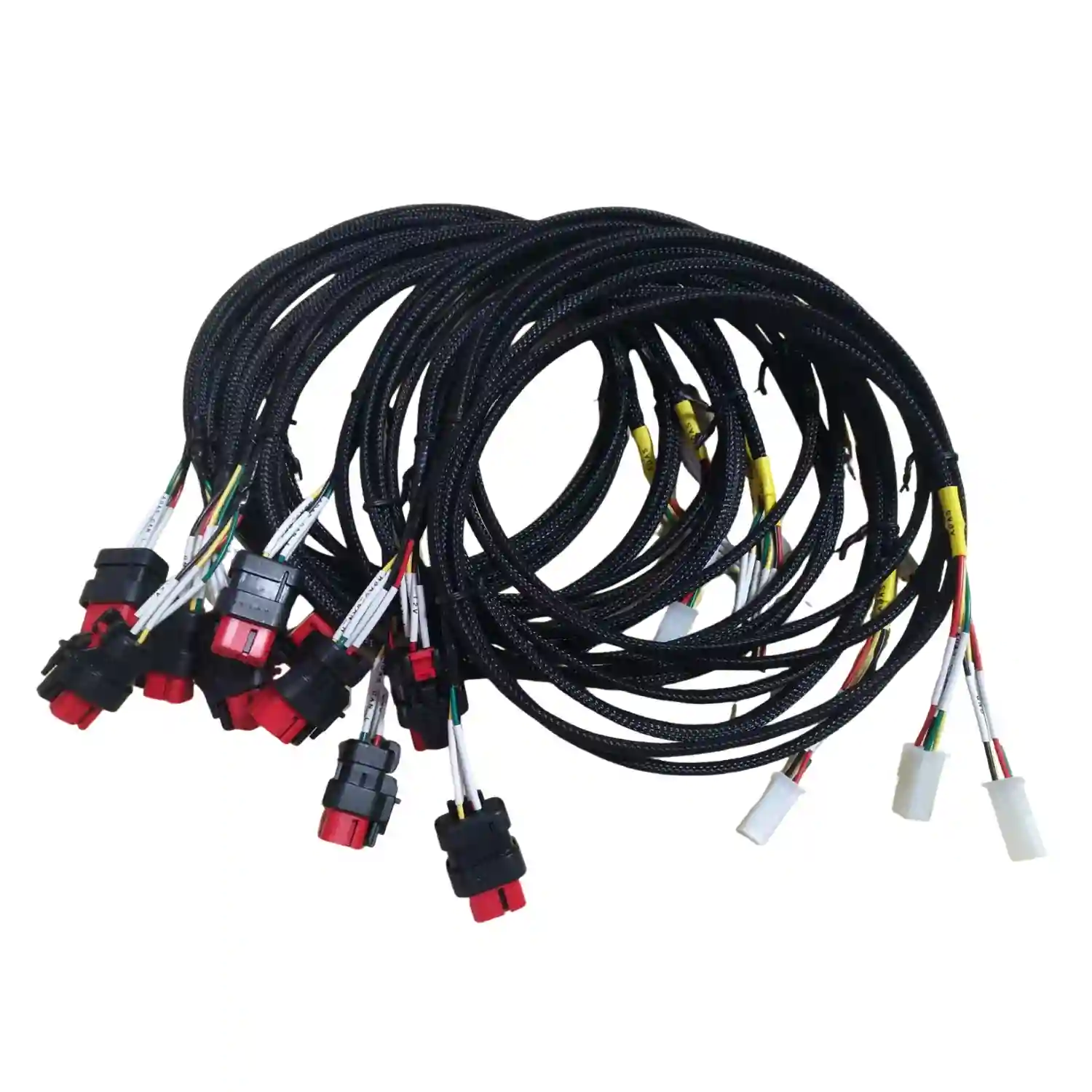
Many buyers treat an industrial cleaning robot as a simple branch of the broader robotics market. That assumption is expensive. A warehouse AMR, a six-axis welding robot, and an autonomous floor scrubber may all move on wheels and use batteries, but the cable assembly risks are different. Cleaning robots run near water tanks, chemical dosing systems, vacuum motors, rotating brushes, dock-charging contacts, and service panels that operators open regularly. The harness must survive both the machine's duty cycle and the maintenance routine around it.
That means cable design cannot stop at conductor ampacity or flex life. Engineers also need to manage detergent splash, wick-back through stranded conductors, washdown residue inside connector cavities, and abrasion where a harness crosses stamped chassis edges or pivots near a recovery tank. If your team already has a broader robot program, compare this application-specific guide with our robotic cable assemblies guide, our waterproof wire harness capability, and our industrial cable assembly page.
Typical sealing target for exposed branches
Recommended dock-mating validation cycles
Continuity and polarity test coverage at release
Typical clamp spacing in high-vibration wet zones
Cleaning robots punish the transition zone more than the cable core. If the branch exits a protected cavity and sees splash, vibration, and service access, the review should require extra strain relief, a sealed connector, and at least 20% margin on bend radius and current rise before release.
Why Cleaning Robots Are a Different Cable Problem
Industrial cleaning robots combine low-voltage mobility with environmental exposure that looks more like food equipment or outdoor machinery. The drive system and battery pack live in a dirty, wet chassis. Sensor packages sit high for vision but still route through condensate-prone cavities. Operators empty recovery tanks, change brushes, and wipe down housings, which means the cable assembly has to tolerate human handling as well as machine motion.
From a manufacturing perspective, these machines also mix circuit types in a compact footprint: battery leads, charger branches, CAN or Ethernet data, safety interlocks, fluid-level sensors, and motor power. The wrong routing decision lets noise from a brush motor corrupt a sensor line. The wrong connector choice turns a routine service panel into a leak path. The wrong insulation system survives lab continuity but embrittles after repeated detergent wipe-downs.
Subsystem Decisions That Actually Matter
The simplest way to keep this product class reliable is to stop treating the entire harness as one problem. Break the robot into functional zones and define the cable requirements for each zone. The comparison below is usually enough to expose the risky circuits before tooling starts.
| Subsystem | Electrical Load | Main Risk | Recommended Control |
|---|---|---|---|
| Battery and drive power | 24V to 80V, high current bursts | Heat, voltage drop, abrasion near chassis edges | Fine-strand copper, abrasion sleeve, locked power connector, thermal rise check |
| Brush and vacuum motors | Moderate current, vibration-heavy | Splash exposure and repeated shock loading | Tinned copper, sealed branch breakouts, clamp spacing under 150 mm |
| Lidar, camera, and 3D sensors | Low-voltage data and control | EMI, intermittent faults, connector contamination | Shielded twisted pairs, isolated wet-zone routing, shield termination review |
| Water level and chemical dosing sensors | Low current sensing circuits | Condensation wick-back and false readings | IP67 or better connector, adhesive-lined transitions, insulation resistance checks |
| Dock charging interface | Repeated mate-unmate cycles | Contact wear, arcing residue, misalignment | Serviceable connector set, plating review, 500+ cycle validation, wipe-clean geometry |
Notice that flex life is only one column. In cleaning robots, routing and serviceability often create more field failures than raw conductor fatigue. A lidar branch that works electrically can still fail because an operator must pull it too hard during tank removal. A charging lead can pass bench current tests but wear out in months if the dock connection self-aligns poorly and wipes contamination into the contacts on every cycle.
For cleaning robots, the validation plan should separate survivability into three questions: can the assembly carry the load, can it stay sealed, and can a technician service the machine without overstressing the cable. If one answer is weak, the harness is not ready even if continuity is perfect on day one.
Wire, Connector, and Sealing Stack
We usually start with tinned copper conductors because moisture and condensate are hard to eliminate completely in this application. From there, insulation selection depends on chemical exposure, flex expectation, and routing density. If the cable passes near scrubber heads or fluid tanks, the jacket needs to survive more than splash. It also needs to resist abrasion from trapped grit and survive cleaning chemistry residue between service intervals.
Connectors need the same application logic. A sealed connector family from our waterproof connector guide may be right near the brush deck but excessive inside a dry electronics cavity where size and service speed matter more. What matters is placing the seal where the environment changes and giving the branch enough strain relief that the seal is not doing the mechanical work alone.
For sensor and communication circuits, keep shields continuous and route them away from motor branches whenever possible. If the platform uses CAN, Ethernet, or camera links, validate the actual signal path. The test plan should align with the same discipline described in our CAN bus cable guide and shielded vs unshielded cable comparison, because wet contamination plus EMI is a bad combination for low-level signals.
Manufacturing Controls and Validation
A strong BOM does not guarantee a strong assembly. This product class needs process control at the crimp, seal, and branch transition level. We typically want documented crimp settings, seal insertion checks, branch breakout protection, and a test sequence that includes continuity, polarity, insulation resistance, and functional checks where charging or data circuits matter. For higher-risk programs, combine that with flex checks and wet-environment validation before SOP.
The production release package should also define what gets tested at sample level versus 100% at end of line. In most cleaning robot programs, 100% continuity and polarity are non-negotiable. Insulation resistance is strongly recommended for exposed branches. Pull-force checks remain useful for crimp validation, especially if operators will disconnect and reconnect the harness during routine maintenance. Our testing capability and quality inspection checklist show the baseline controls we recommend before volume release.
Seal validation
Verify grommet position, adhesive flow, and cavity fill instead of assuming a rated connector stays sealed after assembly.
Sensor-line verification
Run shield continuity and intermittent-fault checks on data circuits, not just simple open-short testing.
Dock-charge simulation
Validate mate-unmate wear, temperature rise, and misalignment tolerance before a production charger geometry is frozen.
Service review
Review the technician path with the actual panel opening and tank-removal motion to catch overpull and pinch points early.
How OEMs Should Source This Assembly
Buyers should not ask only for price, lead time, and MOQ. Ask the supplier how they will protect the wet-zone transitions, what test coverage is 100% versus sample-based, how they validate dock-charging wear, and whether they can support both prototype iterations and stable production documentation. If the answer is just "we build to print," the engineering support may be too shallow for a failure-sensitive machine.
The strongest suppliers for this segment can usually walk through routing assumptions, crimp windows, sealing checkpoints, and service-access constraints with specific numbers. They should be comfortable discussing bend radius, clamp spacing, current rise, shielding, ingress protection, and field-repair strategy in the same conversation. If your team is still defining the sourcing package, pair this article with our wire harness RFQ guide and DFM checklist.
Common Failure Modes to Eliminate Early
- Using an unsealed connector at a tank-adjacent branch because the compartment looks dry in CAD.
- Routing sensor pairs in parallel with motor leads for long distances, then chasing intermittent communication faults in validation.
- Letting the connector body act as the strain-relief feature instead of adding a proper clamp or boot.
- Specifying a dock-charge interface for current only and never validating insertion wear, wipe contamination, or thermal rise.
- Skipping service-motion review, which leads to hidden overpull every time a technician removes a tank, brush module, or side panel.
"A cleaning robot harness should be reviewed like a service part, not just an electrical part. If a technician can pinch it, soak it, or tug it during normal maintenance, that action belongs in your validation plan before the first production order."
FAQ
What IP rating should a cable assembly for an industrial cleaning robot use?
For most autonomous scrubbers and washdown floor machines, exposed cable interfaces should target at least IP67 and often IP68 on connectors placed near tanks, squeegees, or wheel wells. If the machine sees hot-water washdown or high-pressure spray, engineers often move to IP69K-style sealing and then verify it with production leak checks plus insulation resistance above 100 megaohms after moisture testing.
Are standard robotic cables good enough for industrial cleaning robots?
Not always. A standard high-flex robot cable may survive motion but still fail early if detergent splash, 85% to 98% relative humidity, or repeated battery-service handling are part of the real duty cycle. Cleaning robots need a blend of flex life, chemical resistance, abrasion control, and serviceable connector placement rather than flex rating alone.
Which conductor plating is better for cleaning robot harnesses?
Tinned copper is usually the safer default because it slows corrosion when moisture reaches the conductor bundle, especially at low-voltage power and sensor branches. Bare copper can work in sealed dry compartments, but once the route is exposed to condensate or cleaning fluid, tinned copper typically gives a better field-life margin for a modest material premium of roughly 8% to 15%.
How should dock-charging cables be tested before production release?
Run 100% continuity and polarity testing, then validate current-carrying circuits with contact-resistance checks, thermal rise review, and repeated mate-unmate cycling. For lithium-powered machines, we typically want at least 500 insertion cycles on the charging interface and a loaded current test that confirms connector temperature rise stays inside the supplier limit.
What is the most common failure point in cleaning robot cable assemblies?
The highest-risk area is usually the transition zone: the point where a cable leaves a protected cavity and enters a moving, wet, or service-access area. That is where bend stress, fluid ingress, and poor strain relief combine. In many field returns, the electrical design is acceptable but the boot, clamp spacing, or routing radius is off by only 20 to 30 mm.
Do industrial cleaning robots need different test plans for sensor cables?
Yes. Vision, lidar, encoder, and water-level sensor circuits should not be released using only gross continuity tests. Add shield continuity, insulation resistance, intermittent-fault checks during flexing, and connector retention verification. If the robot uses CAN or Ethernet, confirm the expected impedance or pair integrity instead of relying on a simple open-short test.
Related Reading
Robotic Cable Assemblies Guide
Broader high-flex design guidance for industrial automation programs.
Read moreWaterproof Connectors
Connector sealing choices for wet and washdown environments.
Read moreTesting Methods
How continuity, hipot, insulation resistance, and functional testing fit together.
Read moreNeed a Cleaning-Robot Cable Assembly Reviewed Before Release?
We help OEMs and automation integrators review wet-zone routing, connector sealing, charging interfaces, and production test plans before failures reach the field. Send the drawing, harness print, or prototype notes through our quote page or contact page and we can quote the build around the real duty cycle.