Table of Contents
- 1. Why CAN bus cable construction matters
- 2. Impedance, twist, and pair balance
- 3. Comparison table: recommended cable constructions
- 4. When shielding is necessary and when it is not
- 5. Wire gauge, connectors, and termination details
- 6. Validation tests before production release
- 7. Common mistakes that destabilize the network
- 8. FAQ
CAN bus is forgiving compared with many high-speed serial systems, but it is not magic. Teams still lose margin when they treat the cable like generic hookup wire and ignore pair geometry, stub length, shielding strategy, or connector transitions. Those errors often stay invisible during a quick bench check, then appear later as intermittent communication faults during vibration, cold start, or inverter switching.
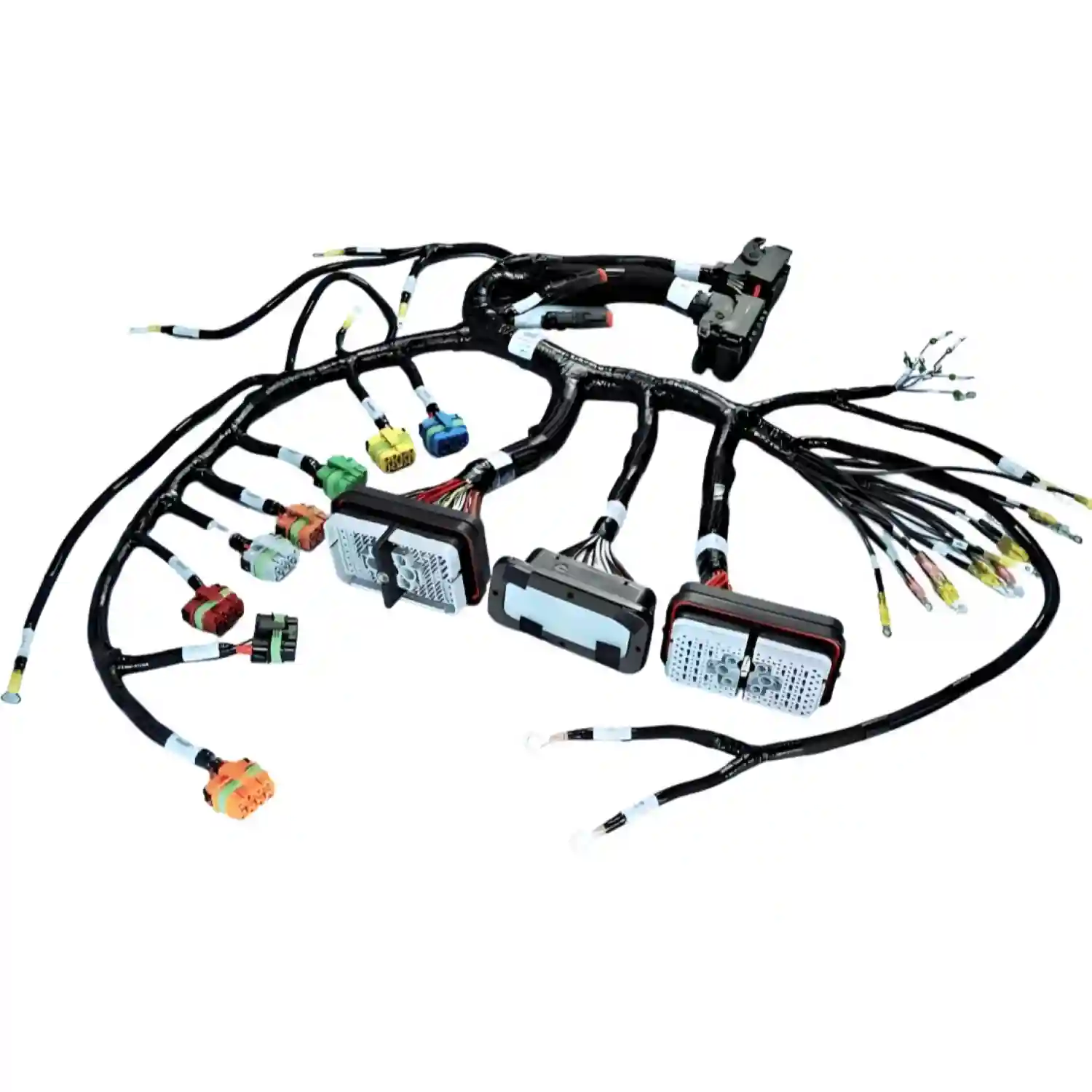
For production work, the cable must support the full network, not just a single node. That means the harness design needs to align with bus topology, node spacing, termination location, and environmental noise. A well-built data wire harness protects signal integrity through the entire vehicle or machine, while a marginal design pushes the burden onto software retries and field debugging.
The technical baseline usually starts with the CAN bus physical layer and the cable assumptions behind ISO 11898. Heavy-duty vehicles then layer on application expectations such as SAE J1939. The lesson for cable buyers is simple: the harness is part of the network, not just a passive commodity.
"If the pair loses symmetry for even 20 to 30 mm near the connector, CAN may still pass continuity but you have already spent some of your noise margin."
Impedance, Twist, and Pair Balance
High-speed CAN and CAN FD designs typically assume a 120 ohm differential cable. That target is influenced by conductor spacing, insulation dielectric constant, shield proximity, and the consistency of the twist pitch. A cable does not need lab perfection to work, but it does need stable geometry across the entire routed length.
Pair balance matters almost as much as nominal impedance. If one conductor is routed longer than the other, untwisted aggressively at the connector, or terminated with different mechanical stress, the system becomes more vulnerable to common-mode conversion. That is why experienced harness teams preserve the twist as close as practical to the terminal, instead of opening the pair early for cosmetic wire dressing.
The same principle applies when comparing classical CAN with CAN bus cable assemblies for faster data phases. CAN FD raises the value of consistent pair construction because the network tolerates less distortion from stubs, impedance steps, and poor connector breakout handling.
Comparison Table: Recommended Cable Constructions
The right CAN cable depends on environment more than marketing labels. The matrix below is a practical starting point for production decisions.
| Environment | Typical Gauge | Shielding | Jacket / Insulation | Selection Note |
|---|---|---|---|---|
| Passenger vehicle interior | 22-24 AWG | Unshielded or foil optional | PVC or thin-wall automotive insulation | Good when routing is separated from high-current switching |
| Engine bay / off-highway | 20-22 AWG | Foil or foil plus braid | XLPE, cross-linked automotive insulation | Better thermal and chemical margin near heat and fluids |
| Industrial machine control | 20-22 AWG | Foil with drain wire | PVC, TPE, or PUR | Useful when bundled near drives, contactors, and motors |
| Robotics / continuous flex | 22-20 AWG fine-strand | High-flex braid or foil plus braid | PUR or TPE | Need flex-rated stranding and stable pair geometry |
| Heavy-duty J1939 vehicle | 18-20 AWG | Usually shielded | Abrasion-resistant thermoset or XLPE | Longer runs and harsher EMI exposure justify more margin |
| Prototype bench harness | 24-22 AWG | Optional | General-purpose PVC | Acceptable only for short, controlled validation work |
When Shielding Helps
Shielding is not mandatory on every CAN network. It becomes more valuable when the cable runs near motors, high-voltage systems, switching power electronics, or long bundles carrying noisy power circuits. In these cases, a foil shield with drain wire is often a cost-effective baseline.
If the harness also needs mechanical toughness or flex life, a foil-plus-braid or braid-focused shield strategy can offer better durability than foil alone. The termination method matters as much as the shield itself. A poorly grounded braid can turn an expensive shield into decoration.
When Unshielded Is Fine
Unshielded twisted pair often works well in vehicle interiors, body electronics, and moderate industrial environments. CAN is inherently differential, so pair twist and sane routing provide a lot of noise rejection already.
The mistake is assuming unshielded means uncontrolled. You still need stable twist, separation from high-current branches, and disciplined termination. If routing constraints are poor, an unshielded pair placed next to switching conductors can lose more margin than a shielded pair routed correctly.
"A shield does not fix bad topology. First control stub length, pair routing, and termination discipline. Then add shielding when the environment actually demands it."
Wire Gauge, Connectors, and Termination Details
Gauge selection should reflect more than ampacity. CAN bus conductors carry low current, but the cable still needs to survive assembly handling, terminal crimping, vibration, and service. That is why 22 AWG and 20 AWG are common choices even where the electrical load would allow much smaller wire.
Connector choice must also match the environment. Compact signal connectors may be fine inside an enclosure, while sealed automotive programs often need terminal systems with positive locking, controlled seal compression, and predictable pull-out performance. If your harness joins into a larger module, pair integrity should be maintained right through the connector cavity assignment rather than split into arbitrary pin locations.
For procurement teams, the safe approach is to buy the whole process rather than just the wire. A qualified supplier should understand crimp validation, pair preservation, and the inspection controls needed to keep each build consistent. The same attention applies if the harness later integrates into box build assemblies or mixed power-signal cable systems.
Crimp Window
Choose terminals validated for the actual strand count and insulation OD, not just nominal AWG.
Breakout Control
Keep the untwisted section short and mechanically stable at every connector transition.
Documentation
Record pair ID, shield termination method, pinout, and test results in the work instruction and control plan.
"For CAN FD, the connector breakout is often the hidden weak point. The cable may be nominally 120 ohm, but a sloppy untwist zone can still trigger edge distortion above 2 Mbit/s."
Validation Tests Before Production Release
Continuity alone is not enough for a production CAN harness. A useful release plan starts with 100% pinout and continuity checks, then adds resistance and insulation tests as required by the application. Programs with higher risk or higher speed should also review impedance behavior, physical twist preservation, and actual network performance under representative load.
This is where a supplier's cable testing capability matters. If the team cannot verify the finished assembly beyond a simple go/no-go fixture, the burden shifts onto vehicle or machine integration. That is a slow and expensive place to discover a pair imbalance, weak shield termination, or wrong cavity loading.
Recommended validation stack
- 100% continuity, shorts, and pinout verification
- Conductor resistance and shield/drain continuity checks
- Visual audit of twist retention at both connector ends
- Sample-level impedance or TDR review for critical programs
- EMC and vibration validation when routed near motors or HV systems
- Functional network test with representative nodes and termination
Common Mistakes That Destabilize the Network
Design and routing mistakes
- Using two loose single conductors instead of a controlled twisted pair
- Excessively untwisting the pair to simplify connector dressing
- Running the bus in parallel with inverter or motor leads for long distances
- Adding uncontrolled stubs through branch routing shortcuts
Production and sourcing mistakes
- Substituting wire with different dielectric or pair geometry without validation
- Choosing terminals by AWG label only and ignoring strand count or insulation OD
- Leaving shield terminations inconsistent across operators or shifts
- Releasing the harness after continuity only, with no functional network confirmation
These failure modes are preventable when the harness is reviewed as a complete system. The most reliable sourcing path is to define the cable construction, connector family, routing assumptions, and test plan before quotation, then lock those items into the approved drawing and process documentation.
FAQ
1. What impedance should a CAN bus cable be?
Most high-speed CAN and CAN FD networks are designed around 120 ohm characteristic impedance, with system termination created by two 120 ohm resistors in parallel for an effective 60 ohm load. A cable that drifts far from 120 ohm can create reflections and unstable communication at higher bit rates.
2. Does CAN bus cable need shielding?
Not always. A twisted pair with controlled routing is often enough in moderate-noise environments. Shielding becomes more important near inverters, motors, high-current switching, or long parallel runs with power wiring. In those cases, foil or foil-plus-braid can materially reduce common-mode noise.
3. What wire gauge is typical for CAN bus wiring?
Common production ranges are 24 AWG to 18 AWG depending on network length, connector system, and durability target. Many automotive and industrial CAN harnesses use 22 AWG or 20 AWG because they balance flexibility, crimp compatibility, and mechanical robustness.
4. Can I use ordinary hook-up wire for CAN bus?
It may function on a short bench setup, but it is not a robust production choice. Generic single conductors do not control twist pitch, pair balance, or impedance, so the network margin falls quickly as length, node count, or data rate increases.
5. What is different about CAN FD cable compared with classical CAN?
CAN FD usually pushes higher edge rates during the data phase, so pair symmetry, impedance consistency, stub control, and connector transitions matter more. A cable that works at 500 kbit/s on classical CAN can still become marginal when the data phase rises to 2 to 5 Mbit/s on CAN FD.
6. How should a CAN bus cable assembly be tested before release?
A sensible release plan includes 100% continuity and pinout verification, insulation checks as required, resistance checks, visual inspection of twist preservation at terminations, and at least sample-level network validation. Critical programs often add impedance or TDR checks, EMC evaluation, and vibration testing.
Need a production-ready CAN bus cable assembly?
Our team builds custom CAN bus and data harnesses with controlled pair routing, shield options, validated crimps, and 100% test coverage. If you need help with CAN, CAN FD, J1939, or mixed power-and-signal harnesses, we can review your drawing and recommend a manufacturable cable construction.