Robotics Cable Assembly
Purpose-built cable assemblies for industrial robots, collaborative robots, and automation cells. Validated to 20M+ flex cycles with bend radii down to 5x OD\u2014far beyond standard high-flex cable performance.
Robotics Cable Capabilities
Cable assemblies designed from the ground up for the mechanical and electrical demands of robotic systems.
Ultra-High Flex Cycles
Cables rated for 10M to 20M+ flex cycles with validated bend radius testing per IEC 60228 and VDE 0298. Designed for continuous robot arm articulation.
Tight Bend Radius
Minimum bend radius down to 5x cable outer diameter for compact robotic joints. Standard cables typically require 10-15x OD, limiting routing options.
EMI Shielding
Braided and foil shielding configurations achieving >90 dB attenuation at 1 GHz. Critical when servo drives and signal cables share the same cable chain.
Wide Temperature Range
TPE and PUR jackets rated from -40°C to +105°C for cold storage robots and foundry automation. Silicone options extend to +200°C.
Integrated Design
Hybrid cable assemblies combining power, signal, data (EtherCAT, PROFINET), and pneumatic lines in a single jacket, reducing robot arm routing complexity by up...
Rapid Prototyping
First article robotic cable prototypes in 5 business days with full flex cycle validation data. Production tooling ready within 3 weeks of approval.
Robotic Cable Specifications
Key parameters that differentiate robotic-grade cable assemblies from standard industrial cables. These numbers matter when your robot runs 24/7.
| Parameter | Standard Industrial | Our Robotic Grade | Industry Benchmark |
|---|---|---|---|
| Flex Cycle Life | 1M\u20133M cycles | 10M\u201320M+ cycles | 5M\u201310M cycles |
| Min Bend Radius | 10\u201315x OD | 5\u20137.5x OD | 7.5\u201310x OD |
| Shielding Effectiveness | 40\u201360 dB @ 1 GHz | >90 dB @ 1 GHz | 60\u201380 dB @ 1 GHz |
| Temperature Range | -20\u00B0C to +80\u00B0C | -40\u00B0C to +105\u00B0C | -25\u00B0C to +90\u00B0C |
| Jacket Material | PVC | TPE / PUR / Silicone | PUR |
| Torsional Rating | Not specified | \u00B1180\u00B0/m validated | \u00B190\u00B0/m typical |
| IP Rating Options | IP20 | IP67 / IP68 / IP69K | IP65 / IP67 |
| Certification | UL 758 | UL 758 + IEC 60204-1 + IPC/WHMA-A-620 Class III | UL 758 + IPC/WHMA-A-620 Class II |
Flex cycle ratings are validated on our in-house test rig per VDE 0298 test methods. Standard industrial cables are typically rated for linear cable chain applications only\u2014they are not designed for the combined bending and torsional stress found in multi-axis robot arms.
Which Cable for Which Robot?
Not every robot needs the most expensive cable. Here is how we match cable construction to the actual mechanical demands of your application.
SCARA Robots (2\u20134 Axes)
Primarily linear and rotational motion in a single plane. Torsional stress is moderate. A high-flex TPE cable with 5\u20137.5x OD bend radius and 5M\u201310M cycle rating is usually sufficient.
6-Axis Articulated Robots
Complex multi-axis motion with combined bending and torsion at joints 2, 3, and 5. Requires robotic-grade PUR or TPE cables with \u00B1180\u00B0/m torsional rating and 10M+ cycle life.
Collaborative Robots (Cobots)
Lower payload but frequent re-teaching and re-deployment. Cables must tolerate repeated connector mating cycles and occasional pinch events. Lightweight, flexible TPE with high mating-cycle connectors.
Delta / Parallel Robots
Extremely high acceleration (up to 15G) with short, fast strokes. Cable weight directly impacts cycle time. Ultra-lightweight constructions with aramid strength members and thin-wall TPE jackets.
Gantry / Cartesian Systems
Linear motion along 2\u20133 axes with long cable runs (5\u201330m). Standard high-flex chain-rated cables work well here. The priority is low friction in the cable carrier and consistent impedance for long signal runs.
AGV / AMR Mobile Robots
Vibration, occasional impact, and environmental exposure (oil, water, debris). Cables need abrasion-resistant PUR jackets, IP67+ sealing, and strain relief at every termination point.
Our Process
A structured approach that catches problems before they reach your production floor.
Application Analysis
We review your robot model, axis configuration, cable carrier type, and duty cycle. This determines flex class, bend radius, and shielding requirements.
Cable & Connector Selection
Based on the flex class and environment, we select cable constructions (TPE, PUR, silicone) and connectors (M8, M12, hybrid, custom) matched to your robot...
Prototype & Validation
We build first articles and run flex cycle validation on our test rig. You receive a test report with cycle count, resistance drift, and visual inspection data.
Production Tooling
Custom stripping dies, crimp tools, and test fixtures are built. Overmold tooling is designed if strain relief or environmental sealing is required.
Controlled Production
Manufacturing under IPC/WHMA-A-620 Class II or III criteria with 100% electrical testing. Every cable is hipot tested and continuity verified.
Ongoing Support
Kanban delivery, field failure analysis, and design revisions as your robot platform evolves. We track flex life data across your fleet for predictive...
One Cable, Multiple Functions
The biggest routing challenge in robot arms is managing multiple separate cables for power, encoder signals, fieldbus communication, and pneumatics. Each cable adds weight, stiffness, and a potential failure point. Hybrid robotic cables solve this by combining multiple circuits into a single, flex-optimized construction.
A typical 6-axis robot hybrid cable might carry: 3-phase 400V motor power (4 x 1.5mm\u00B2), two encoder signal pairs (individually shielded), one EtherCAT or PROFINET data pair, and optional pneumatic tubing\u2014all within a 14\u201318mm OD PUR jacket. This reduces cable count by 60\u201370% and cuts installation time by roughly 40%.
Hybrid Cable Benefits
- 60–70% fewer cables in arm
- 40% faster installation
- Reduced cable carrier load
- Single strain relief point
- Lower total cost of ownership
Design Considerations
- Power/signal internal shielding
- Impedance matching for data pairs
- Conductor gauge optimization
- Jacket material for environment
- Connector pin density planning
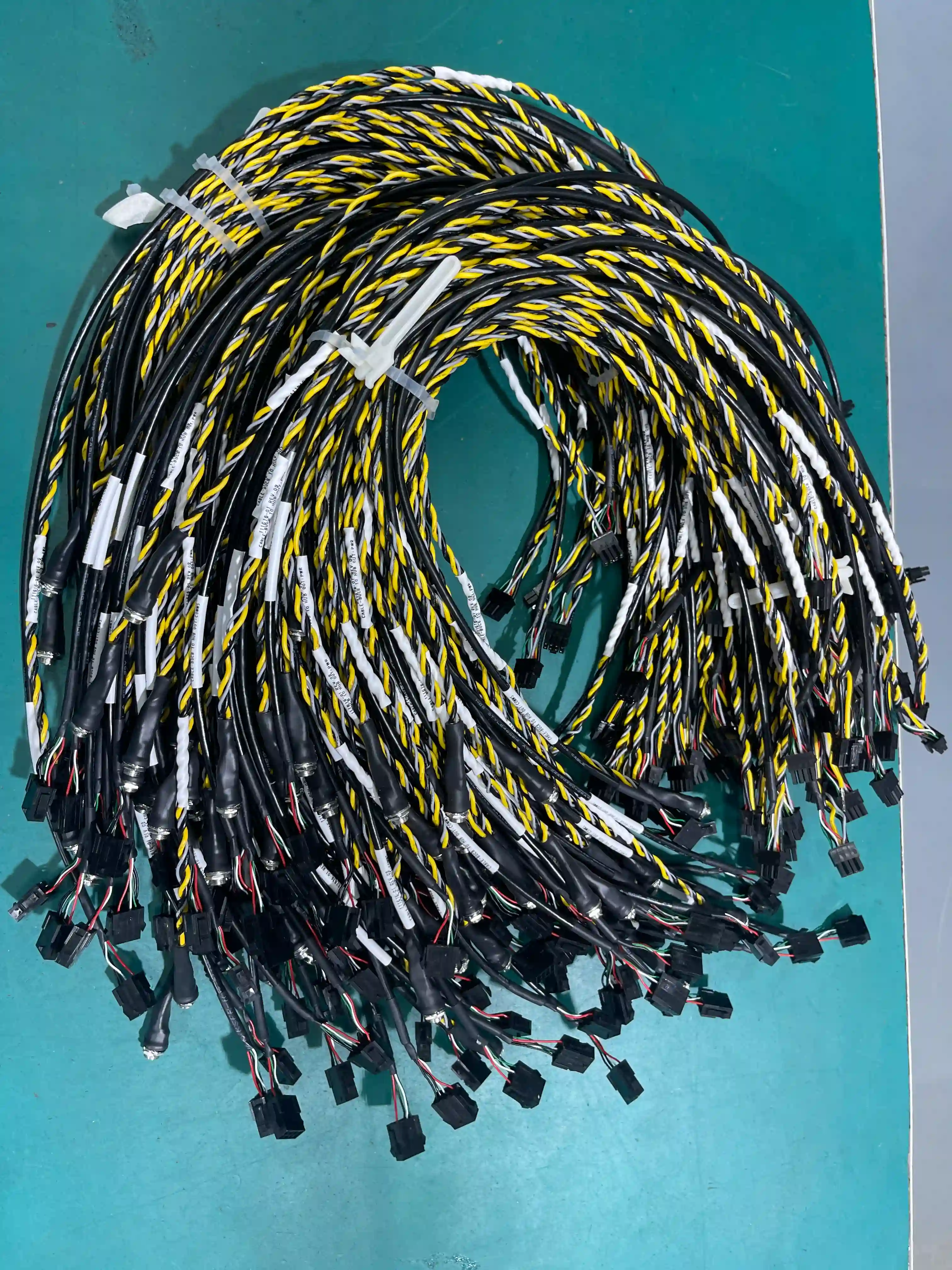
Representative Project: Welding Cell 6-Axis Robot Cable Retrofit
Illustrative project type, not a specific customer engagement.
Challenge
An industrial robotics user experienced recurring cable failures on six-axis welding robots. The original cables were standard chain-rated PUR assemblies not designed for the combined bending and torsion at axes 2 and 3. Each failure caused hours of unplanned downtime and significant lost production cost.
Solution
We designed a hybrid robotic cable combining 3-phase 400V power, foil-shielded encoder pairs, and a data pair in a single PUR jacket with a high torsional rating. Overmolded connectors at the base and a custom connector at the wrist. Bend radius specified at 6x OD. Full flex cycle validation to 10M cycles on our test rig.
Results
No cable failures in the early operating period (previously several failures per year per robot). Cable count per arm was reduced, cutting installation time substantially. Total cost of ownership dropped meaningfully once eliminated downtime was accounted for, and the design approach was suitable for rollout across additional robot cells.
Standards & Compliance
Robotic cable assemblies must meet multiple overlapping standards depending on the application, industry, and installation environment.
Cable & Harness Standards
- IPC/WHMA-A-620 Class III
Highest workmanship class for critical applications
- IEC 60204-1
Electrical equipment of machines — general requirements
- UL 758 / UL 20276
Appliance wiring material and data cable safety
- VDE 0298
German standard for cable flex life testing methods
Industry-Specific Requirements
- IATF 16949
Automotive quality management for robot cells in OEM plants
- ISO 13485
Medical device quality for surgical and rehabilitation robots
- IEC 60601-1
Medical electrical equipment safety for robotic surgery
- ISO 10218-1/2
Robot safety requirements influencing cable routing and protection
Full compliance documentation and certificates of conformance are provided with every shipment. We maintain traceability from raw material lot through finished cable assembly per IPC requirements.
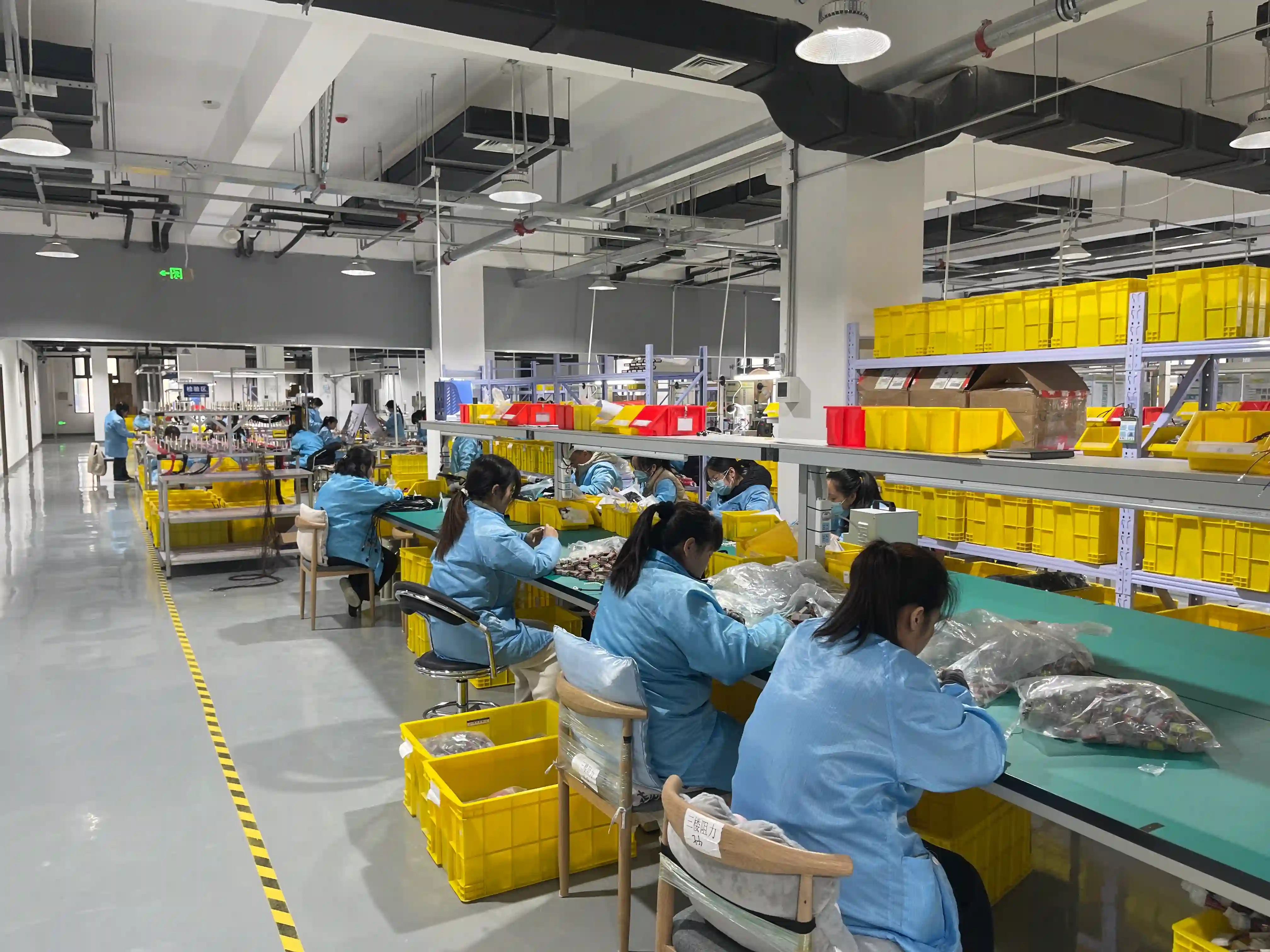
Built for Your Volume
Whether you need 10 prototype cables for a new robot model or 50,000 production units for a fleet deployment, our manufacturing line scales without compromising quality. Automated cutting and crimping ensures consistency from the first piece to the last, while 100% electrical testing catches defects before they ship.
Frequently Asked Questions
Common questions about robotic cable assemblies from engineers and procurement teams.
How many flex cycles do robotic cables typically last?
It depends on the cable construction and bend radius. Standard high-flex cables rated to 5M cycles at 10x OD bend radius. Robotic-grade TPE/PUR cables achieve 10M–20M+ cycles at 5–7.5x OD. We validate actual cycle life on our flex test rig and provide a certified test report with each cable part number.
What files do I need to provide for a robotic cable quote?
Ideally: robot model and axis count, cable routing diagram or drag chain specs, connector pinout, signal/power requirements, and expected annual volume. If you have a sample or competitor part number, that works too. We can quote from a concept description, but the more detail you provide, the more accurate the first quote will be.
When should I choose a robotic cable vs a standard high-flex cable?
Use robotic-grade cables when your application involves multi-axis articulation (3+ axes), bend radii below 10x OD, or combined torsional and bending motion. Standard high-flex cables (see our high-flex cable assembly page) are sufficient for linear cable chains with single-axis bending above 10x OD. Robotic cables cost 20–40% more but last 3–5x longer in multi-axis applications.
What is the lead time for robotic cable assemblies?
Prototypes ship in 5 business days for standard configurations. Custom overmolded or hybrid assemblies take 2–3 weeks for first articles. Production lead time is 3–4 weeks after tooling approval, with kanban scheduling available for ongoing programs to reduce effective lead time to 1 week.
What certifications apply to robotic cable assemblies?
We manufacture to IPC/WHMA-A-620 Class II or III. For machinery installations, cables comply with IEC 60204-1. Automotive robot cells require ISO 9001 certification (which we hold). Cable materials meet UL 20276 (data) and UL 758 (appliance wiring). We can provide VDE and cURus markings on request.
Can you combine power and signal in one robotic cable?
Yes. Hybrid robotic cables are common—they reduce routing bulk and weight in the robot arm. We typically separate power and signal pairs with internal shielding foils to prevent crosstalk. For example, a 4-axis SCARA cable might carry 3-phase 400V power, 2 encoder signal pairs, and an EtherCAT pair in a single 12mm OD jacket.
What is the MOQ for robotic cable assemblies?
Prototype quantities start at 1 piece and there is no fixed minimum order. For standard configurations an economical production batch is typically around 50 pieces (about 100 for custom overmolded or hybrid assemblies), but lower volumes are accepted with a setup surcharge. We stock common robotic connector types (M8, M12, D-sub) to reduce lead time on small orders.
Related Services
These services are frequently paired with robotic cable assemblies.
High Flex Cable Assembly
Continuous flexing cables for linear motion and cable chains
Learn moreShielded Cable Assembly
EMI/RFI protected cables for noisy electrical environments
Learn moreM12 Cable Assembly
Industrial circular connectors common in robotic systems
Learn moreOvermolded Cable Assembly
Custom molded strain relief and environmental sealing
Learn moreYour Partner for Robotics Cable Assembly Manufacturing
A robotics cable assembly is fundamentally different from a standard industrial cable. The combined bending, torsion, and acceleration in a multi-axis robot arm creates mechanical stresses that destroy conventional cables in months. We design and manufacture cable assemblies specifically for these conditions, using materials and constructions validated to tens of millions of flex cycles.
Our engineering team starts every project by analyzing your robot's axis configuration, duty cycle, and operating environment. This determines the cable flex class (per IPC/WHMA-A-620), jacket material (TPE for general robotics, PUR for abrasion resistance, silicone for extreme heat), and shielding strategy (braid for physical protection, foil for high-frequency EMI, or both for servo-driven axes).
Hybrid cable designs are our specialty for robotic applications. Instead of routing 4\u20136 separate cables through a robot arm\u2014each with its own connector, strain relief, and failure risk\u2014we combine power, signal, data, and even pneumatic lines into a single flex-optimized assembly. This approach reduces cable count by 60\u201370%, cuts installation time by approximately 40%, and significantly improves reliability because there are fewer termination points to fail.
We serve the full range of robotic applications: automotive manufacturing cells, medical and surgical robots, warehouse AGVs and AMRs, food processing cobots, and semiconductor cleanroom robots. Our testing capabilities include flex cycle validation, hipot dielectric testing, and environmental chamber testing to ensure every cable meets its rated performance.
For engineers specifying cables for new robot platforms, we offer a rapid prototyping service with first articles in 5 business days. Each prototype ships with a full test report including continuity, hipot, and flex cycle data. Production tooling\u2014including custom overmolding for strain relief and environmental sealing\u2014is ready within 3 weeks of design approval.
Real Project Experience
How we've handled similar wire harness and cable assembly projects
See de-identified project scenarios — supplier qualification, connector-shortage recovery, lead-time compression, and engineering spec lockdown — drawn from real production records.
Ready to Design Your Robotic Cable Assembly?
Share your robot model and application details. Our engineering team will recommend the optimal cable construction and provide a quote within 24 hours.