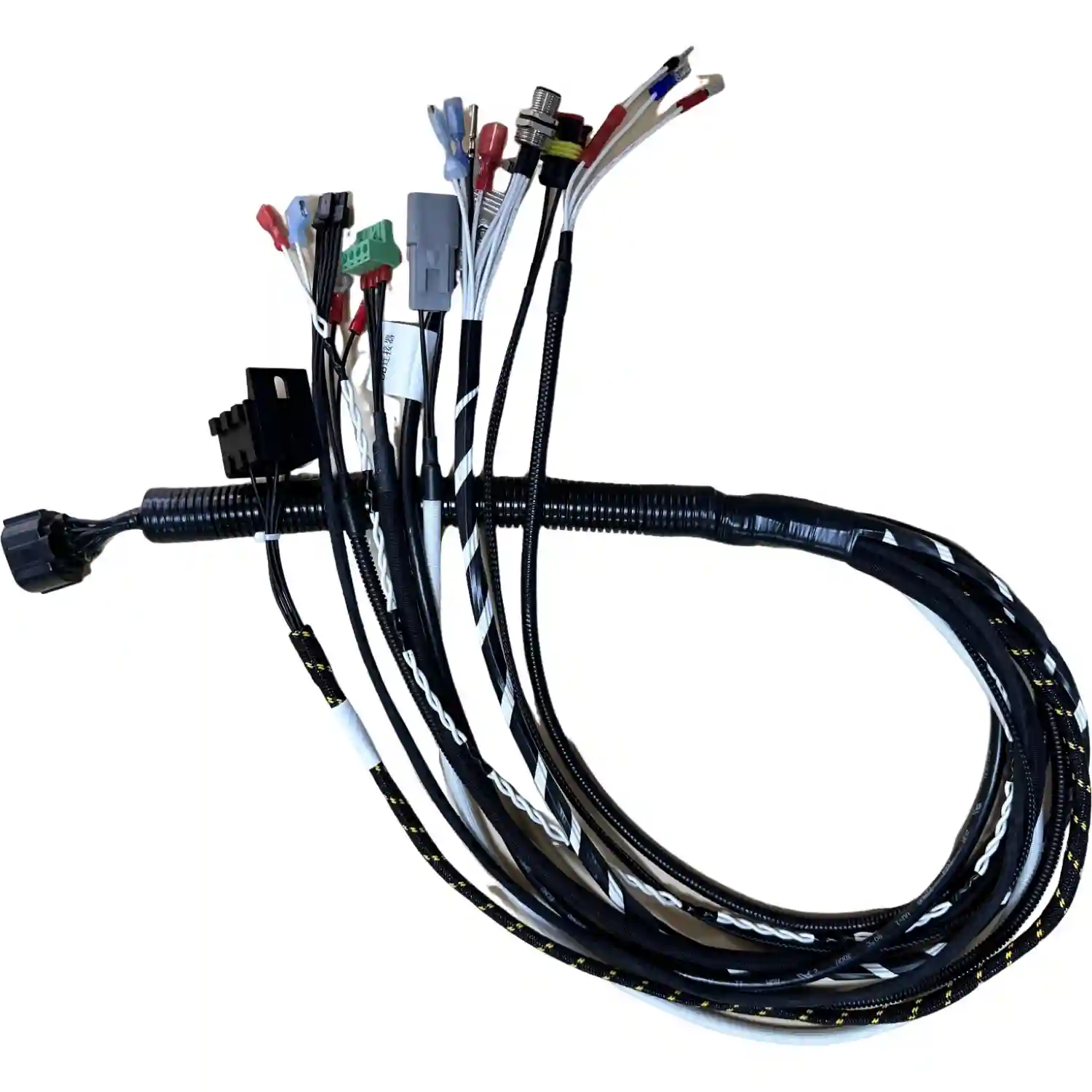
First article inspection is where a cable assembly program either becomes repeatable or starts accumulating hidden risk. We see this at the factory every week: a prototype passes continuity, looks acceptable on the bench, then FAI exposes a mislabeled branch, an over-compressed seal, or a crimp height drifting 0.05 mm outside the terminal supplier window. Those are not cosmetic issues. They are early warnings that the build process, drawing, or material callout is not stable enough for production release.
In practical terms, FAI is the documented bridge between prototype build and controlled manufacturing. It confirms that the released drawing, approved BOM, work instructions, fixtures, and test plan all produce the same result. If you are setting up a new harness or cable project, pair this guide with our rapid prototyping service, testing capability overview, and quality inspection checklist.
Typical first article samples reviewed before release
Common review cycle for standard cable assemblies
Core evidence blocks in a complete FAI package
Expected pinout and visual verification on first articles
"A first article is not a courtesy sample. It is evidence. If the report cannot trace the build to the drawing revision, terminal spec, and test result, you do not have approval data, you have only a prototype that happened to work once. In our factory, that distinction matters more than any single dimension on the print."
What First Article Inspection Really Means
A good cable assembly FAI answers four questions at once. Did we build the exact revision requested? Did we use the specified materials? Did the sample pass the dimensional, electrical, and workmanship criteria? Can we reproduce this result on the actual production line? That is why FAI sits above simple end-of-line testing. Continuity alone will not tell you whether a TE Connectivity terminal was substituted without approval, a Molex housing uses the wrong keying, or the label format no longer matches the customer's ERP receiving rules.
Formal aerospace programs often map FAI to first article inspection documentation and AS9102 logic. Automotive customers may ask for FAI before or alongside PPAP. Industrial and medical customers usually use their own templates, but the evidence set is similar: drawing compliance, traceability, test output, photos, deviations, and signoff.

FAI Confirms
- Drawing revision and BOM match the approved release package
- Wire lengths, breakouts, labels, and connector orientation meet print tolerance
- Crimp, solder, sealing, and overmolding processes are controlled
- Electrical test coverage matches the product risk level
FAI Does Not Replace
- Ongoing in-process audits during regular production
- Process capability studies for automated or high-volume lines
- Environmental validation such as vibration, thermal, or IP sealing tests
- Supplier change control after production release
When FAI Is Required
Many buyers assume FAI only happens on the first build. In reality, any meaningful change can trigger a new first article. We re-run or partially re-run FAI when a revision changes wire gauge, terminal plating, connector family, label format, branch geometry, backshell torque, or test method. The same applies when production moves from manual assembly to a semi-auto line, or from one plant to another, because process variation often appears even when the part number stays the same.
The underlying quality logic mirrors ISO 9001 quality management principles: a released product is only stable when changes are documented, reviewed, and verified. If your supplier says a new terminal is "equivalent" but cannot show the revised FAI evidence, treat that as a process gap, not a sourcing shortcut.
"The most expensive FAI failures are not dramatic. They are quiet mismatches: a label barcode that scans incorrectly, a breakout dimension that steals routing clearance, or a seal compressed just enough to pass inspection but not enough to survive 500 mating cycles. That is why first article review must combine paperwork, measurements, and real product handling."
Typical Re-FAI Triggers
What a Strong FAI Report Includes
A useful FAI report lets a customer, auditor, or internal quality engineer reconstruct exactly what was built and why it was accepted. Our team usually structures the package around traceability, dimensional evidence, process evidence, and release status. If any of those blocks are missing, the FAI is hard to defend later during a complaint review or supplier audit.
| Report Element | Why It Matters | Typical Evidence | Risk If Missing |
|---|---|---|---|
| Revision control | Confirms exact print and BOM used | Drawing rev, ECO number, approved BOM | Wrong build released to production |
| Material traceability | Shows approved wire and connector lots | Lot codes, C of C, label photos | Unapproved substitutions hidden in launch |
| Dimensional results | Verifies fit and routing envelope | Overall length, breakouts, connector clocking | Assembly fits test bench but not final product |
| Electrical test summary | Confirms pinout and insulation integrity | Continuity, shorts, IR, hipot as required | Latent wiring faults missed before build release |
| Process evidence | Validates crimp and assembly method | Crimp height, pull force, work instruction photos | Repeatability cannot be proven |
| Deviation log | Separates accepted exceptions from hidden defects | NCR list, waiver approval, corrective actions | Disputes later on what was approved |
Measured Features
Overall length, breakout positions, label location, strip length, and connector orientation should be recorded against the drawing tolerance.
Test Evidence
Pull-force data, crimp height, continuity, insulation resistance, or hipot records prove the build is not only dimensional but functional.
Release Control
Customer approval, internal quality release, and frozen work instructions keep the approved article from drifting during ramp-up.
How Many Samples and Which Tests
The right sample quantity depends on process complexity, not on a generic quality slogan. A two-end jumper with standard crimp terminals and a stable continuity test board may only need one documented golden sample plus one retained reference. A multi-branch wire harness with sealed connectors, printed labels, braided shielding, or overmolded exits should rarely rely on a single piece. We usually want enough samples to prove the process is repeatable across operators, fixtures, and test steps, even if the customer only requests one formal first article report.
In our factory, the FAI review becomes much stronger when the sample plan separates non-destructive evidence from destructive evidence. One or two pieces may be kept fully intact for dimensional, visual, and electrical approval. Another sample can be opened for cross-section checks, retention testing, or cut-and-strip confirmation. That approach avoids the common mistake of approving a beautiful sample that was never challenged by the process checks most likely to reveal weakness.
The same rule applies to acceptance criteria. A customer may say "inspect all dimensions," but the smarter method is to identify critical-to-function features first: connector clocking, breakout positions, branch lengths, terminal retention, and any interface dimension affecting fit. Cosmetic features still matter, especially for visible medical or consumer products, but they should not crowd out the features that determine whether the assembly installs, seals, and survives service.
Low-Complexity FAI
- 1 to 2 samples with 100% dimensional and electrical review
- Standard open-barrel crimps with known applicator settings
- Limited branch geometry and no custom tooling
- Minimal destructive testing if process history is established
High-Complexity FAI
- 3 to 5 samples, often including one destructive verification piece
- Sealed automotive connectors, custom molds, or braided/shielded constructions
- Multiple critical dimensions affecting fit-up in the customer assembly
- More evidence needed for requalification after process transfer or tooling change
FAI vs In-Process Inspection vs PPAP
| Control Method | Primary Purpose | When Used | Typical Output |
|---|---|---|---|
| First Article Inspection | Validate the first build against the release package | New launch, revision, process move, requalification | FAI report, sample approval, deviation log |
| First Piece Inspection | Confirm setup at line start or shift start | Daily startup, setup change, tool change | Startup record, operator signoff |
| In-Process Inspection | Control repeatability during production | During all production lots | Patrol checks, SPC, layered audits |
| Final Inspection | Screen outgoing product before shipment | End of lot or 100% test stage | Acceptance record, shipment release |
| PPAP | Approve manufacturing process and submission package | Automotive SOP, major change, customer request | PSW, control plan, PFMEA, capability evidence |
Recommended Approval Workflow
The cleanest FAI flow is simple. Freeze the release package. Build samples from the intended process. Inspect them with the same test coverage required for production risk. Close every deviation in writing. Then lock the approved method into the router, tester program, labels, and packing spec before ramp. If any of those steps are skipped, the launch still depends on tribal knowledge, and that is where repeat defects begin.
Freeze the drawing revision, BOM, approved alternates, and test requirements before building samples.
Build 1 to 5 samples on the intended line using production-grade tools, fixtures, labels, and test boards.
Measure critical dimensions, verify connector keying, and confirm all wire colors, markings, and branch IDs.
Run electrical tests plus process checks such as crimp height, pull force, torque, and seal position when relevant.
Create the FAI report with photos, evidence attachments, and a clear approved or rejected status for each item.
Close deviations before release, then freeze work instructions and operator training to the approved article.
"If the first article is built on one bench, inspected by one engineer, and then handed to a different production team with different tools, you have not validated the process. You have validated a moment. Real FAI discipline means the sample, the report, and the line release all describe the same method within a measurable tolerance window."
Common Findings During Cable Assembly FAI
The highest-value FAI findings are usually small enough to miss during casual prototype review. In our experience, the recurring issues are incorrect label syntax, terminal backout risk, branch dimensions drifting after taping, and undocumented material swaps driven by lead time pressure. Those findings are exactly why buyers should not treat first article approval as a checkbox.
Most Frequent NCRs
- Wire cut length within total tolerance, but breakout point outside branch tolerance
- Crimp height acceptable on one cavity, unstable across multi-cavity applicator positions
- Heat shrink or labels blocking connector latch visibility
- Equivalent connector family used without customer revision approval
- Tester program passing continuity but missing cavity presence check
Best Preventive Actions
- Balloon the drawing so every critical feature maps to the report
- Freeze approved material alternates before prototype purchasing begins
- Capture setup parameters for crimp presses, stripping, and tester fixtures
- Photograph labels, packaging, and orientation-sensitive connectors
- Require written deviation closure before mass production booking
Buyer Checklist Before Approval
Before signing off an FAI, buyers should challenge the package the same way a quality engineer would. Ask whether the report proves repeatability, not only one-off assembly success. Check whether the critical characteristics are measured, whether substitutions were disclosed, and whether the test coverage matches the application. A medical or aerospace cable assembly deserves more evidence than a simple internal jumper, even if both pass continuity.
- Confirm the report references the latest drawing revision and all approved deviations.
- Review photos for connector orientation, labels, branch breakout, and packaging configuration.
- Match electrical test coverage to the product risk level, not only to what is convenient to test.
- Ask for crimp or retention evidence on terminals, splices, and sealed cavities where failure risk is high.
- Verify the approved article is linked to production work instructions, tester programs, and label files.
If you are preparing a supplier handoff, our wire harness RFQ guide, crimping capability page, and crimping best practices article help define the data pack that makes FAI faster and cleaner.
FAQ
What is first article inspection in cable assembly manufacturing?
First article inspection is a documented approval step performed on the first completed sample or first production lot before release. It verifies drawing compliance, IPC/WHMA-A-620 workmanship, dimensions, pinout, labels, materials, and test records so the same build can be repeated in production without hidden errors.
How many samples should be included in a cable assembly FAI?
Most programs start with 1 to 5 fully finished samples, but automotive, aerospace, or medical projects often require more evidence than a single piece. If tooling, overmolding, or automated testing is involved, we usually recommend at least 3 samples plus destructive evidence such as crimp height or pull-force data.
What should a cable assembly FAI report include?
A solid FAI report should include the approved drawing revision, BOM confirmation, wire and connector traceability, dimensional results, electrical test results, crimp data, photos, label verification, deviation list, and final approval signoff. Aerospace programs may also ask for AS9102-style accountability and ballooned drawing references.
What is the difference between FAI and PPAP for wire harnesses?
FAI proves the first build matches the released design. PPAP is broader and usually covers process capability, control plans, material certifications, and submission evidence for ongoing production readiness. Many automotive harness programs require both: FAI at prototype or launch, then PPAP before full SOP release.
When must first article inspection be repeated?
Repeat FAI whenever the drawing revision changes, a connector or terminal changes, a new crimp applicator is introduced, production moves to another line or plant, or a critical process like overmolding is requalified. High-reliability customers also require repeat FAI after long production gaps such as 12 months.
How long does first article inspection usually take for a cable assembly?
For a straightforward cable assembly, FAI can often be completed in 24 to 72 hours after sample build. Complex harnesses with 50 or more circuits, sealed connectors, custom labels, or customer-specific reports can take 3 to 7 business days because dimensional checks, destructive testing, and document review take longer.
Need a Cable Assembly Supplier That Documents FAI Properly?
We support prototype builds, first article inspection reports, electrical testing, and production launch packages for wire harness and cable assembly programs. If you need a quote or want us to review your current drawing set, send the files through our quote page or contact our engineering team.
Request a Quote