Aerospace cable assemblies operate in some of the most demanding environments engineered by humanity — and beyond. From the –65°C cold soak at 40,000 feet to +260°C zones near jet engine nacelles, from 20g vibration profiles on fighter aircraft to direct and indirect lightning strikes carrying 200,000 amperes, these interconnect systems must perform flawlessly every time. A single cable failure in flight is not a warranty claim; it is a potential loss of aircraft and life. That is why the aerospace industry has developed the most rigorous set of standards in any manufacturing sector: RTCA DO-160G for environmental testing and SAE AS9100 Rev D for quality management.
For engineers specifying aerospace cable assemblies and procurement teams evaluating suppliers, understanding these standards is not optional — it is a prerequisite to program success. DO-160G defines 23 categories of environmental testing that simulate the conditions an airborne electronic system will face during its service life. AS9100 Rev D builds on ISO 9001 with aerospace-specific requirements for configuration management, counterfeit parts prevention, and risk management that have no equivalent in commercial manufacturing. Together with MIL-SPEC material standards, IPC/WHMA-A-620 Class 3 workmanship criteria, and full lot traceability requirements, these standards form a compliance framework that separates aerospace-grade cable assemblies from everything else.
This guide covers every aspect of aerospace cable assembly compliance: the DO-160G test categories that apply to cable interconnects, AS9100 Rev D quality system requirements, critical MIL-SPEC and industry standards, material selection for extreme environments, manufacturing and quality requirements, and a practical framework for selecting an aerospace-certified cable assembly supplier. Whether you are designing a new avionics harness, qualifying a replacement supplier for an existing aircraft program, or transitioning a commercial cable assembly to aerospace service, this guide provides the technical foundation you need.
23
DO-160G Test Categories
–65°C to +260°C
Operating Temperature Range
100%
Inspection Required for Class 3
6,000+
Connection Points in Complex Harnesses
Aerospace cable assembly requires disciplined traceability for every material decision, crimp, solder joint, and test result. Requirements should start with the operating environment and applicable DO-160 test categories rather than the bill of materials, because those conditions determine whether the assembly will survive in service.
What Makes Aerospace Cable Assembly Different
The gap between a commercial-grade cable assembly and an aerospace-grade assembly is not a matter of degree — it is a fundamentally different engineering and manufacturing philosophy. Commercial assemblies are designed for controlled indoor environments with benign temperature ranges and minimal mechanical stress. Aerospace cable assemblies must survive the most extreme combination of environmental stresses found in any application, and they must do so with near-perfect reliability for decades.
Extreme Temperatures
Aerospace cable assemblies must operate across a –65°C to +260°C range. At altitude, unpressurized zones experience extreme cold soak. Near engines and APUs, temperatures routinely exceed +200°C. Commercial PVC insulation becomes brittle at –20°C and melts at +105°C — it cannot survive the first hour of an aerospace duty cycle.
Vibration & Lightning
Aircraft experience continuous vibration profiles from 10 Hz to 2,000 Hz during flight. Turbine engines generate severe high-frequency vibration. Commercial aircraft are struck by lightning an average of once per year, with indirect lightning currents coupling into cable bundles at up to 3,200 amperes. Every connector, splice, and termination must survive these loads.
100% Inspection Required
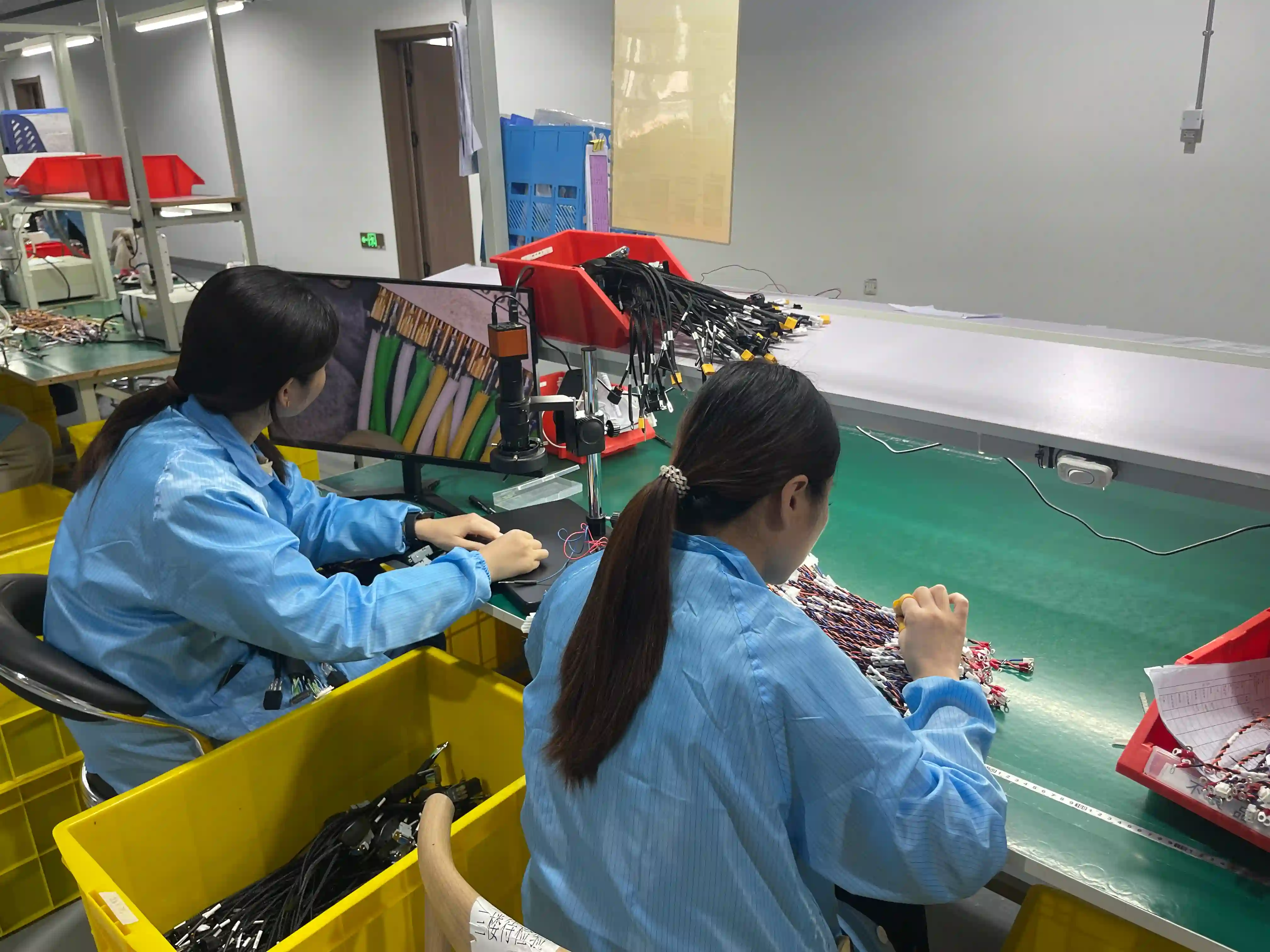
Unlike commercial assemblies where statistical sampling may be acceptable, IPC/WHMA-A-620 Class 3 requires 100% inspection of every assembly. Every crimp, every solder joint, every wire route, and every connector insertion is visually inspected under magnification and electrically tested. There is no sampling plan — every unit must pass.
Why Commercial Cables Fail in Aerospace
Common failure modes when commercial-grade cable assemblies are used in aerospace environments include: insulation cracking at low temperature causing short circuits, connector contact corrosion from altitude-induced condensation cycling, EMI susceptibility causing avionics malfunctions, vibration-induced wire fatigue at connector backshells, and outgassing in unpressurized compartments that degrades adjacent components. These failures are not hypothetical — they have caused FAA Airworthiness Directives and fleet-wide inspections.
DO-160G Environmental Testing Standard
RTCA DO-160G "Environmental Conditions and Test Procedures for Airborne Equipment" is the primary standard for qualifying electronic and electrical equipment installed on aircraft. Published by RTCA Inc. and recognized by the FAA, EASA, and virtually every civil aviation authority worldwide, DO-160G defines 23 sections of environmental testing that simulate the conditions equipment will encounter during its service life. For cable assemblies, specific sections carry particular significance.
Key DO-160G Test Sections for Cable Assemblies
| Section | Test Category | Cable Assembly Impact | Typical Duration |
|---|---|---|---|
| 4.0 | Temperature & Altitude | Insulation integrity, contact resistance stability at –55°C to +85°C (or higher categories) | 2–5 days |
| 7.0 | Operational Shock & Crash Safety | Connector retention, backshell integrity, wire retention in clamps | 1–2 days |
| 8.0 | Vibration | Wire fatigue, crimp integrity, connector mating force retention | 3–10 days |
| 6.0 | Humidity | Insulation resistance degradation, contact corrosion, seal integrity | 10+ days |
| 15–21 | EMI / EMC (Conducted & Radiated) | Shielding effectiveness, cable bundle coupling, pin injection susceptibility | 5–15 days |
| 22.0 | Lightning (Indirect Effects) | Pin injection and cable bundle testing per waveforms 1–5 | 3–7 days |
| 23.0 | Lightning (Direct Effects) | External cable exposure, connector shell arc-over, shielding burn-through | 2–5 days |
Cable Bundle Testing vs Pin Injection
DO-160G Section 22 defines two primary methods for testing lightning indirect effects on cable assemblies. Pin injection testing applies standardized lightning transient waveforms directly to individual connector pins to verify that connected equipment can withstand induced voltages and currents. Cable bundle testing applies electromagnetic fields to entire cable bundles routed on a test fixture that simulates the aircraft installation, measuring the induced energy on each conductor. The method used depends on the aircraft zone classification and the equipment's criticality level. For cable assembly manufacturers, understanding these test methods is essential because shielding termination quality, connector backshell bonding, and overall shield transfer impedance directly determine pass/fail outcomes.
Common DO-160 Test Failures & Prevention
- EMI shielding failures — Caused by poor shield termination at backshells. Prevention: use 360° shield clamp terminations and verify shield transfer impedance before assembly. See our guide on EMI/RFI shielding methods.
- Vibration-induced contact intermittents — Caused by undersized wire or incorrect crimp barrel selection. Prevention: verify crimp pull force exceeds specification by margin, use strain relief at every breakout point.
- Temperature cycling insulation cracks — Caused by using insulation materials that become brittle at low temperature. Prevention: specify PTFE or ETFE insulation rated to –65°C minimum.
- Lightning transient damage — Caused by inadequate transient protection design. Prevention: proper shield grounding, TVS diode protection, and cable separation per SAE AS50881.
DO-160G testing is not inexpensive. A full qualification program covering temperature, vibration, humidity, EMI/EMC, and lightning can cost $50,000 to $200,000+ and take 8 to 16 weeks depending on the number of test categories and severity levels required. However, this investment is made once per design; production assemblies are then built to the qualified configuration and verified through production acceptance testing. For more on cable testing methodologies, see our complete guide to cable assembly testing methods.
AS9100 Rev D Quality Management
AS9100 Rev D is the aerospace quality management system standard published by SAE International. Built on the foundation of ISO 9001:2015, AS9100 adds over 100 aerospace-specific requirements that address the unique risks and regulatory demands of aviation, space, and defense manufacturing. For cable assembly manufacturers, AS9100 certification is the baseline requirement — without it, you cannot supply to any major aerospace OEM or Tier 1 integrator.
Key AS9100 Requirements Beyond ISO 9001
Clause 8.1.4: Counterfeit Parts Prevention
AS9100 Rev D introduced an explicit requirement for documented processes to prevent counterfeit parts from entering the supply chain. For cable assembly manufacturers, this means maintaining an approved supplier list, verifying material certifications against original manufacturer databases, implementing incoming inspection procedures for authenticity verification, and controlling disposition of suspected counterfeit materials. This clause has been a focus area in recent AS9100 surveillance audits.
- Approved supplier list with periodic re-evaluation
- Incoming inspection for material authenticity
- Quarantine and reporting procedures for suspect parts
Configuration Management & FOD Control
Aerospace manufacturing requires formal configuration management — tracking the exact revision level of every drawing, specification, and process document used to build each assembly. Foreign Object Debris (FOD) prevention programs are mandatory, including controlled access production areas, tool accountability systems, and end-of-shift FOD inspections. A single piece of wire insulation left inside a connector can cause an intermittent failure that takes months to diagnose.
- Drawing revision control with change notification
- FOD prevention program with accountability
- Product safety and risk management per Clause 8.1.1
Common AS9100 Audit Failures for Cable Assembly Manufacturers
Based on OASIS (Online Aerospace Supplier Information System) data, the most frequently cited nonconformances during AS9100 audits of cable assembly manufacturers include:
- Clause 8.4.1 (Supplier Management) — Incomplete supplier evaluation records, missing delivery performance tracking, or failure to flow-down quality requirements to sub-tier suppliers.
- Clause 7.1.5 (Calibration) — Overdue calibration on crimp tools, test equipment, or inspection gauges. One out-of-calibration crimp tool can invalidate an entire production lot.
- Clause 8.5.2 (Traceability) — Gaps in material lot traceability, missing operator or inspector sign-offs on travelers, or incomplete test data records.
Critical MIL-SPEC & Industry Standards
Beyond DO-160G and AS9100, aerospace cable assemblies are governed by a layered system of material, connector, workmanship, and installation standards. These specifications are not interchangeable — each addresses a specific aspect of design, materials, or manufacturing. Understanding how they interconnect is essential for both specifying and producing compliant assemblies.
MIL-DTL-38999 Connectors
The primary high-performance circular connector for aerospace applications. Series III (breech coupling) is the standard choice for aircraft, providing rapid connect/disconnect with environmental sealing and EMI shielding. Available with composite, aluminum, or stainless steel shells and supporting up to 128 contacts per connector.
- 500+ mating cycles with maintained contact resistance
- EMI shielding effectiveness >60 dB at 10 GHz
- Environmental sealing per MIL-STD-810 salt fog and humidity
SAE AS50881 Wiring Standard
The SAE standard governing the design and installation of electrical wiring interconnect systems (EWIS) on aircraft. Formerly MIL-W-5088, AS50881 defines wire routing, bundle sizing, harness protection, clamp spacing, bend radii, separation requirements, and grounding practices for aerospace installations.
- Wire derating curves for bundled configurations
- Separation requirements between power, signal, and RF cables
- Minimum bend radius and clamp spacing tables
AS22759 Wire Specs
The specification for fluoropolymer-insulated aerospace wire (PTFE, ETFE, cross-linked ETFE). Defines conductor material, insulation type, temperature rating, and electrical properties. These are the building blocks of every aerospace cable harness.
- Temperature: –65°C to +260°C
- Silver or nickel plated conductors
- Low smoke, zero halogen options
IPC/WHMA-A-620 Class 3
The industry standard for cable and wire harness assembly workmanship. Class 3 is the highest reliability level, required for aerospace, defense, and life-support applications. Defines acceptance criteria for crimps, solder joints, wire routing, lacing, and connector assembly.
- 100% visual inspection required
- Zero defects acceptance criteria
- Certified operators and inspectors required
ITAR & DFARS
International Traffic in Arms Regulations (ITAR) controls export of defense articles. DFARS 252.225-7014 requires domestic specialty metals. These compliance requirements apply to many aerospace and all defense cable assembly programs, restricting who can manufacture and where materials can be sourced.
- ITAR registration with DDTC
- DFARS specialty metals compliance
- CMMC cybersecurity requirements
Companies entering the aerospace market often underestimate the documentation burden. The documentation package is as important as the physical assembly: every wire must trace to a material lot, every crimp to a calibrated tool, and every test result to a serial number. Incomplete records make an assembly non-conforming regardless of build quality, so suppliers need the quality management infrastructure AS9100 demands.
Material Selection for Extreme Environments
Material selection is the single most critical design decision in aerospace cable assembly. The wrong insulation material, conductor plating, or shielding configuration will cause failures during DO-160G qualification testing — or worse, in service. Here is a comprehensive comparison of the three primary insulation materials used in aerospace wire, along with conductor and shielding options. For a deeper comparison, see our guide on high-temperature cable materials.
PTFE vs ETFE vs FEP Insulation Comparison
| Property | PTFE (Teflon) | ETFE (Tefzel) | FEP |
|---|---|---|---|
| Max Temperature | +260°C | +200°C | +200°C |
| Min Temperature | –65°C | –65°C | –200°C |
| Flexibility | Good | Excellent | Excellent |
| Abrasion Resistance | Good | Excellent | Good |
| Weight (Relative) | Baseline | 30% lighter | Similar to PTFE |
| Chemical Resistance | Excellent | Excellent | Excellent |
| Relative Cost | High | Moderate | High |
| Typical Application | Engine bay, exhaust zones | General airframe, avionics | Sensor cables, low-temp zones |
Conductors & Shielding
Conductor Plating Selection
- Silver-plated copper — Highest conductivity, rated to +200°C. Standard choice for general airframe wiring where maximum current capacity is needed. Susceptible to tarnishing above +200°C.
- Nickel-plated copper — Rated to +260°C. Required in engine bay zones and anywhere sustained high temperatures occur. 10–15% lower conductivity than silver-plated, but superior high-temperature stability.
- Tin-plated copper — Economy option rated to +150°C. Used only in benign zones where temperature and performance requirements are lower. Not suitable for most aerospace primary wiring.
EMI Shielding Options
- Braided copper shield — 85–95% optical coverage. Provides excellent shielding effectiveness for conducted and radiated EMI. Standard choice for most aerospace cable bundles.
- Foil + braid combination — 100% coverage with foil plus 85%+ braid. Required for high-frequency shielding above 1 GHz and in severe EMI environments near radar and EW systems.
- Conduit / overbraided armor — Used in zones requiring both EMI shielding and mechanical protection from abrasion, pinch points, or maintenance traffic. Adds weight but provides the highest protection level.
Weight reduction is a constant priority in aerospace. Every pound removed from aircraft wiring saves approximately $1,000 per year in fuel cost over the aircraft's service life. Strategies include using ETFE insulation instead of PTFE where temperature allows (30% weight reduction), selecting high-strength copper alloy conductors that permit smaller gauge wire for the same current rating, and optimizing shield type to match the actual EMI threat rather than over-specifying. However, weight savings must never compromise safety margins or DO-160 compliance.
Manufacturing & Quality Requirements
Aerospace cable assembly remains one of the most manual manufacturing processes in the industry. Unlike PCB assembly or connector molding, wire harness fabrication requires skilled technicians who can interpret complex engineering drawings, route wires through three-dimensional form boards, perform precision crimps and solder joints, and build assemblies that pass 100% visual inspection under magnification. Automation is limited to wire cutting, stripping, and some crimping — the assembly itself is fundamentally a craft.
Operator Training & Certification
Aerospace cable assembly operators require a minimum of 2 months of supervised training before working independently. They must be certified to IPC/WHMA-A-620 Class 3 and IPC J-STD-001 Class 3 (for soldering). Certifications must be current, and operators are recertified annually. Training records, certification cards, and competency evaluations are maintained as quality records and audited during AS9100 surveillance audits.
Crimping Standards & Verification
Every crimp performed on an aerospace cable assembly must use a calibrated tool with verified positioner settings per the contact manufacturer specification. Crimp force monitoring records the force profile of each crimp for comparison against a validated window. Destructive pull testing is performed on sample crimps from each production setup to verify tensile strength. All crimp tools carry calibration stickers with expiration dates, and any out-of-calibration condition triggers a full review of all assemblies produced since the last known good calibration.
Soldering per IPC J-STD-001 Class 3
Where solder terminations are required, they must comply with IPC J-STD-001 Class 3 (or the Space Addendum for spacecraft applications). This requires specific flux types, minimum solder fillet dimensions, zero cold joints or disturbed solder, and complete wetting on all termination surfaces. Operators performing solder work must hold current J-STD-001 certification for the applicable class.
FOD Prevention Program
Foreign Object Debris prevention is mandatory for all aerospace manufacturing. Cable assembly areas must maintain controlled access, tool inventory accountability (all tools checked out and checked in each shift), clean work surfaces, and end-of-shift FOD inspections. Wire clippings, stripped insulation, and solder debris are common FOD sources that must be controlled. A single wire strand left inside a connector backshell can cause an intermittent failure that costs thousands of flight hours to diagnose.
Full Lot Traceability: Melt to Delivery
Every material in an aerospace cable assembly must be traceable to its original manufacturer lot number. This chain starts at the metal melt (for conductors and connector shells), continues through wire manufacturing, connector fabrication, incoming inspection, and assembly, and ends with the delivered product. The traveler document records every material lot, every operator who touched the assembly, every inspection result, and every test data point. This traceability package is maintained for the life of the program, typically 20 to 30 years.
Selecting an Aerospace Cable Assembly Supplier
Choosing the right aerospace cable assembly supplier is one of the most consequential decisions in any aircraft or defense program. The wrong choice leads to qualification failures, delivery delays, airworthiness documentation gaps, and — in the worst case — in-service failures. Here is the evaluation framework that experienced aerospace procurement teams use.
Certification Checklist
AS9100 Rev D Certification
Verify the certificate is current, the scope includes cable assembly manufacturing, and the registrar is accredited. Check the OASIS database for audit history and any open nonconformances.
IPC/WHMA-A-620 Class 3 Certified Trainers
The supplier should have certified IPC trainers on staff, not just certified operators. This indicates the capability to train new operators and maintain certification currency internally.
ITAR Registration (If Applicable)
Required for any defense-related cable assembly. Verify current registration with the Directorate of Defense Trade Controls (DDTC). Unregistered suppliers handling ITAR-controlled data face severe federal penalties.
Testing & Engineering Capabilities
In-House Electrical Testing
Continuity, hipot, insulation resistance, and crimp force analysis must be performed in-house on calibrated equipment. Environmental testing (DO-160) can be outsourced to accredited labs, but electrical testing should not be.
Engineering Support & DFM
Look for suppliers with dedicated aerospace engineers who can provide design for manufacturability (DFM) consultation, material substitution recommendations, and DO-160 test preparation support.
First Article Inspection (AS9102)
The supplier must demonstrate capability to perform and document first article inspections per AS9102, including dimensional verification, process validation, and complete documentation packages.
Red Flags When Evaluating Suppliers
Be cautious of suppliers who: cannot produce a current AS9100 certificate with cable assembly in the scope, quote lead times significantly shorter than 10–12 weeks for new aerospace programs, propose "equivalent" non-QPL materials to reduce cost, lack documented FOD prevention programs, cannot provide aerospace program references from named OEMs or Tier 1 integrators, or do not have calibrated crimp force analyzers and automated test equipment on site. Any of these indicates the supplier may not be prepared for the rigor of aerospace manufacturing.
For an in-depth look at our aerospace and defense cable assembly capabilities, visit our aerospace industry page. To start a conversation about your specific program requirements, request a quote and our aerospace engineering team will respond within 24 hours.
Quality shortcuts eventually surface during qualification, source inspection, or service. Aerospace cable assemblies require traceable materials, validated processes, and documented tests. AS9100 supports this discipline by making compliant work the default operating system rather than an exception described only in a quality manual.
Frequently Asked Questions
What is the difference between DO-160 and MIL-STD-810?
DO-160G and MIL-STD-810H are both environmental testing standards, but they serve different markets and have different test philosophies. DO-160G is published by RTCA and is specifically designed for airborne electronic equipment installed on civil and military aircraft. It defines 23 test sections with standardized severity categories tied to aircraft zones. MIL-STD-810H is a Department of Defense standard covering 28 environmental test methods for all types of military equipment, including ground vehicles, naval systems, and manportable gear. MIL-STD-810 allows more tailored test profiles based on the specific platform lifecycle environment. For aerospace cable assemblies installed on civil aircraft, DO-160G is the required standard. For military aircraft, the contract may specify either DO-160 or MIL-STD-810, depending on the program.
How long does AS9100 certification take?
Achieving AS9100 Rev D certification typically takes 12 to 18 months for a manufacturer starting from scratch. This timeline includes quality management system documentation development (3-4 months), system implementation and employee training (3-4 months), internal audit and management review cycles (2-3 months), and the Stage 1 and Stage 2 certification audits with an accredited registrar (2-3 months). Companies already holding ISO 9001 certification can often transition faster, in 6 to 10 months, since the core quality management framework is already in place. The key additional requirements for aerospace include counterfeit parts prevention, configuration management, special process controls, and the OASIS reporting requirements.
What is IPC/WHMA-A-620 Class 3?
IPC/WHMA-A-620 is the industry standard titled "Requirements and Acceptance for Cable and Wire Harness Assemblies." It defines three classes of product quality. Class 1 is for general electronic products. Class 2 is for dedicated service electronic products where continued performance is required. Class 3 is the highest level, designated for high-reliability products where continued performance or performance-on-demand is critical, equipment downtime cannot be tolerated, and the end-use environment may be severe. Aerospace, defense, and life-support equipment require Class 3. The practical difference is that Class 3 requires 100% inspection of all workmanship attributes (crimps, solder joints, wire routing, lacing, connector assembly), zero defect acceptance criteria, and certified operators and inspectors.
What materials are used for aerospace cable insulation?
The three primary insulation materials for aerospace wire are PTFE (Teflon), ETFE (Tefzel), and FEP. PTFE offers the highest temperature rating at +260°C and is used in engine bay and exhaust zones. ETFE is the most widely used aerospace wire insulation, rated to +200°C with superior abrasion resistance and 30% weight savings over PTFE — making it the standard for general airframe wiring. FEP provides excellent flexibility and low-temperature performance to –200°C, used for sensor cables and cryogenic applications. All three are fluoropolymer-based, providing inherent chemical resistance to jet fuel, hydraulic fluids, and de-icing chemicals. Polyimide (Kapton) is also used where minimum weight and thickness are required, though it has known arc-tracking susceptibility that requires careful installation design.
How much does DO-160 testing cost?
DO-160G testing costs vary significantly based on the number of test sections required and the severity categories specified. A single test section (such as Section 8 Vibration alone) might cost $8,000 to $25,000 at an accredited test laboratory. A comprehensive qualification program covering temperature/altitude, vibration, shock, humidity, EMI/EMC (conducted and radiated emissions and susceptibility), and lightning indirect effects typically costs $50,000 to $200,000 or more. Lead times for test laboratory scheduling range from 4 to 12 weeks, and the actual testing program may take an additional 8 to 16 weeks to complete. These costs are incurred once per design qualification; production assemblies are verified through less expensive production acceptance testing.
When is ITAR registration required for cable assemblies?
ITAR (International Traffic in Arms Regulations) registration is required when a cable assembly is specifically designed, developed, configured, adapted, or modified for a defense article listed on the United States Munitions List (USML). This includes cable assemblies for military aircraft, missiles, naval vessels, and ground combat vehicles. If the cable assembly is a commercial item that happens to be installed on a military platform, ITAR may not apply, but this determination must be made through a formal commodity jurisdiction (CJ) request to the Department of State. When in doubt, consult with an ITAR compliance specialist before sharing technical data with any foreign person or entity. Violations carry penalties up to $1 million per offense and potential criminal prosecution.
Related Articles
Mil-Spec vs Commercial Grade Cable Assembly
Detailed comparison of military specification and commercial grade cable assemblies covering materials, testing, cost, and when to choose each grade for your application.
Read more EngineeringTop 6 EMI/RFI Shielding Methods
Comprehensive guide to electromagnetic shielding techniques for cable assemblies, including braided shields, foil wraps, conduit, and combination approaches for aerospace EMI compliance.
Read more MaterialsTop 5 High-Temperature Cable Materials
In-depth comparison of PTFE, ETFE, FEP, silicone, and fiberglass insulation materials for cable assemblies operating in extreme thermal environments.
Read moreAbout the Author
OurPCB Engineering Team supports aerospace and defense cable assembly programs for commercial and military aircraft, satellites, and defense electronics. The team works with DO-160G environmental testing, AS9100 Rev D quality systems, MIL-SPEC material selection, and the traceability requirements that define aerospace-grade production.