Confusing a wire harness with a cable assembly can lead to unnecessary cost, overbuilt products, or premature field failures. The correct choice depends on the protection, routing, serviceability, and environmental demands of the application.
For industry reference, see cable harness and IPC standards.
The short answer? Wire harnesses organize. Cable assemblies protect. The full answer requires understanding the application, environment, budget, and long-term reliability requirements.
In This Article
What is a Wire Harness?
A wire harness is a bundled arrangement of wires, cables, and terminals that transmits electrical signals or power. Each wire remains individually identifiable and accessible. Think of it like organizing your computer cables with zip ties—the cables run together but maintain their individual identity.
Wire harnesses are typically held together using:
- Cable ties (zip ties) — Economical, quick to apply
- Electrical tape — Flexible, easy routing
- Braided sleeving — Some abrasion protection
- Split loom tubing — Moderate protection, easy maintenance access
- Spiral wrap — Expandable, good for service access
The key characteristic? You can see and access individual wires. This makes wire harnesses ideal for applications requiring service access, troubleshooting, or modifications after installation.
What is a Cable Assembly?
A cable assembly encases multiple wires or cables within a single protective sheath, creating a unified product that's built to survive harsh conditions. From the outside, you see one cable—the individual conductors inside are completely protected and inaccessible without cutting the outer jacket.
Cable assemblies use protective materials including:
- Thermoplastic jackets (PVC, TPE, TPU) — Chemical and abrasion resistance
- Rubber compounds — Flexibility in extreme temperatures
- Overmolded housings — Watertight strain relief
- Metal braiding or conduit — EMI shielding and crush protection
- Armored jacketing — Extreme mechanical protection
The defining feature? Complete environmental protection. Cable assemblies are designed to survive what would destroy a wire harness—oil, water, UV exposure, constant flexing, and physical abuse.
A cable assembly can add unnecessary cost where a simple wire harness is sufficient, while an unprotected harness can fail quickly outdoors. Define the operating environment before choosing the construction.
5 Key Differences Between Wire Harness and Cable Assembly
1. Protection Level: Organization vs. Armor
This is the fundamental difference. Wire harnesses keep wires organized and routed correctly but offer minimal environmental protection. The individual wires must rely on their own insulation plus whatever external protection the enclosure provides.
Cable assemblies, conversely, add substantial protection through their outer jacket. This makes them suitable for exposed installations where they'll face mechanical stress, chemicals, moisture, or temperature extremes.
2. Manufacturing Complexity
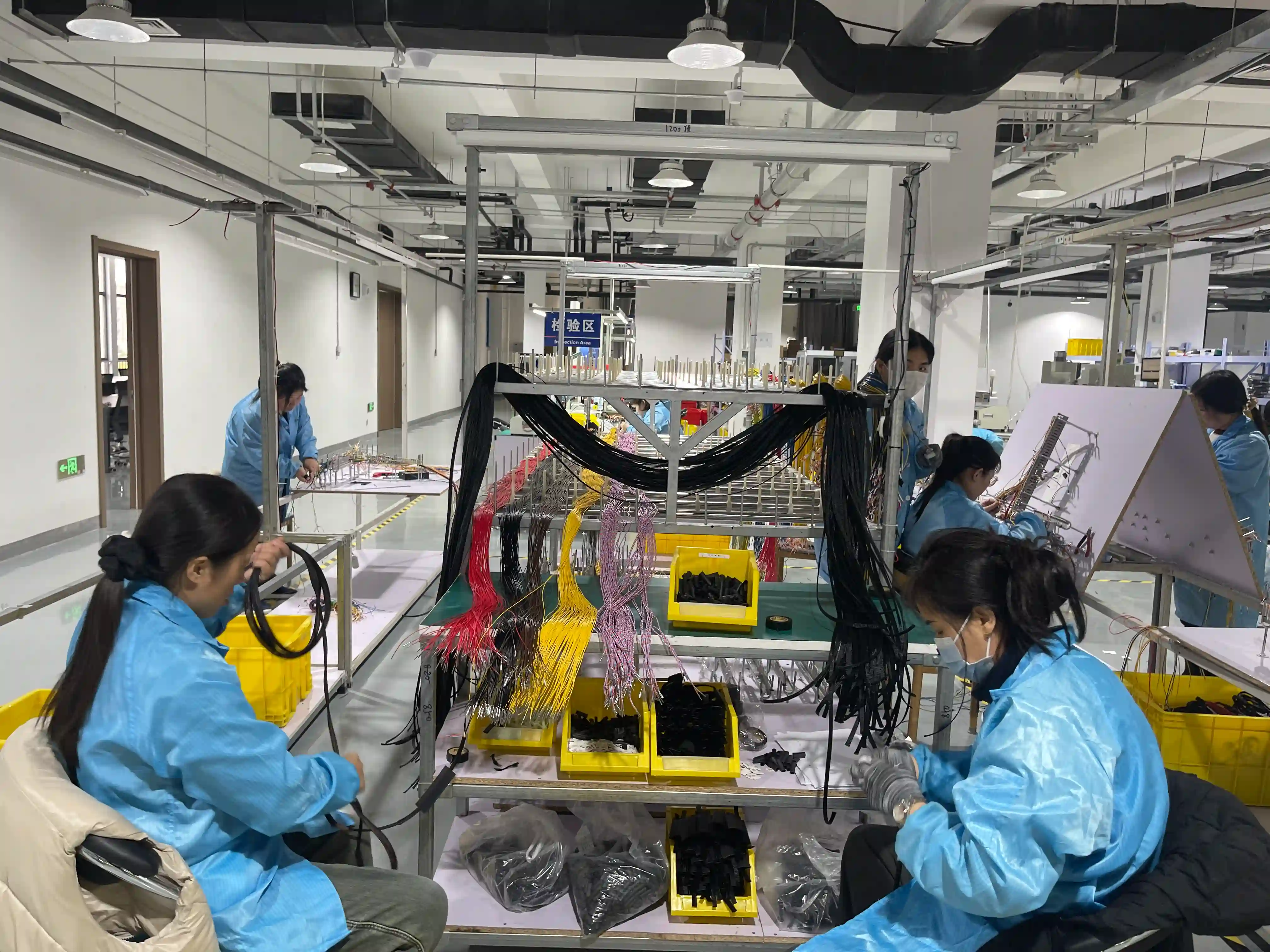
Wire harness production is highly labor-intensive and typically done on large assembly boards. Operators route wires along predetermined paths, terminating connectors at various breakout points. Our automotive harness production lines can have 30+ operators working on a single harness board.
Cable assembly manufacturing is more streamlined—usually point-to-point with fewer branches. However, processes like overmolding and potting require specialized equipment and add manufacturing time.
3. Cost Structure
Wire harnesses typically cost less due to:
- Simpler materials (no outer jacketing)
- Faster production of basic designs
- Lower tooling requirements
Cable assemblies command premium pricing because:
- Material costs are higher (jacket, potting compounds)
- Manufacturing requires more steps
- Testing requirements are typically more stringent
4. Serviceability
Need to add a wire or replace a damaged one? Wire harnesses make this relatively straightforward—you can access individual conductors, splice in new wires, or replace terminals. Many industrial control harnesses are designed specifically for field modification.
Cable assemblies are designed as sealed units. Repairs usually mean replacing the entire assembly. This is intentional—you want that waterproof cable to stay waterproof, which means no access points.
5. Environmental Suitability
A simple rule of thumb is:
Wire Harness is Best When...
- • Protected inside an enclosure
- • Controlled indoor environment
- • Service access needed
- • Multiple breakout points required
- • Weight is critical (aerospace, drones)
- • Budget is constrained
Cable Assembly is Best When...
- • Exposed to outdoor elements
- • High vibration or movement
- • Chemical or oil exposure
- • Water/dust ingress possible
- • Point-to-point connection
- • Maximum durability required
Wire Harness vs Cable Assembly: Complete Comparison
| Feature | Wire Harness | Cable Assembly |
|---|---|---|
| Primary Purpose | Organization & routing | Protection & durability |
| Structure | Multiple branches, breakouts | Point-to-point, unified |
| Outer Protection | Tape, ties, split loom | Jacketing, overmolding |
| IP Rating Capability | Limited (IP54 max typical) | IP67, IP68 achievable |
| Typical Environment | Indoor, protected enclosure | Outdoor, harsh conditions |
| Cost | Lower ($) | Higher ($$-$$$) |
| Weight | Lighter | Heavier (more material) |
| Flexibility | Generally more flexible | Varies by jacket material |
| Serviceability | Easy to modify/repair | Replace entire unit |
| EMI Shielding | Optional, per-wire | Often included overall |
| Lead Time | 2-4 weeks typical | 3-6 weeks (if overmolded) |
When to Use a Wire Harness vs Cable Assembly
Choose a Wire Harness When:
Your product provides the protection. If the harness lives inside a washing machine, car dashboard, or control panel enclosure, the product chassis handles environmental protection. The harness just needs to organize and route connections efficiently.
You have complex routing requirements. Wire harnesses excel at distributing power and signals from one source to multiple destinations. An automotive engine harness might connect 50+ sensors, actuators, and modules—try doing that with cable assemblies and you'll have a nightmare of separate cables.
Weight matters. In aerospace and drone applications, every gram counts. Wire harnesses eliminate the weight of outer jacketing while still providing organized routing.
Choose a Cable Assembly When:
The cable is exposed to the environment. Outdoor equipment, marine applications, agricultural machinery—anywhere the cable faces rain, dust, UV, or temperature extremes. The outer jacket is your first line of defense.
High flex life is required. Robotic arm cables might flex millions of times. Cable assemblies with proper strain relief and flex-rated conductors can handle this; wire harnesses cannot.
You need signal integrity. High-speed data transmission (USB, Ethernet, coaxial) benefits from cable assembly construction with proper shielding and controlled impedance. Our USB cable assemblies and coaxial assemblies are designed specifically for signal integrity.
Cost Analysis: Real Numbers
Here's what typical cost differences look like based on our production data:
| Configuration | Wire Harness | Cable Assembly | Difference |
|---|---|---|---|
| Simple 10-wire, 1m length | $8-12 | $15-25 | +60-100% |
| Medium complexity, 20 circuits | $25-40 | $45-75 | +80-90% |
| With overmolded connectors | N/A | +$5-15 per end | — |
| IP67 waterproof requirement | Often not possible | +20-30% vs standard | — |
* Prices are estimates for medium volumes (1,000-5,000 units). Contact us for specific pricing.
Industry Applications: Real-World Examples
Automotive Industry
Automotive applications use both extensively. Inside the cabin—dashboard, door modules, seats—you'll find wire harnesses protected by the vehicle body. Engine bay, chassis, and exterior connections typically use cable assemblies due to exposure to heat, oil, water, and road debris.
The shift to electric vehicles has increased demand for high-voltage cable assemblies that can safely handle 400V-800V battery systems.
Medical Devices
Medical equipment often requires cable assemblies for patient-contact cables (cleanability, durability) and wire harnesses for internal equipment wiring. Our medical-grade cable assemblies are designed for autoclave sterilization and biocompatibility requirements.
Industrial Automation
Factory automation and robotics applications demonstrate clear use cases for both. Control panel internals use wire harnesses for easy troubleshooting. Robot arm cables use high-flex cable assemblies rated for 10+ million flex cycles.
Consumer Electronics
Inside your laptop, TV, or gaming console—wire harnesses connecting PCBs, displays, and power supplies. When designing these board-to-wire interfaces, engineers often rely on a PCB trace width calculator to ensure copper traces can handle the current before it transitions into the harness. External connections (chargers, peripheral cables)—cable assemblies for durability and user handling.
Overmolded cable assemblies are usually unnecessary inside a sealed control cabinet when a simple harness satisfies the actual environmental and service requirements. Construction should follow verified needs rather than assumptions.
"Wire Harness vs Cable Assembly: Complete Guide to Differences & When to Use Each only becomes production-ready after measurable validation. That usually means 100% continuity, a defined insulation threshold such as 500 VDC, and one application-specific check tied to IEC 60529, UL, or the customer's own spec."
Frequently Asked Questions
Can a wire harness be waterproof?
To a limited degree, yes. Using waterproof connectors and sealed boots at breakout points can achieve IP54 or IP55. For true IP67/IP68 ratings, a cable assembly with overmolded construction is typically required.
Which is better for EMI shielding?
Cable assemblies generally provide better EMI protection due to continuous outer shielding. However, shielded wire harnesses using individually shielded wires or overall braided shields can achieve excellent EMI performance for specific applications.
What about hybrid solutions?
Absolutely common. Many products use wire harnesses internally that transition to cable assemblies where they exit the enclosure. We design hybrid solutions regularly—it's often the most cost-effective approach.
How do lead times compare?
Simple wire harnesses: 2-3 weeks. Complex harnesses with custom connectors: 4-6 weeks. Cable assemblies with overmolding: 4-6 weeks (tooling adds time initially). Our 48-hour rapid prototyping service is available for standard, ready-to-build designs with available materials; exact timing is confirmed at quote.
Is there a minimum order quantity?
Not with us. Our No MOQ policy means we produce quantities from 1 prototype to 500,000+ production units for both wire harnesses and cable assemblies.
Making Your Decision
The wire harness vs cable assembly decision ultimately comes down to three questions:
- What environment will it operate in? Protected enclosure = wire harness possibility. Exposed = cable assembly.
- What's your routing complexity? Multiple breakouts = wire harness strength. Point-to-point = cable assembly simplicity.
- What's your cost vs. durability priority? Budget-conscious indoor = wire harness. Maximum durability = cable assembly.
Still unsure? That's exactly what our engineering team is here for. We review thousands of applications annually and can recommend the optimal approach for your specific requirements—and we're often able to identify cost savings opportunities in the process.
Related Resources
About OurPCB Engineering Team
OurPCB Engineering Team brings 15+ years of combined experience in connector engineering and harness design, developing solutions for automotive, medical, industrial, and aerospace applications. Connect with our engineering team for complex technical requirements or design consultations.